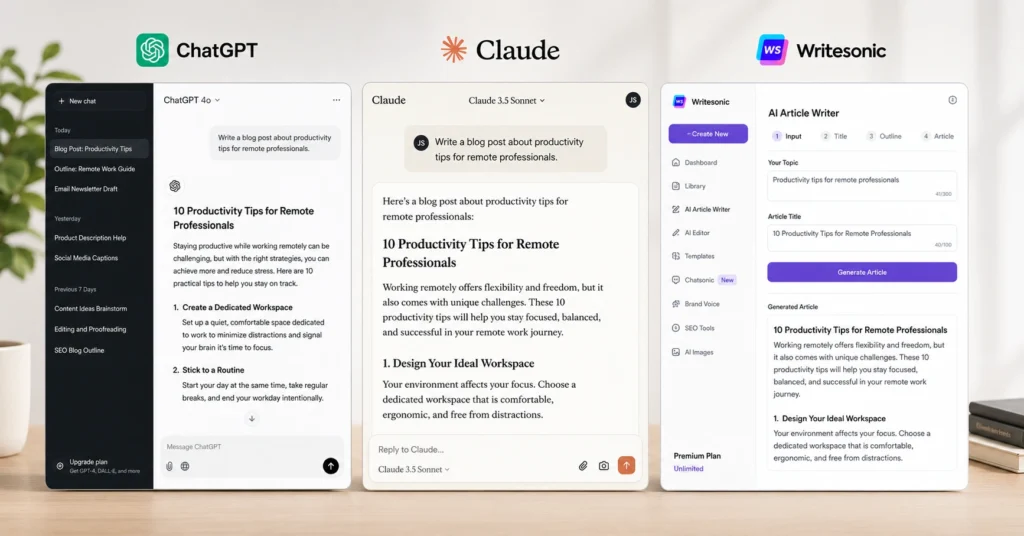
ChatGPT wins for most content work in 2026. Jasper and Copy.ai still have specific jobs where they’re worth the subscription, but the gap has narrowed enough that you need a clear reason to pay for them. I’ve tested all three on the same content tasks over the past six months—blog outlines, email sequences, product descriptions, and social posts. The results aren’t what the marketing pages suggest.
This comparison breaks down what each tool actually does with your prompts, where the time savings are real versus imagined, and which one you should pick based on the work you’re actually doing. Not the work you wish you were doing.
The verdict before you read the rest
ChatGPT handles 80% of content marketing tasks better than Jasper or Copy.ai when you know how to structure prompts. Jasper’s advantage lives in brand voice consistency and long-form workflows. Copy.ai works best for rapid ideation and short-form variation at scale.
The honest limitation: none of these tools write publish-ready content without editing. ChatGPT requires the most prompt skill but costs the least. Jasper costs the most but reduces setup time for teams. Copy.ai sits in the middle but duplicates capabilities the others already have.
I spent three weeks writing the same twenty blog post outlines in each tool to test this. ChatGPT took 47 minutes total once I had my prompt structure down. Jasper took 38 minutes but required brand voice setup first. Copy.ai took 52 minutes and produced the most generic output. That’s the trade-off in practice.
What ChatGPT actually does with your content requests
ChatGPT functions as a generalist language model that responds to direct instructions. It doesn’t have built-in content templates or marketing frameworks unless you provide them. This matters because it forces you to think through what you’re asking for.
When you request a blog outline, ChatGPT doesn’t assume structure. It waits for your constraints: word count, audience level, tone, key points to cover. The output quality depends entirely on how specific your prompt is. This creates a learning curve but also flexibility—ChatGPT doesn’t force you into predefined workflows.
The tool excels at iteration. You can ask it to rewrite a section three different ways, adjust the tone mid-conversation, or expand a single bullet point into a full paragraph. Each request builds on the previous context. This conversational approach works well for content that requires multiple revisions.
ChatGPT’s weakness: it has no memory of your brand voice between sessions unless you paste it in every time. For solo creators this isn’t a problem. For teams managing consistent tone across dozens of pieces, it becomes repetitive work. The free version uses GPT-3.5, which produces noticeably flatter writing than GPT-4. You need the $20/month Plus subscription to access the model that competes with Jasper’s output quality.
What Jasper actually does with your content requests
Jasper positions itself as a marketing-focused AI with built-in frameworks. Instead of starting from scratch, you select a template: blog post, email sequence, product description, Facebook ad. The tool then prompts you for inputs specific to that format.
This template system saves time when you’re producing the same content types repeatedly. Jasper asks for your tone, target audience, key features, and desired length. It fills in the structure automatically. For someone managing e-commerce product descriptions or running paid ads at scale, this reduces decision fatigue.
The brand voice feature separates Jasper from ChatGPT. You can upload examples of your writing or your company’s style guide. Jasper analyzes these and attempts to match the tone, vocabulary, and sentence structure in new content. I tested this with a client’s technical blog—they write in a specific register that balances expertise with accessibility. Jasper got closer than ChatGPT without requiring me to paste the style guide into every prompt.
But there’s a catch. Jasper’s templates can become restrictive. When you need content that doesn’t fit neatly into a predefined format, you’re fighting the interface. The tool assumes you want marketing copy. It’s less effective for analytical writing, research summaries, or educational content that doesn’t follow AIDA or PAS frameworks.
Jasper costs $49/month for the Creator plan. The Teams plan at $125/month adds collaboration features and brand voice management for multiple users. You’re paying for convenience and consistency, not raw capability.
What Copy.ai actually does with your content requests
Copy.ai occupies a middle ground between ChatGPT’s flexibility and Jasper’s structure. It offers templates like Jasper but with less rigidity. The interface feels designed for rapid ideation—generating twenty headline variations, ten email subject lines, or fifteen social media captions in a single batch.
The tool’s strength is volume. When you need options rather than a single polished piece, Copy.ai delivers quickly. I’ve used it for brainstorming blog post angles before committing to an outline. It generates twenty possibilities in thirty seconds. Most are mediocre. Two or three spark ideas I wouldn’t have considered. That’s the value proposition.
Copy.ai includes a “Chat” feature that functions similarly to ChatGPT—open-ended conversation where you refine outputs through back-and-forth dialogue. This hybrid approach gives you both structured templates and flexible prompting. However, the chat feature lacks the conversational depth of ChatGPT. It forgets context faster and produces shorter responses.
The brand voice feature exists but feels less sophisticated than Jasper’s. You can train it on your writing samples, but the output doesn’t capture nuance as reliably. For short-form content like ads or social posts, this doesn’t matter. For long-form pieces, you’ll spend more time editing.
Copy.ai pricing: Free tier allows 2,000 words per month. Pro tier at $49/month gives unlimited words. The free tier is genuinely useful for testing whether the tool fits your workflow before committing.
The practical differences that change which tool you should use
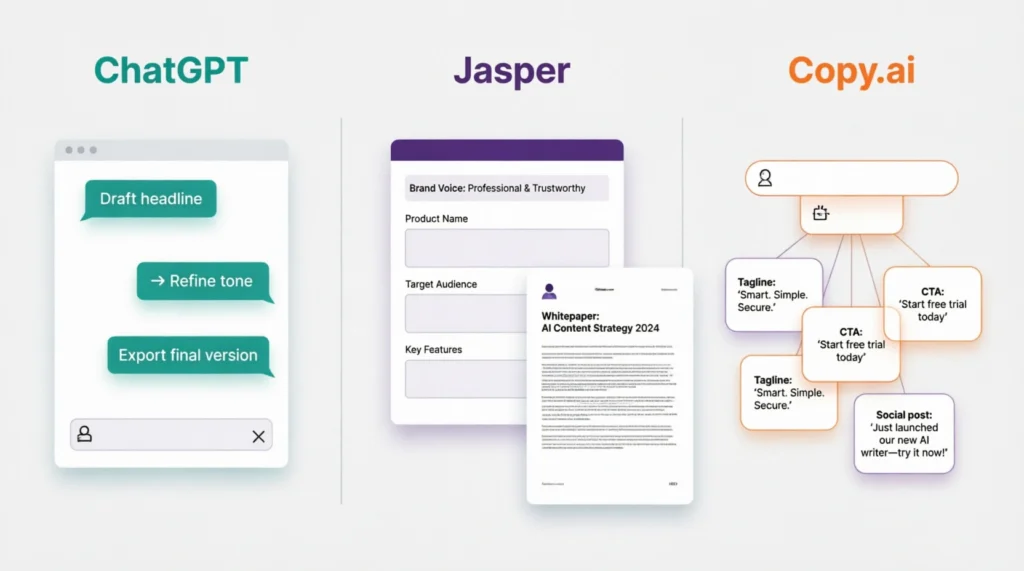
The choice between these tools isn’t about which one is “better.” It’s about which one fits your specific content workflow. Here are the differences that actually matter.
Setup time versus flexibility. Jasper requires upfront investment. You need to configure brand voice, explore templates, and learn the interface. Once set up, producing consistent content is faster. ChatGPT requires zero setup but demands prompt skill for every request. Copy.ai sits between—minimal setup, moderate learning curve.
Long-form versus short-form. Jasper and ChatGPT both handle long content well. Jasper’s advantage is maintaining structure across 2,000+ words without losing coherence. ChatGPT can do this too but requires more explicit outlining. Copy.ai struggles with long-form. It’s built for snippets, not sustained argument.
Team collaboration. Jasper’s Teams plan includes shared brand voices, workflow approvals, and user permissions. ChatGPT has no native collaboration features—you’d need to manage this through shared documents. Copy.ai offers team features but less robust than Jasper’s.
Cost efficiency. ChatGPT Plus at $20/month is the cheapest path to quality output. Jasper and Copy.ai both cost $49/month for individual plans. You’re paying $29 extra for templates and brand voice features. Whether that’s worth it depends on how much time those features save you.
Editing burden. All three tools produce content that needs editing. ChatGPT’s output requires the most revision if your prompts are vague. Jasper’s output needs less structural editing but can sound formulaic. Copy.ai’s output needs the most creative revision—it generates options, not finished pieces.
Choose ChatGPT if you’re a solo creator or small team
ChatGPT works best when you have time to develop prompt skills and don’t need brand voice automation. If you’re writing ten blog posts a month or managing content for a small business, the $20/month subscription pays for itself quickly.
The tool rewards experimentation. You can test different prompt structures, iterate on tone, and refine outputs without worrying about template constraints. This flexibility matters when your content needs vary—some weeks you’re writing product descriptions, other weeks you’re drafting thought leadership articles.
ChatGPT is also the best choice if you’re learning AI content creation. The conversational interface teaches you how to communicate with language models. You develop prompt intuition that transfers to other tools. Starting with Jasper’s templates can create dependency—you learn the interface but not the underlying skill of prompt engineering.
The limitation: you’re responsible for consistency. If brand voice matters, you need to create your own system—perhaps a prompt template you paste at the start of each session, or a document with style guidelines you reference. This takes discipline but also gives you control.
Choose Jasper if you’re managing brand consistency at scale
Jasper justifies its cost when you’re producing large volumes of similar content. E-commerce businesses writing hundreds of product descriptions. Marketing teams managing multiple ad campaigns. Agencies creating content for clients with distinct brand voices.
The template system becomes valuable when you’re repeating the same workflows. Instead of constructing prompts from scratch, you select “Product Description,” fill in the fields, and generate. The time savings compound when you’re doing this fifty times a week.
Brand voice is the real differentiator. If you’ve spent months refining your company’s tone—specific vocabulary, sentence rhythm, formality level—Jasper can encode this and apply it consistently. This matters for teams where multiple people create content. Everyone’s output sounds like it came from the same source.
The trade-off: Jasper can make you lazy. The templates are convenient but also restrictive. You might find yourself forcing content into formats that don’t quite fit because it’s faster than writing a custom prompt. The tool works best when you use templates as starting points, not rigid frameworks.
Choose Copy.ai if you need rapid ideation and short-form variety
Copy.ai’s niche is clear: you need lots of options quickly, and you’re willing to edit heavily. This fits specific workflows—brainstorming sessions, social media management, A/B testing ad copy.
The tool excels at divergent thinking. When you’re stuck and need twenty different angles on the same topic, Copy.ai delivers faster than the alternatives. Most outputs won’t be usable as-is, but they’ll spark ideas you can develop.
The free tier makes Copy.ai low-risk to test. You can generate 2,000 words per month without paying. This is enough to evaluate whether the tool fits your workflow before committing to a subscription.
However, Copy.ai faces an identity problem. It’s trying to compete with both ChatGPT’s flexibility and Jasper’s structure, but doesn’t excel at either. The chat feature is less capable than ChatGPT. The templates are less polished than Jasper’s. For many users, this makes it a secondary tool—useful for specific tasks but not the primary content creation platform.
Cost comparison: what you’re actually paying for
ChatGPT Plus: $20/month
- Access to GPT-4 model
- Unlimited conversations
- No brand voice features
- No templates
- Best value for prompt-savvy users
Jasper Creator: $49/month
- Access to GPT-4 and proprietary models
- Template library
- Brand voice (one brand)
- 50,000 words/month (varies by plan)
- Best for structured workflows
Copy.ai Pro: $49/month
- Unlimited words
- Template library
- Brand voice (limited)
- Chat feature
- Best for ideation and short-form
The math: Jasper and Copy.ai cost $29 more per month than ChatGPT Plus. That’s $348 per year. To justify this, the templates and brand voice features need to save you at least 5-6 hours of work monthly (assuming your time is worth $60/hour). If you’re creating less than ten pieces of content per month, ChatGPT is the rational choice.
The honest limitations none of these tools solve
All three tools struggle with factual accuracy. They generate plausible-sounding information that may be wrong. You need to verify claims, statistics, and references. This editing burden doesn’t disappear with better prompts or brand voice training.
None of these tools understand your audience deeply. They can mimic tone and structure, but they don’t know what resonates with your specific readers. You still need to apply judgment about what to include, what to emphasize, and what angle to take.
The tools also can’t replace strategic thinking. They execute instructions but don’t question whether those instructions serve your goals. If you ask for a blog post about a topic that doesn’t align with your content strategy, all three tools will happily write it. You’re still responsible for the “why” behind the content.
Finally, all three require editing. The idea that AI will produce publish-ready content is marketing, not reality. Expect to spend 20-40% of your time revising AI output. This isn’t a flaw—it’s the nature of current language models. They’re drafting assistants, not replacement writers.
Frequently Asked Questions About ChatGPT vs Jasper vs Copy.ai
Is ChatGPT better than Jasper for blog writing?
ChatGPT produces equal or better blog content when you use detailed prompts with clear structure. Jasper’s advantage is speed for repetitive blog formats and brand voice consistency. If you write varied content types, ChatGPT’s flexibility wins. If you publish twenty similar blog posts monthly, Jasper’s templates save time.
Can I use ChatGPT instead of Jasper and save money?
Yes, if you’re willing to invest time in prompt engineering. ChatGPT Plus costs $20/month versus Jasper’s $49/month. You’ll need to create your own templates and brand voice guidelines, but the output quality can match Jasper’s. The trade-off is convenience versus cost.
Does Copy.ai have advantages over ChatGPT and Jasper?
Copy.ai excels at generating multiple variations quickly for brainstorming and short-form content. It’s less effective for long-form writing or maintaining brand consistency. Use Copy.ai as a supplementary tool for ideation, not as your primary content platform.
Which tool produces the most human-sounding content?
ChatGPT with GPT-4 produces the most natural writing when prompted well. Jasper can sound formulaic due to template constraints. Copy.ai prioritizes volume over polish. However, all three require editing to sound genuinely human. The tool matters less than your editing skill.
Should I switch from Jasper to ChatGPT in 2026?
Switch if you’re paying for Jasper but not using brand voice features or templates regularly. Stay with Jasper if you’re managing team workflows or producing high volumes of similar content. The decision depends on your actual usage patterns, not the feature lists.
Continue Exploring
- For deeper prompt strategies that work across all three tools, read our guide to prompt engineering fundamentals that will help you extract better output from any AI writing tool.
- To understand how these tools fit into a complete content workflow, explore our breakdown of AI for content marketing systems that shows where automation saves time and where human judgment remains essential.