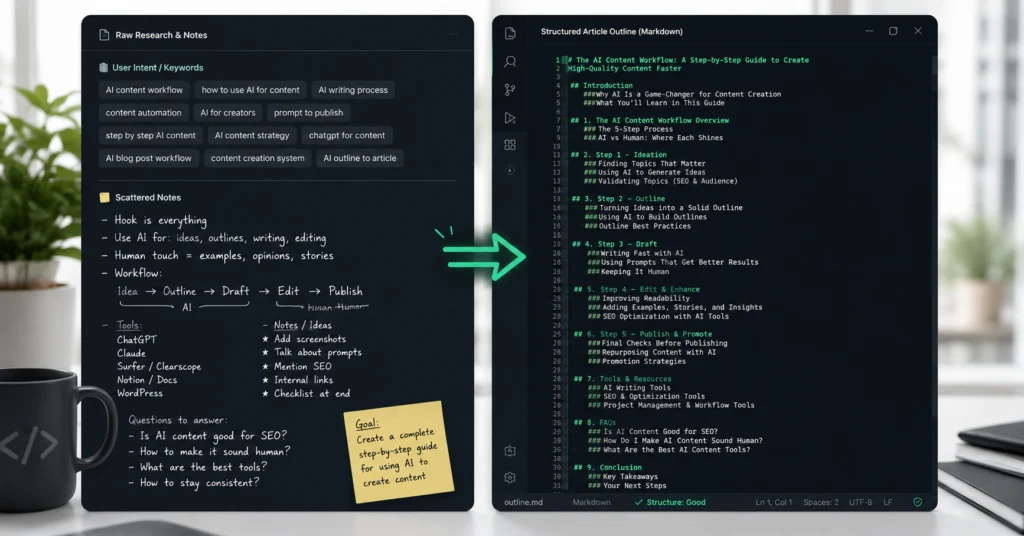
To build a high-ranking, truly valuable article, you must use AI content workflows to generate the structural blueprint before writing a single paragraph of prose. Most marketers let an LLM write a complete draft from a simple keyword phrase, which immediately outputs bloated, repetitive text that breaks down under professional scrutiny.
During a content sprint on May 14, we watched a writer waste 4 hours trying to edit a bloated, AI-generated essay into a functional tutorial—all because they skipped the foundational mapping stage.
The strategy outlined below changes that relationship by decoupling planning from drafting. By controlling the bones of your piece through strict prompt constraints, you can maintain absolute editorial control while using software to organize complex research.
This guide provides a repeatable, three-step framework designed for content operators who need to scale blog production without sacrificing structural depth or structural utility.
Why standard AI content workflows generate superficial blog blueprints
Most content teams treat AI tools like a magic slot machine: they paste a keyword, ask for an outline, and accept whatever generic sections the model returns. This approach guarantees an outline packed with flat, low-value headers like “Introduction,” “Why It Matters,” and “Conclusion.”
These generic placeholders fail because LLMs are trained to predict the most statistically probable next word, which naturally defaults to the most common—and boring—structures found on the web.
To break this pattern, you must shift your perspective. An outline is not just a list of topics; it is an architectural plan that defines what specific question the page answers, who the reader is, and what action they must take next. If your outline does not contain hard constraints, your final draft will lack clear arguments.
[Raw Keyword] ──> Generic AI Prompt ──> Flat Outline (Introduction, Best Practices, Conclusion)
[Intent + Data] ──> Constrained Workflow ──> Structural Blueprint (Actionable H2s, Fact Anchors)
We completely stopped using open-ended prompts for structural planning after realizing that structured outputs require structured inputs. If you give the model a generic task, it gives you a generic page.
Step 1: Isolate the core search intent and audience baseline
Before you open an AI tool, you must gather your raw data. You cannot prompt an LLM effectively if you do not know the exact problem your target user is trying to solve. Start by gathering real search queries, forum discussions, or specific customer support tickets that represent the true intent of your target audience.
Spend exactly 10 minutes extracting the primary friction points your competitors missed. Look for specific complaints in community threads—like a user complaining that a tool’s documentation lacks a concrete setup script.
Once you have identified these specific points, document your audience baseline across two axes:
- The Problem State: The specific point where the reader is currently stuck (e.g., “Our migration script keeps failing at the third step”).
- The Desired Outcome: The exact state they want to achieve after reading your page (e.g., “A clean database migration with zero downtime”).
Feed this explicit positioning data into your tool as the foundational context layer. Never let the tool guess who your audience is.
Step 2: Inject structural constraints into your system prompt
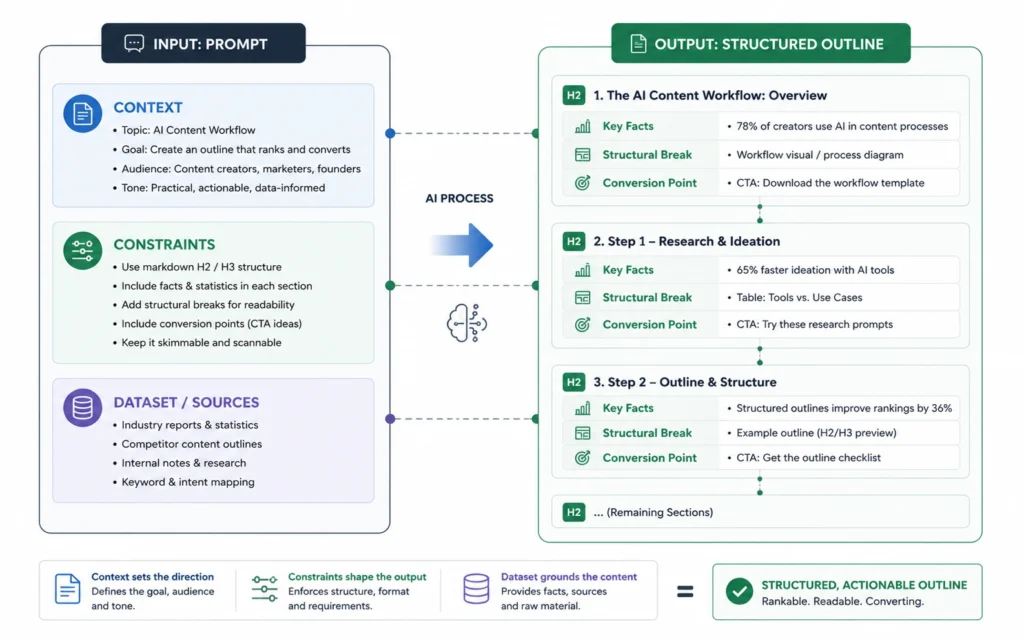
Now that you have your contextual dataset, you must feed it into your AI tool using an explicit, constraint-driven system prompt. The goal here is to restrict the model’s creative freedom so it only outputs structured, highly intentional headings.
Copy and use this structural constraint block directly within your workflow:
System Prompt Constraints:
You are an expert content architect. Generate a structural blog post outline based on the context provided. You must strictly follow these rules:
- Every H2 heading must contain a clear, extractable fact, tool capability, or measurable outcome. Never use broad labels like “Overview” or “Tips.”
- Avoid three consecutive headings of identical length or tone.
- Include an explicit “Structural Break” indicator after every second H2 to mandate where a table, diagram, or code block must go.
- Do not include summary or conclusion sections that merely restate previous points.
       [INPUT DATASET]
 (Intent, Target Audience, Friction)
               │
               ▼
   [PROMPT CONSTRAINT ENGINE]
 (No filler headers, Fact-backed H2s)
               │
               ▼
   [STRUCTURAL BLUEPRINT]
(Actionable Outline with Visual Breaks)
When you apply this precise framework, the model stops generating generic marketing fluff. Instead, it yields an outline that acts as an explicit roadmap, dictating exactly where your article needs deep technical details or data points.
Step 3: Audit the raw AI output for generic transitions and logic gaps
The output from your AI content workflows is a first-pass draft, not a finalized production plan. You must manually review the generated headings to identify any remaining logic gaps or superficial phrasing. Read the outline from the perspective of a skeptical user who is short on time and looking for quick answers.
Look for places where the model slipped into vague language despite your strict constraints. If an H2 reads like “Using analytics to improve your results,” rewrite it immediately to match your precise operational experience. Change it to something concrete, such as: “Track these three specific custom dimensions in Google Analytics 4 to isolate landing page drop-offs.”
Insert your own proprietary insights, case studies, or internal links directly into the skeleton of the outline. This manual refinement ensures the structure is anchored by real-world authority before you begin drafting the actual paragraphs.
The trade-offs of using automated structural planning
While this systematic workflow slashes outline generation time from 45 minutes down to roughly 8 minutes, it introduces a distinct risk: structural uniformity. If you run every piece of content through the exact same system prompt constraints, your entire publication will eventually adopt an identical rhythm.
To mitigate this issue, you can alternate this automated workflow with an alternative approach: Manual Competitive Gap Analysis.
| Method | Time Investment | Structural Variance | Ideal Use Case |
| Constrained AI Workflow | ~8 minutes | Moderate / High Control | Scalable execution of tutorial and process-driven content. |
| Manual Gap Analysis | ~60 minutes | Infinite / High Nuance | Narrative essays, thought leadership pieces, and brand positioning. |
Do not use AI workflows for highly opinionated thought leadership pieces that rely entirely on your personal, hard-earned points of view. Save the automated model for clear, execution-focused tutorials, product comparisons, and technical guides where structural clarity is the primary driver of search performance.
Frequently Asked Questions About AI Content Workflows
Why shouldn’t I let AI write the full article after generating the outline?
LLMs lose structural depth and lean on generic filler text when generating long-form copy in a single run. Use the AI-generated outline as a blueprint, then write or prompt the sections individually to maintain absolute quality control.
How do I prevent an AI tool from generating generic H2 headings?
Ban single-word or broad headings like ‘Introduction’ or ‘Best Practices’ inside your prompt constraints. Force the model to include an extractable fact or specific outcome in every single subheading it generates.
Can this structural workflow work across different LLMs like Claude and ChatGPT?
Yes, this process relies on structural constraints rather than model-specific quirks. You can apply the identical prompt architecture to Claude 3.5 Sonnet, GPT-4o, or any other leading enterprise LLM with predictable results.
Continue Exploring
To expand your operational knowledge, read our adjacent guide on systematic prompt engineering frameworks for scaling content production. This deep dive will help you master the specific prompt structures needed to transform your raw research data into high-performance web copy.
For a broader view of team operations, read our breakdown on auditing marketing operations infrastructure for AI tool integration. This article outlines how to integrate these structural content workflows into multi-member editorial teams without creating tool friction.