Most creators don’t fail because they can’t make content. They fail because they try to monetise before they’ve earned the right to. You need an audience that trusts you, a format that works, and a clear path from content to revenue.
I spent eight months building a YouTube channel before earning my first $50 from AdSense. The problem wasn’t the content quality—it was that I hadn’t validated whether anyone would pay for what I was creating. Once I switched to affiliate marketing and promoted tools I actually used, I made $340 in the first month. The audience was there. I just needed the right monetisation method.
This guide walks through how to make money as a content creator using the Creator Income Sequence: which stream to build first, when to add the second, and what actually works in 2026. No theory. Just the methods that convert views into revenue.
What Creator Monetisation Actually Is (And What It Isn’t)
Creator monetisation isn’t about going viral or building a “personal brand.” It’s about creating content that solves a specific problem for a specific audience, then offering them a relevant way to pay for a solution.
The mistake most beginners make: they think monetisation starts after they have an audience. It doesn’t. Monetisation starts when you choose your niche and platform. If you pick a niche with no commercial intent—like posting random daily vlogs with no clear audience—you’ll struggle to monetise no matter how many views you get.
Here’s what actually works: choose a niche where people already spend money. Personal finance, software tutorials, fitness coaching, business education, product reviews. These niches have buyers, not just viewers.
The real question isn’t “how do I make money?” It’s “what problem am I solving, and who will pay to solve it?” Answer that first. Everything else follows.
Why the Order You Build Income Streams Matters More Than the Streams Themselves
Most creators try to launch a course, start affiliate marketing, and apply for ad revenue all at once. This spreads your effort too thin. You end up with three half-built income streams instead of one that actually works.
The Creator Income Sequence exists because each stream requires different skills, audience size, and trust levels. Build them in the wrong order, and you waste months.
First stream (months 1-6): Affiliate marketing or services. These require the least audience trust. You can start with zero followers if you’re offering a service, or with a small engaged audience for affiliate links.
Second stream (months 6-12): Ad revenue or sponsorships. These need consistent traffic and audience growth. YouTube AdSense, for example, requires 1,000 subscribers and 4,000 watch hours. You can’t rush this.
Third stream (months 12+): Digital products or memberships. These require the most trust. People won’t buy your $200 course unless they’ve already consumed your free content and seen results.
I learned this the hard way. I tried to launch a membership community at month four with 800 subscribers. Three people joined. I shut it down, focused on affiliate content instead, and relaunched the membership 10 months later with 8,000 subscribers. This time, 127 people joined in the first week.
The sequence isn’t optional. It’s the difference between grinding for months and building momentum.
Content Creation Hub — Understanding the broader content ecosystem helps you choose which income streams align with your format.
The Creator Income Sequence: Which Stream to Build First, Second, and Third
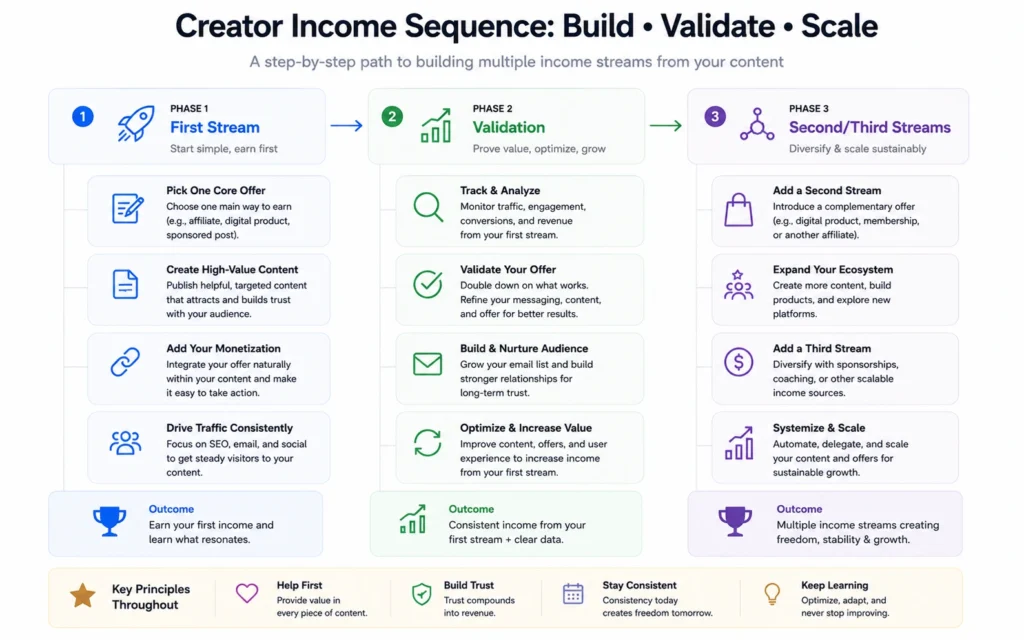
Let’s break down each income stream with specific numbers, timelines, and what it actually takes to make it work.
First Stream: Affiliate Marketing or Services (Months 1-6)
Affiliate Marketing:
- Time to first dollar: 2-8 weeks
- Typical commission: 5-30% per sale
- Monthly income potential (month 6): $100-500
- What you need: Content that reviews, compares, or tutorials products
Affiliate marketing works because you’re recommending products people already want to buy. You don’t create the product, handle customer service, or manage inventory. You just connect buyers to sellers.
The key: promote products you’ve actually used. Your audience can tell when you’re padding an article with affiliate links to random products. But if you write a detailed tutorial showing how you use Notion to organise your content calendar, and link to Notion’s affiliate program, that’s helpful.
Services:
- Time to first dollar: 1-4 weeks
- Typical rate: $50-500 per project
- Monthly income potential (month 6): $500-2,000
- What you need: A skill you can deliver (video editing, copywriting, social media management)
Services are the fastest path to revenue. If you’re learning video editing while building your YouTube channel, offer to edit videos for other creators. You get paid while you learn, and you build relationships in your niche.
The downside: services don’t scale. You’re trading time for money. Use services to fund your content creation, not as your endgame.
Second Stream: Ad Revenue or Sponsorships (Months 6-12)
Ad Revenue (YouTube, Blog Display Ads):
- YouTube requirements: 1,000 subscribers + 4,000 watch hours
- Typical RPM (revenue per 1,000 views): $2-15 depending on niche
- Monthly income potential (month 12): $200-1,000
- What you need: Consistent publishing and growing audience
Ad revenue is passive once you hit the threshold, but it takes time. Finance and business niches earn higher RPMs ($10-15) than entertainment ($2-5). Choose your niche wisely.
Sponsorships:
- Typical rate: $10-50 per 1,000 followers/views
- Monthly income potential (month 12): $300-1,500
- What you need: Engaged audience and media kit
Sponsorships pay better than ads, but you need to pitch brands or join creator marketplaces. Start with smaller brands in your niche. They’re easier to work with and more likely to say yes.
Third Stream: Digital Products or Memberships (Months 12+)
Digital Products (Courses, Templates, E-books):
- Time to create: 4-12 weeks
- Typical price: $27-500
- Monthly income potential (month 18): $500-5,000
- What you need: Proven expertise and audience trust
This is where the real money is. But you can’t skip to this step. People buy digital products from creators they trust. That trust takes time to build.
Memberships (Patreon, YouTube Members, Paid Newsletters):
- Typical price: $5-50/month
- Conversion rate: 1-5% of audience
- Monthly income potential (month 18): $300-3,000
- What you need: Consistent exclusive content
Memberships provide recurring revenue, which is valuable. But you need to deliver ongoing value. One creator I know offers monthly Q&A calls, early access to videos, and a private Discord. His 300 members pay $10/month. That’s $3,000/month recurring.
Creator Monetisation strategies — Dive deeper into specific monetisation methods and platform requirements.
Best Practices for Stacking Income Streams Without Burning Out
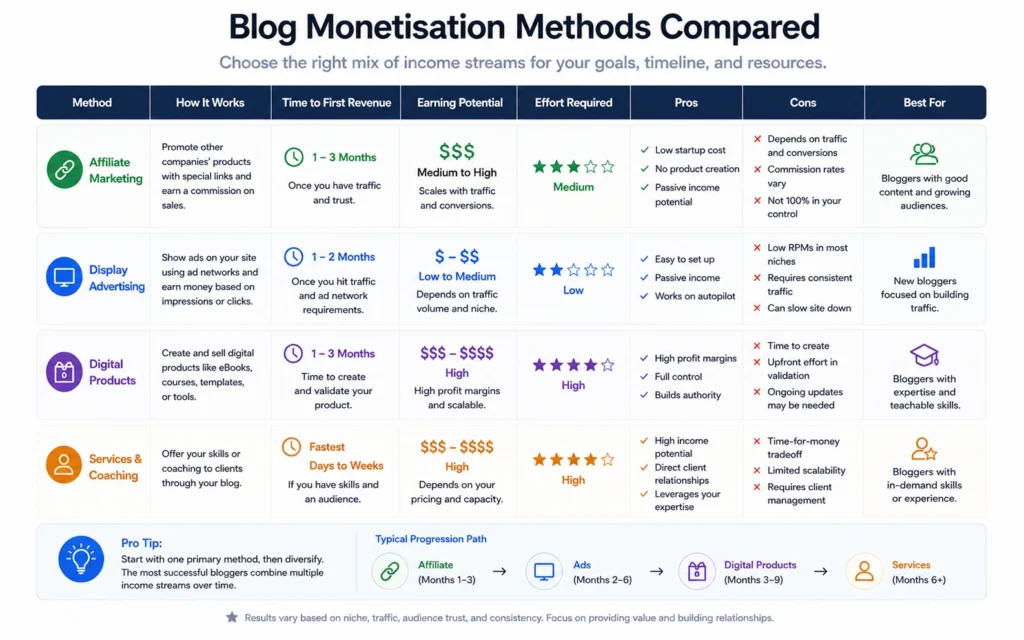
Once your first stream is generating $500-1,000/month consistently, you can add a second. But don’t just pile on work. Stack streams that complement each other.
Good combinations:
- YouTube videos + affiliate links in descriptions (same content, two revenue streams)
- Blog posts + display ads + affiliate links (one piece of content, three streams)
- Free tutorials + paid course (free content builds trust, course monetises it)
Bad combinations:
- Daily TikTok videos + weekly YouTube videos + monthly podcast + weekly newsletter (too many formats)
- Selling three different courses at once (splits your audience)
- Offering five different services (becomes a freelance agency, not a creator business)
The rule: one content format, multiple monetisation methods. Not multiple formats, multiple methods.
I run a YouTube channel and a newsletter. Same topics, different formats. The newsletter promotes my YouTube videos. The YouTube videos link to my newsletter. Both promote the same affiliate products. This takes 10 hours/week total. If I added TikTok, Instagram, and a podcast, I’d need 30+ hours/week. I’d burn out in three months.
Short-Form Video strategies — Learn how to repurpose content across formats without multiplying your workload.
The Monetisation Mistakes That Cost Beginners Months of Revenue
Mistake 1: Waiting for “enough” followers before monetising
You don’t need 10,000 followers to make money. You need 100 people who trust you. I’ve seen creators with 2,000 followers make $800/month from affiliate marketing while creators with 50,000 followers make $50/month because they’re waiting for brand deals.
Start monetising immediately. Even if it’s just one affiliate link in your first video.
Mistake 2: Promoting too many products
Your audience doesn’t want 15 affiliate links in every description. They want one or two recommendations that actually help. I promote three tools consistently across my content. That’s it. My conversion rate is 8% because my audience knows I only recommend what I use.
Mistake 3: Ignoring email from day one
Social media algorithms change. Platforms die. Your email list is the only audience you own. Start collecting emails immediately, even if it’s just a simple “subscribe for weekly tips” landing page. I waited 14 months to start my newsletter. Those 14 months cost me thousands of subscribers I’ll never get back.
Mistake 4: Not tracking what works
Most creators have no idea which content drives revenue. They just post and hope. Use UTM parameters on your affiliate links. Check your analytics weekly. Double down on what converts. I found that my tutorial videos generate 10x more affiliate revenue than my opinion videos. So I make more tutorials.
Advanced Strategies: When and How to Add Your Second and Third Streams
Once your first stream hits $1,000/month consistently for three months, you’re ready to add a second. But don’t just add random streams. Add streams that leverage your existing work.
The 80/20 rule for stacking:
Spend 80% of your time on your primary income stream. Spend 20% testing the second stream. Once the second stream hits $500/month, you can shift to 60/40. Never let a new stream cannibalise your proven stream.
Productising your knowledge:
The highest-leverage move is turning your knowledge into a digital product. But don’t build a course nobody wants. Validate first.
Here’s how: create a free guide or checklist related to your topic. Offer it in exchange for email addresses. Then email your list: “I’m thinking of creating a detailed course on [topic]. Would you be interested? Reply and let me know.”
If 20+ people say yes, build it. If fewer than 10 say yes, your audience isn’t ready or the topic isn’t compelling enough.
The membership ladder:
Don’t jump straight to a paid membership. Build a free community first. Start a Discord server or Facebook group. Engage daily. After three months, offer a paid tier with exclusive content.
One creator I know grew a free Discord to 1,200 members in six months. He then launched a $15/month premium tier with weekly coaching calls. 89 people joined. That’s $1,335/month recurring revenue from an audience he already had.
Blogging for creators — Learn how written content can support your video or social media monetisation.
Key Takeaways: Your First Steps to Creator Monetisation
Stop waiting for permission. Stop waiting for “enough” followers. Stop waiting for the perfect moment.
Start with affiliate marketing or services today. Build your first stream to $500-1,000/month. Then add your second stream. Follow the Creator Income Sequence. Don’t skip steps.
Track everything. Build your email list from day one. Promote fewer products, but promote them consistently. Choose a niche with commercial intent.
The creators who make money aren’t the ones with the most followers. They’re the ones who treat content creation as a business, not a hobby.
Your next step: Pick one income stream from this guide. Set a 30-day goal. Publish your first monetised piece of content this week. Not next month. This week.
Frequently Asked Questions About How to Make Money as a Content Creator
How long does it take to make money as a content creator?
Most creators see their first $100 within 3-6 months of consistent publishing. Reaching $1,000/month typically takes 12-18 months. The timeline depends on your niche, platform choice, and how quickly you validate your first income stream. Don’t expect full-time income in the first year.
Do I need a large audience to make money as a content creator?
No. You can monetise with as few as 1,000 engaged followers through affiliate marketing, digital products, or services. Ad revenue requires larger audiences (10,000+ subscribers on YouTube, for example), but direct monetisation methods work with smaller, niche audiences. Focus on engagement, not just follower count.
What is the easiest way for beginners to make money as a content creator?
Affiliate marketing is the most accessible starting point. You promote products you already use and earn commissions on sales. It requires no inventory, no customer support, and you can start immediately. The downside: commissions are typically 5-30%, so you need volume or high-ticket products to make significant income.
Should I focus on one income stream or multiple streams?
Start with one income stream and get it to $500-1,000/month before adding another. The Creator Income Sequence matters: master your first stream, then layer on complementary streams. Trying to build three income streams at once usually means none of them work. Depth before breadth.
What platform is best for making money as a content creator in 2026?
YouTube remains the most reliable for ad revenue and long-term discoverability. TikTok and Instagram Reels offer faster growth but weaker monetisation. For beginners, start where your audience already is, then repurpose content across platforms. Don’t chase every new platform—master one first.
Continue Exploring
- Creator Tools — Discover the software and platforms that streamline content production and monetisation workflows.
- YouTube & Video Creation — Master video production techniques that increase watch time and ad revenue potential.