The biggest mistake new bloggers make is choosing a platform based on features instead of goals.
I’ve watched creators spend weeks customizing a WordPress site when they really needed an email-first publishing system. I’ve also seen writers start on Substack, build a loyal audience, then discover they wanted content hubs, landing pages, and deeper SEO control six months later.
The platform isn’t the business.
It’s the infrastructure underneath the business.
When people search for wordpress vs substack, they’re usually asking a deeper question: What kind of creator am I trying to become?
That’s the decision that matters.
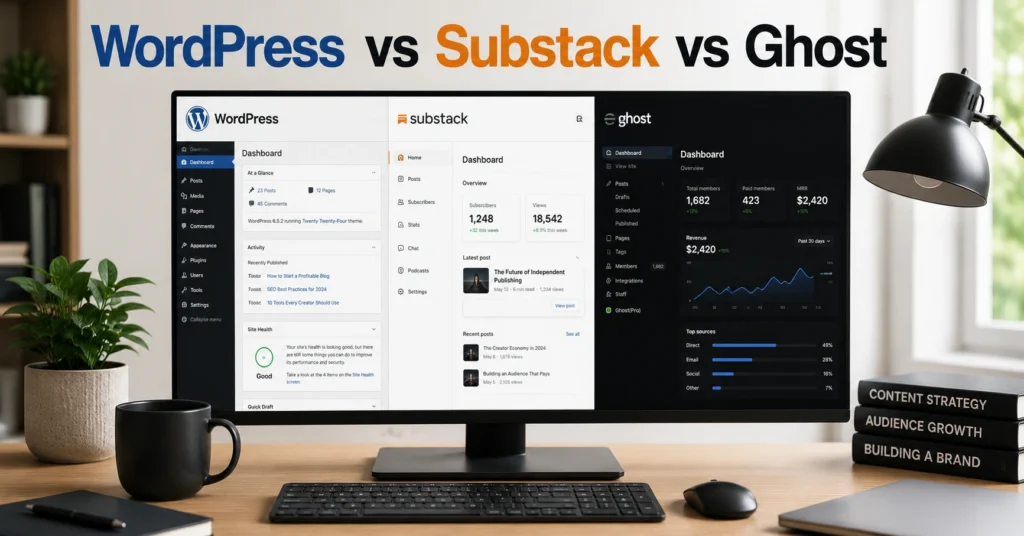
WordPress, Substack, and Ghost can all publish content. The differences appear when you look at ownership, growth, monetisation, email distribution, and long-term flexibility.
By the end of this guide, you’ll know which platform fits your goals—and which platform creates unnecessary work.
Overview
The short answer is simple.
Choose Substack if your primary goal is writing newsletters and building an audience quickly.
Choose Ghost if newsletters and memberships are central to your business, but you want more ownership and branding control.
Choose WordPress if you’re building a long-term content asset that depends on search traffic, customization, and platform flexibility.
Here’s where most comparisons go wrong.
They compare features.
Experienced creators compare constraints.
A feature is something a platform can do.
A constraint is something the platform makes difficult.
That’s what changes decisions.
WordPress
WordPress powers a large portion of the web because it can adapt to almost any publishing model.
Blog.
Membership site.
Course platform.
Media publication.
Affiliate site.
Documentation library.
The trade-off is complexity. You’ll spend time managing plugins, themes, hosting, security updates, and technical decisions.
Substack
Substack removes almost every technical decision.
You create an account.
Write.
Publish.
Send emails.
That’s the appeal.
The limitation appears when your publishing operation grows. Customization options remain narrow because the platform is designed around newsletters first.
Ghost
Ghost sits between the two.
It combines blogging, memberships, newsletters, and publishing into one streamlined system.
In practical terms, Ghost often feels like what many writers expected WordPress to feel like before installing their seventh plugin.
But Ghost has a smaller ecosystem and fewer integrations than WordPress.
That’s the trade-off.
Step-by-Step Guide
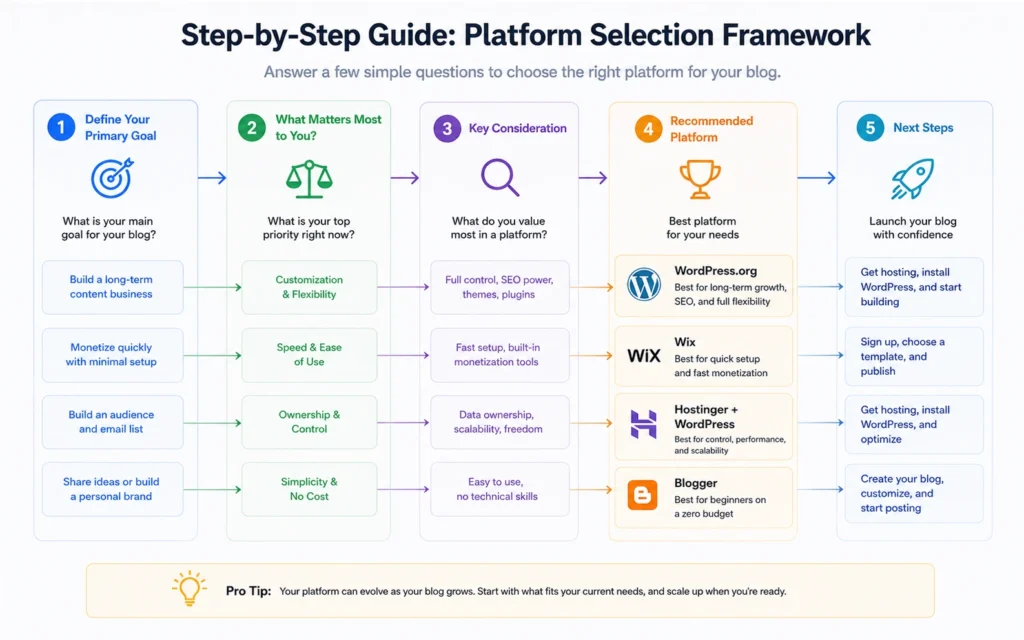
Instead of starting with platform features, start with the job you need the platform to perform.
Step 1: Decide How Readers Will Find You
This decision removes a surprising amount of confusion.
If most readers will discover you through search engines, WordPress usually wins.
If most readers will discover you through email subscriptions, Ghost and Substack become stronger options.
Many beginners underestimate this distinction.
Search-driven businesses need content architecture.
Newsletter-driven businesses need subscriber relationships.
Those are different systems.
Step 2: Decide Whether You Need Ownership or Convenience
Substack optimizes for convenience.
WordPress optimizes for ownership.
Ghost attempts to balance both.
Here’s the practical question:
If your platform disappeared tomorrow, how much control would you want over your content, branding, and audience experience?
Creators rarely ask this question at the beginning.
They often ask it later.
Usually after growth creates limitations.
Step 3: Define Your Monetisation Plan
Different platforms support different business models.
If you’re building:
- Affiliate content
- SEO-focused blogs
- Digital product sites
- Service businesses
WordPress is usually the strongest choice.
If you’re building:
- Paid newsletters
- Subscriber communities
- Reader-supported writing
Substack and Ghost become more attractive.
The monetisation model should influence the platform—not the other way around.
Step 4: Estimate Your Technical Tolerance
A useful test:
Would you rather spend 45 minutes solving a plugin issue or 45 minutes writing?
Most creators know their answer immediately.
If technical work drains your energy, don’t ignore that signal.
A platform that looks powerful on paper can become a publishing obstacle in practice.
Step 5: Think Beyond Year One
Most platform decisions are evaluated over weeks.
The better approach is evaluating over years.
Ask:
- Will this support 500 articles?
- Will this support paid products?
- Will this support email growth?
- Will this support team members?
The answers matter more than today’s setup process.
Tips & Examples
The strongest platform choice often comes from understanding real publishing scenarios.
Scenario 1: The SEO-Focused Blogger
A creator wants to publish tutorials, comparison posts, and product reviews.
Traffic comes primarily from search.
Monetisation comes from affiliates and products.
Use WordPress.
The ability to structure content, optimize pages, and expand functionality matters more than publishing speed.
I’ve seen creators migrate from Substack to WordPress for exactly this reason. Search-driven businesses eventually need more control over content architecture.
Scenario 2: The Independent Writer
A writer publishes essays twice per week.
The goal is subscriber growth and reader relationships.
The business model is paid subscriptions.
Use Substack.
The publishing workflow stays simple.
The audience receives content directly in their inbox.
Less setup.
More writing.
Scenario 3: The Newsletter Business
A creator plans to combine:
- Articles
- Email newsletters
- Memberships
- Premium content
Ghost often becomes the strongest option.
The platform was built around this workflow.
One observation from real creator operations: every additional tool introduces friction. Ghost reduces the number of moving parts compared with a WordPress plus newsletter-stack setup.
The Mistake That Costs Time
Many beginners choose the most powerful platform available.
That’s often the wrong decision.
A platform is valuable only if you’ll use its capabilities.
Installing 20 plugins doesn’t improve a content strategy.
Publishing consistently does.
Tools to Use
The platform is only part of the workflow.
The supporting tools matter too.
WordPress Stack
Useful additions include:
- SEO plugins
- Caching plugins
- Analytics tools
- Form builders
- Membership software
The strength of WordPress is flexibility.
The weakness is decision overload.
There is usually another plugin.
And then another one.
Substack Stack
The appeal is simplicity.
Most creators can begin without additional software.
That simplicity speeds up publishing.
But it also limits customization.
You gain speed by accepting constraints.
Ghost Stack
Ghost includes many features creators typically add through plugins elsewhere.
That reduces operational complexity.
For newsletter-first businesses, this often creates a cleaner workflow than assembling multiple tools together.
One Tool Decision That Matters More Than Platform Choice
Analytics.
Track:
- Subscriber growth
- Returning visitors
- Traffic sources
- Content performance
Many creators spend hours debating platforms while ignoring the data that actually improves publishing decisions.
The platform matters.
Measurement matters more.
Frequently Asked Questions About WordPress vs Substack
Is Substack better than WordPress for beginners?
For creators who want to publish newsletters immediately, yes.
For creators building search-driven content businesses, usually not.
The easier platform is not always the better long-term platform.
Match the tool to the business model.
Can Ghost replace WordPress?
For many newsletter-focused creators, absolutely.
Ghost handles publishing, memberships, and email distribution well.
Large content operations with extensive customization requirements still often prefer WordPress because of its ecosystem and flexibility.
Which platform is best for SEO?
WordPress generally offers the most SEO control.
Ghost performs well and covers most publishing needs.
Substack supports SEO basics but provides fewer optimization options.
If search traffic is your primary growth channel, WordPress usually remains the strongest option.
Which platform costs less?
Substack has the lowest setup barrier.
WordPress hosting costs vary depending on traffic and requirements.
Ghost can become cost-effective when replacing multiple newsletter and membership tools.
The cheapest option depends on the workflow you’re replacing
What should beginners choose in 2026?
For a newsletter-first creator: Substack.
For a newsletter business with memberships: Ghost.
For a long-term content site built around search, products, or services: WordPress.
That’s the clearest answer to the wordpress vs substack 2026 decision.