They look for a tool that will generate entire videos automatically. Then they spend an hour fixing robotic scripts, replacing weak hooks, and correcting captions that never sounded natural in the first place.
The useful version of AI for short form video is much less dramatic. It doesn’t replace creative judgment. It removes repetitive work that keeps showing up every time you publish.
One of the biggest mistakes I see is creators spending 40 minutes writing a script and another 30 editing captions manually when both tasks could be reduced to a few minutes with the right workflow. The result isn’t better because AI is smarter. The result is better because the creator gets more time to focus on packaging, delivery, and retention.
The creators getting the most value from AI right now aren’t building fully automated channels. They’re building repeatable systems.
This article shows where AI actually helps, how to set it up, the workflow that saves the most time, and the mistakes that quietly reduce content quality.
Why AI for Short Form Video Works Best on Repetitive Tasks
AI is strongest when the task repeats.
That’s the filter worth using before adopting any tool.
If you create five short videos every week, you’ll repeat the same sequence dozens of times each month:
- Research ideas
- Write hooks
- Structure scripts
- Generate captions
- Create title variations
- Repurpose long-form content
- Extract highlights
- Draft descriptions
Those tasks follow patterns. AI performs well with patterns.
The weak use case is asking AI to invent your entire creative direction.
A strong creator usually has a point of view before opening a tool. AI then accelerates execution.
For example, a productivity creator might already know the topic is “why most to-do lists fail.” AI can quickly generate ten hook variations, summarize supporting points, and suggest alternative openings. The creator still decides which version deserves publication.
That’s the distinction many discussions miss.
AI improves throughput.
It doesn’t automatically improve judgment.
And judgment remains the hardest part of short-form content.
Setup Guide: Build One AI Stack Before Adding More Tools
Most creators use too many tools.
The usual pattern looks like this:
- One tool for ideas
- Another for scripts
- A third for editing
- A fourth for captions
- A fifth for scheduling
The workflow becomes harder than the content.
Start smaller.
A practical AI setup usually needs only four functions:
Idea Development
Use AI to expand ideas, identify audience questions, and generate alternative angles.
Good prompt:
“Generate 15 short-form content angles for creators struggling with video retention. Focus on practical mistakes and fixes.”
Bad prompt:
“Give me viral content ideas.”
One produces usable concepts.
The other produces generic internet noise.
Script Drafting
AI can create first drafts quickly.
Treat them as raw material, not finished scripts.
Most strong short-form scripts require human editing because natural speech sounds different from generated writing.
A useful workflow is:
- Generate draft
- Remove filler
- Add personal examples
- Tighten opening
- Reduce word count
Short-form usually improves when you remove words, not add them.
Editing Assistance
Modern editing platforms can:
- Remove silence
- Detect filler words
- Generate captions
- Create jump cuts
- Reframe vertical videos
This is where many creators save the most time.
Repurposing
Long-form content contains dozens of potential short clips.
AI can identify moments worth reviewing.
Reviewing remains important because software often selects technically interesting moments rather than emotionally engaging ones.
That’s a meaningful difference.
Workflow: The Fastest Way to Create AI-Assisted Short Videos
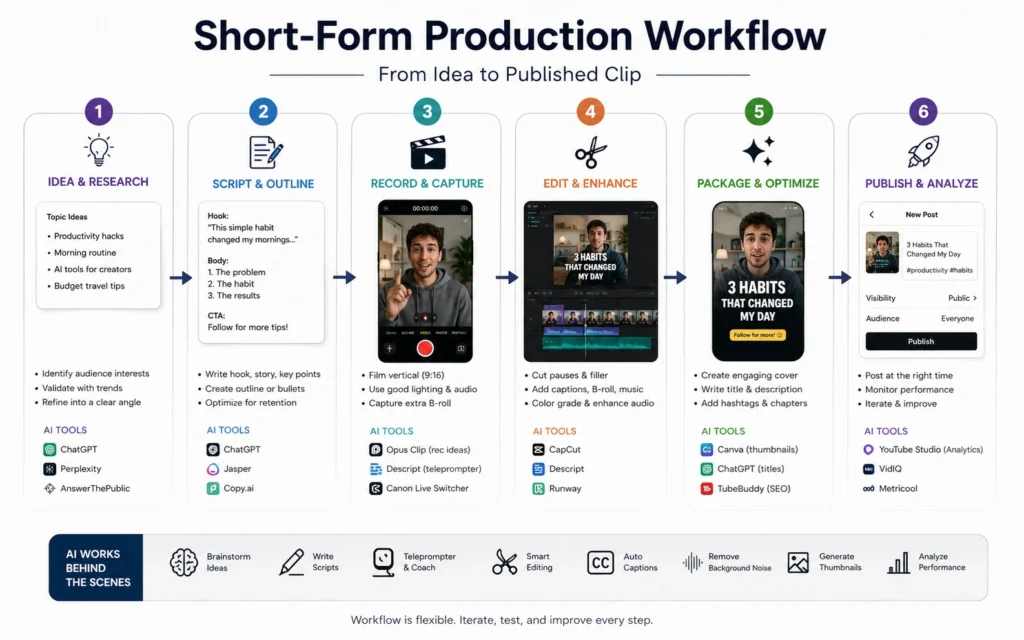
The strongest AI workflow starts before recording.
Most creators think AI belongs in editing.
The bigger gains often happen before the camera turns on.
Step 1: Generate Multiple Angles Before Choosing One
Don’t ask for one idea.
Ask for twenty.
The first few ideas are usually predictable. Better concepts appear after the obvious options are exhausted.
A creator discussing freelancing might request:
- Common mistakes
- Pricing myths
- Client communication failures
- Productivity misconceptions
- Revenue lessons
Then choose the strongest angle manually.
This takes minutes and often produces a month of content directions.
Step 2: Write Hooks Before Scripts
Many creators reverse this.
That’s expensive.
A weak hook makes the rest of the script irrelevant because nobody reaches it.
Ask AI to generate:
- Contrarian hooks
- Mistake-based hooks
- Curiosity hooks
- Outcome-driven hooks
Then select one.
Only after that should the script exist.
I’ve seen creators rewrite entire scripts because the opening wasn’t strong enough. Writing the hook first prevents that waste.
Step 3: Build a Simple Structure
Short-form content doesn’t need complexity.
Most effective videos follow:
Hook → Problem → Insight → Action
Or:
Hook → Mistake → Fix → Result
AI performs surprisingly well when given a structure beforehand.
Instead of asking:
“Write a short video script.”
Use:
“Write a 45-second script using Hook → Problem → Insight → Action.”
The output quality improves immediately because the framework is clearer.
Step 4: Record With Human Delivery
This is where AI stops helping.
Delivery matters.
Tone matters.
Pacing matters.
Experience matters.
A generated script read without personality sounds generated.
A rewritten script delivered with conviction sounds human.
Creators often underestimate this difference.
The script isn’t the product.
The performance is.
Step 5: Use AI During Editing
Editing is where AI consistently saves time.
Common automation includes:
- Caption generation
- Silence removal
- Speaker detection
- Auto-cutting
- Highlight extraction
What previously required 45 minutes can often be reduced to 10–15 minutes.
The gain isn’t just speed.
It’s consistency.
And consistency compounds over hundreds of videos.
Step 6: Create Multiple Versions
One of the most useful applications of AI for short form video 2026 workflows is variation testing.
Generate:
- Three hooks
- Three titles
- Two endings
Now one piece of content becomes multiple publishing opportunities.
This is especially useful when testing platform performance differences between:
- TikTok
- Instagram Reels
- YouTube Shorts
The audience behavior isn’t identical.
Small packaging changes can create large distribution differences.
Step 7: Review Before Publishing
Never skip this.
AI-generated captions often mishear names.
AI-generated scripts sometimes introduce inaccurate claims.
AI-generated edits occasionally cut moments that should remain.
The review stage protects quality.
It’s also where creator judgment earns its value.
Pro Tips: The Places AI Quietly Improves Retention
Retention is rarely improved by a single breakthrough.
It’s improved by dozens of small improvements.
AI can contribute to several of them.
Use AI to Shorten, Not Expand
Most generated scripts are too long.
Ask AI:
“Reduce this script by 30% while preserving the core message.”
The result is often stronger than the original version.
Short-form rewards compression.
Not explanation.
Analyze Existing Scripts
One underused workflow is reverse engineering.
Feed successful scripts into AI and ask:
- What hook pattern was used?
- Where does curiosity appear?
- How is tension maintained?
- When does the payoff arrive?
The answers aren’t perfect.
But they reveal patterns faster than manual analysis.
Build Prompt Libraries
The first useful prompt takes effort.
The fiftieth use is where value appears.
Store prompts for:
- Hook generation
- Script drafting
- Repurposing
- Caption writing
- Content research
An AI workflow is only valuable when it survives repeated use.
If every session starts from scratch, you don’t have a system.
You have experimentation.
Don’t Automate Your Point of View
This is the biggest trap.
AI can generate opinions endlessly.
That doesn’t mean those opinions belong in your content.
Your experience is the differentiator.
Your observations are the differentiator.
Your mistakes are the differentiator.
The internet already has enough generic advice.
The creators building durable audiences add perspective that software can’t manufacture.
That’s still the edge.
Related Resources That Make AI Work Better Inside a Creator System
AI works best when connected to a larger publishing workflow.
A creator who publishes randomly gains less from automation than a creator operating from a repeatable process.
That’s because AI amplifies existing systems.
It doesn’t create them.
If you’re improving your short-form operation, continue here:
Frequently Asked Questions About AI for Short Form Video
Can AI create short-form videos automatically?
Yes, but full automation rarely produces strong results. AI can generate scripts, captions, edits, and clips, but creator review remains important. The strongest workflows combine automation for repetitive tasks with human judgment for ideas, delivery, and final quality control.
What part of short-form creation benefits most from AI?
Editing and repurposing usually produce the biggest time savings. Caption generation, silence removal, clip extraction, and content repackaging can reduce production time significantly while keeping output quality consistent.
Should I let AI write all my scripts?
No. Use AI for first drafts and idea expansion. Then rewrite the script using your own language, examples, and experience. Most successful creators use AI as an assistant rather than a replacement writer.
Does AI improve video performance automatically?
No. Better performance comes from stronger hooks, clearer structure, improved retention, and better packaging. AI can help produce those elements faster, but it cannot guarantee distribution or engagement.
What is the biggest mistake creators make with AI?
Trying to automate judgment. AI is useful for repetitive production work. It struggles with creator insight, audience understanding, and unique perspective. Automate the workflow. Keep ownership of the message.
Continue Exploring
- Short-Form Video category hub: This category collects workflows, retention strategies, publishing systems, and platform-specific lessons for creators producing short-form content consistently.
- planning a month of short-form content: A practical framework for turning one content idea into multiple publishable assets without scrambling for topics every week.