Most blog posts fail before anyone reads the second paragraph.
Not because the writing is poor. Not because the topic is bad. Usually because the article never gave readers a reason to care in the first place.
I’ve reviewed blog posts that were 2,500 words long, well formatted, and technically correct. Yet readers left after 40 seconds. The problem wasn’t grammar. The problem was that the article answered a keyword instead of solving a problem.
That’s the mistake many guides miss when explaining how to write a blog post.
A blog post succeeds when three things happen:
- Someone clicks.
- Someone keeps reading.
- Someone shares or remembers it.
Miss any one of those and growth becomes difficult.
The goal isn’t to publish more articles. The goal is to publish articles that earn attention repeatedly. Search traffic helps people discover the post. Structure helps them finish it. Useful insight gives them a reason to share it.
This workflow focuses on all three.
Why Use This Approach for Blog Writing
Writing for search engines alone creates pages that rank briefly and disappear.
Writing only for human readers often produces articles nobody discovers.
The strongest blog posts sit between those extremes.
A useful way to think about blogging is this:
Search brings the first visit. Value creates the second visit.
Many intermediate bloggers spend weeks learning keyword research and almost no time studying reader behavior. Yet the biggest improvements often come from stronger article structure, clearer examples, and better packaging.
One observation that changed how I approached blogging was noticing where readers stopped scrolling. Analytics repeatedly showed the same pattern: people stayed when the article moved quickly toward a practical answer. They left when the introduction spent five paragraphs defining the topic.
That’s why modern blogging is less about length and more about momentum.
The reader should feel progress every few minutes.
If they don’t, they leave.
And search engines notice that behavior over time.
Setup Guide
Before writing a single sentence, decide what job the article is supposed to perform.
Many writers skip this step. Then they wonder why the finished post feels scattered.
Start with four decisions.
Define the Search Intent
Search intent is the reason someone typed the query.
For example, someone searching “how to write a blog post” isn’t looking for blogging history. They’re looking for a process they can apply today.
Ask:
- What problem brought them here?
- What result are they trying to achieve?
- What action should they take after reading?
If those answers aren’t clear, the article won’t be clear either.
Create the Headline Before the Draft
A surprising amount of weak content comes from writing first and packaging later.
Do the opposite.
Write at least ten headline variations before drafting.
This forces clarity.
Examples:
- How to Write a Blog Post That People Actually Finish Reading
- How to Write a Blog Post for SEO Without Sounding Robotic
- How to Write a Blog Post That Gets Read and Shared
Notice how each headline promises a specific outcome.
That’s the point.
Build the Outline First
A blank document encourages wandering.
An outline creates direction.
A simple structure works well:
- Problem
- Cause
- Solution
- Examples
- Mistakes
- Next step
This approach reduces editing time because the logic already exists before drafting begins.
Gather Proof Before Writing
Strong blog posts contain evidence.
That evidence can be:
- Screenshots
- Analytics observations
- Case studies
- Personal experiments
- Process examples
Readers trust specifics.
Generic statements create doubt.
Workflow
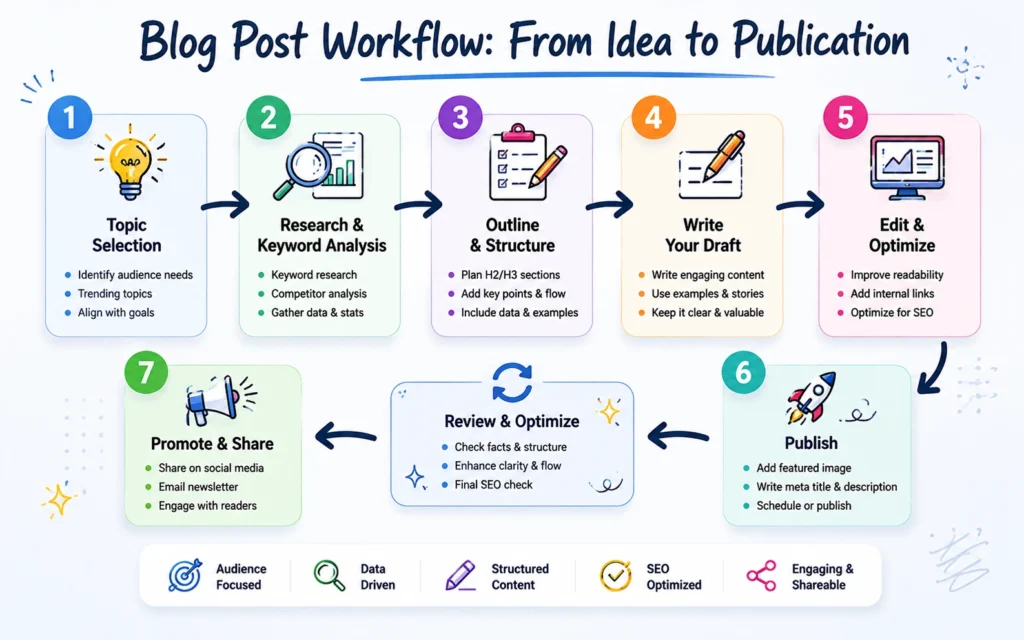
The actual writing process is simpler than most people make it.
The challenge is staying focused on the reader instead of the writer.
Step 1: Write the Introduction Last
Most introductions improve dramatically when written after the article is complete.
You already know the destination.
So it’s easier to create a direct opening.
The introduction only needs three jobs:
- State the problem.
- Explain why it matters.
- Promise the outcome.
Anything beyond that needs a good reason to exist.
Step 2: Make Every Section Earn Its Place
One useful editing question:
“If this section disappeared, would the reader lose something important?”
If the answer is no, remove it.
This sounds harsh.
It works.
Many articles improve after losing 20% of their content.
Readers rarely complain about articles being too concise.
Step 3: Use Examples Earlier Than Feels Necessary
Most writers explain first and demonstrate later.
Switch the order.
Show the example.
Then explain why it works.
Readers understand faster when they see the outcome before the theory.
For example:
Instead of saying:
“Strong openings improve engagement.”
Show:
“Most blog posts fail before anyone reads the second paragraph.”
Then explain why that sentence creates curiosity.
The lesson becomes obvious.
Step 4: Design for Scanning
People rarely read online articles from top to bottom.
They scan.
So write for scanning.
Use:
- Short paragraphs
- Clear subheadings
- Lists
- Visual breaks
- Bold emphasis where necessary
A wall of text signals effort.
Structure signals clarity.
Step 5: Edit in Separate Passes
Trying to fix everything at once slows down the process.
Use separate passes.
Pass one: structure.
Pass two: clarity.
Pass three: grammar.
Pass four: formatting.
This single change reduced my editing time significantly because each review had one objective instead of five competing priorities.
Pro Tips
Most blogging advice focuses on writing.
The bigger gains often come from packaging and distribution.
Write Titles Before You Write Paragraphs
The title determines whether the article gets a chance.
The article determines whether it deserves that chance.
Those are different jobs.
Treat title writing as a separate skill.
Spend time on it.
Stop Chasing Word Count
A 1,200-word article that solves a problem beats a 3,000-word article filled with repetition.
Length should be the result of depth.
Not a target.
One of the most expensive mistakes creators make is assuming longer automatically means better.
It doesn’t.
It often means slower.
Build Around One Core Idea
Many blog posts contain five competing messages.
Readers remember none of them.
Choose one.
Everything else should support it.
The article becomes easier to read, easier to share, and easier to recall later.
Publish on a Schedule You Can Sustain
A weekly article published consistently for six months usually outperforms ambitious publishing plans that collapse after three weeks.
The workflow matters more than the burst.
That’s especially true for blogging.
Because search rewards accumulation.
Not enthusiasm.
The Trade-Off Most Creators Ignore
Fast publishing increases output.
Research-heavy publishing increases depth.
You rarely maximize both.
Choose intentionally.
If you’re building authority in a competitive niche, depth often wins.
If you’re testing audience demand, speed often wins.
The mistake is pretending there isn’t a trade-off.
Related Resources
Good blog writing doesn’t exist in isolation.
It connects to topic research, SEO strategy, content planning, and distribution.
Frequently Asked Questions About How to Write a Blog Post
How long should a blog post be?
Long enough to solve the reader’s problem completely. For some topics that’s 800 words. For others it’s 3,000. Depth matters more than arbitrary word-count targets.
What’s the best blog post structure?
A practical structure is problem, explanation, solution, examples, mistakes, and next step. It keeps readers moving forward and reduces unnecessary tangents.
How often should I publish blog posts?
Choose a schedule you can maintain for at least six months. Consistent publishing generally creates better long-term results than short periods of intense activity.
Should I write for SEO first or readers first?
Start with reader intent. Then optimize the structure and language for search. Articles written only for keywords often struggle to keep attention.
What makes people share blog posts?
People share articles that help them look informed, solve a problem, or explain something clearly to others. Utility creates sharing more often than clever writing.
Continue Exploring
- Blogging Category Hub: Find additional blogging systems, SEO workflows, and publishing frameworks.