Relying entirely on platform ad revenue to fund a business is a recipe for sudden financial failure. When you depend solely on algorithmic changes, an overnight adjustments to an RPM (revenue per thousand views) calculation or a sudden platform policy shift can slice your monthly payout in half without warning. Professional digital business models require an intentional architecture built around diversified creator income streams.
The goal of a modern media operation is to transition traffic away from volatile third-party applications and toward systems you directly own. According to global industry tracking data compiled throughout 2026, full-time independent creators who maintain five or more distinct revenue channels generate roughly 40% more annualized income than those relying on a single monetization pipeline. Diversification is no longer a defensive play to mitigate algorithm risk—it is the baseline framework for sustainable growth.
Platform Dependency Framework:
- Rented Attention: YouTube Ads, TikTok Creator Rewards, Instagram Subscriptions
- Owned Assets: Email Newsletters, Private Communities, Custom Software
- Monetization Match: High-traffic pools fuel low-friction digital sales funnels
This structural shift requires treating your creative output like a media holding company rather than an online portfolio. By systematically deploying performance-based relationships, digital product lines, and recurring community frameworks, you can construct an ecosystem where every piece of published media feeds a predictable financial outcome. Here is exactly how to assemble that system from scratch.
Step-by-Step Guide: Building a Resilient Revenue Stack
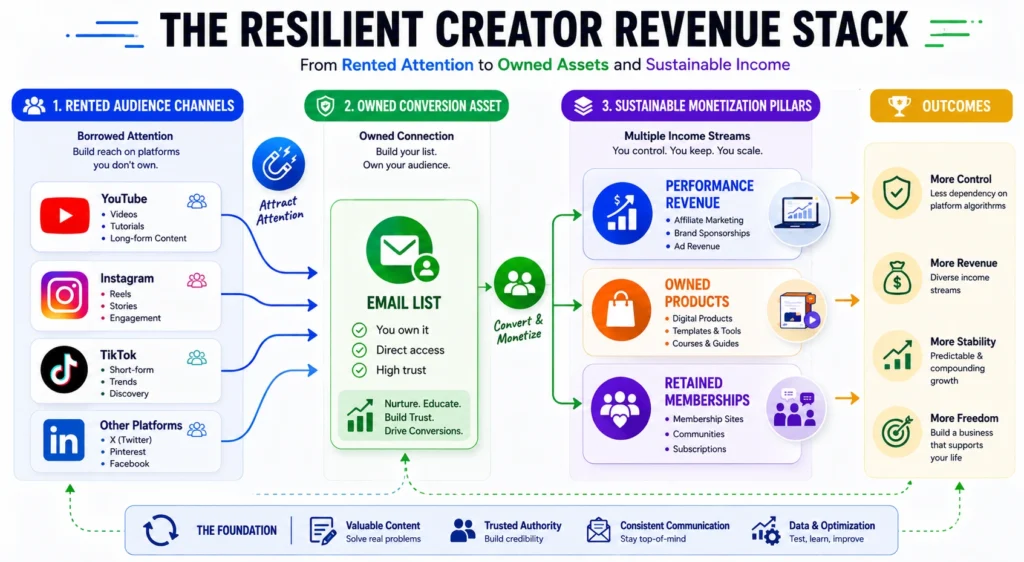
Building a reliable ecosystem of creator income streams 2026 demands an orderly sequence. Attempting to build an e-commerce storefront, launch an online community, and cold-pitch corporate sponsorships in the same month will fragment your focus and degrade the overall production quality of your channels. Follow this precise three-week implementation framework to scale your business safely.
Step 1: Audit your attention assets and find your true baseline (Days 1–7)
Analyze your channel dashboard analytics to identify your highest-performing evergreen content pieces. Calculate your exact direct conversion metric—the ratio of social views to owned email subscribers. If you are currently keeping your entire audience inside a third-party app ecosystem, build a plain, fast-loading landing page dedicated to capturing email addresses. Do not launch a paid offer until you can reliably move 2% to 5% of your video or post viewers into an owned communication channel that you completely control.
Step 2: Deploy low-friction performance conversion channels (Days 8–14)
Review your top ten most-viewed historical content pieces and identify every tool, platform, or physical resource you mention naturally. Register for their official, direct affiliate programs instead of joining bloated, low-margin third-party network aggregates. Embed highly contextual tracking links directly into your description boxes and article bodies using clear, non-promotional prose.
Never place a raw link without explaining exactly what the tool unbottlenecks. Write a single sentence stating how much time or money the resource saves your business.
Step 3: Productise your unique workflow insights (Days 15–21)
Design a small, immediately usable digital asset that resolves a highly repeatable point of friction for your primary audience tier. This can be an optimized configuration template, a data tracking spreadsheet, or a tightly edited implementation checklist. Avoid writing sweeping, philosophical informational books that take months to complete. Focus strictly on building a discrete, functional product that an individual can purchase, open, and successfully apply within fifteen minutes of downloading.
Tips & Examples
Successful audience monetization relies on matching your offer layout with the specific intent of your core viewership. Let’s look at three concrete operational models that show how individual operators can leverage their reach into highly predictable, platform-independent business structures.
The Educational Framework: Templates and Training
An engineering creator with an audience of 15,000 highly targeted subscribers avoids relying on volatile video view payouts. Instead, they document their specific hardware development workflow inside a structured dashboard template. By pricing that operational layout at $49 and embedding the links directly inside highly targeted technical tutorials, they achieve predictable, month-over-month digital product sales.
- The Mechanism: High-intent viewers search for a solution to a specific structural layout issue, discover the clear tutorial, and purchase the ready-made file to completely bypass the manual setup phase.
The Community Engine: High-Retention Memberships
A niche business design channel transitions its most engaged followers off social media and into a dedicated private community platform. They offer a $29 monthly tier that includes a recurring live question-and-answer session alongside access to a shared library of technical blueprints.
Membership Unit Economics:
- Active Member Pool: 250 verified operators
- Monthly Payout Tier: $29 per seat
- Gross Monthly Recurring Revenue (MRR): $7,250
- Platform Operational Overheads: ~$150/mo
This recurring community engine creates financial stability, allowing the operator to spend weeks producing deep-dive investigative content without worrying about short-term algorithm view drops.
The Hybrid Model: Performance Assets and Direct Offers
A modern media operation avoids the standard trap of chasing one-off, flat-fee corporate sponsorships that require endless email negotiations. Instead, they utilize a strict hybrid model across their publishing schedule. They mix evergreen, search-driven tutorials containing high-margin affiliate tracking parameters with direct calls to action pointing toward their own digital product catalogs.
This approach ensures that every single view continues to generate compounding value months after the initial upload date, maximizing the long-term return on your production time.
Tools to Use
To run a diversified collection of creator income streams, you need a reliable software stack that minimizes admin work. Avoid using overly complex, enterprise-level tools that demand hours of upkeep. Focus on clean, reliable platforms built for speed, clear data tracking, and fast checkout experiences.
┌────────────────────────────────────────────────────────┐
│             THE CREATOR REVENUE STACK                  │
├───────────────────┬────────────────────────────────────┤
│ TOOL CATEGORY     │ RECOMMENDED PLATFORM SELECTION     │
├───────────────────┼────────────────────────────────────┤
│ Audience Engine   │ ConvertKit (Kit) / Substack        │
│ Digital Products  │ Gumroad / Lemon Squeezy            │
│ Community Hub     │ Circle / Skool                     │
│ Affiliate Engine  │ Rewardful / LTK / Direct Portals   │
└───────────────────┴────────────────────────────────────┘
When selecting your infrastructure, prioritize platforms that offer direct, unedited access to your customer data and billing metrics. Your commerce solutions should integrate smoothly with your email engine through native automations. This ensures that when someone purchases a template or joins a community tier, they are instantly moved to the correct email segment without requiring your daily manual oversight.
Frequently Asked Questions About Creator Income Streams
How many income streams should a beginner creator start with?
Begin with exactly one engine until it generates regular revenue. Trying to build a digital shop, pitch sponsors, and launch a paid newsletter simultaneously splits your attention and compromises content quality, which damages your core traffic.
What percentage of creator earnings comes from brand deals?
Brand partnerships still command 68% to 70% of total economic activity across the wider creator ecosystem. However, relying on them exclusively leaves your monthly operational budget highly vulnerable to sudden corporate marketing spending cuts.
Can you safely build revenue without millions of views?
High volume is only required for low-yielding models like automated platform ad revenue. By selling direct digital products or highly specific group consults, a creator with fewer than 5,000 hyper-focused followers can easily build a sustainable business.
What is the highest-margin monetization channel for small channels?
Digital products like custom configuration files, scripts, and target templates carry near-zero distribution overheads. Once built, they yield over 90% net profit margins, making them far more lucrative for small channels than merchandise or low-CPM ad networks.
How do you transition an audience to a paid tier without backlash?
Frame the paid offer as an entirely separate, high-utility asset rather than a paywall on your existing free work. Continue delivering your standard, high-quality public content, and offer the paid tier exclusively to viewers who want to save time using pre-built assets.
Continue Exploring
- Category Hub Explore the primary content creation catalog to find additional step-by-step systems designed to scale your production throughput and clean up your multi-channel publishing workflows.