YouTube monetization is no longer a single revenue source. That’s the first thing most beginners get wrong.
Many creators still think YouTube income starts and ends with ad revenue. In practice, creators who stay in the game for years usually combine several income streams. Ads help. But sponsorships, affiliate links, memberships, digital products, consulting, and audience-owned assets often produce more predictable income.
One mistake I see repeatedly is creators delaying monetization until they hit a subscriber milestone. That sounds logical. It also leaves money on the table for months. A channel with 800 subscribers can generate revenue if the audience has a specific problem and the creator offers a useful solution.
This guide explains every major YouTube monetization method available in 2026, how each one works, who it fits, and where beginners should focus first.
Overview
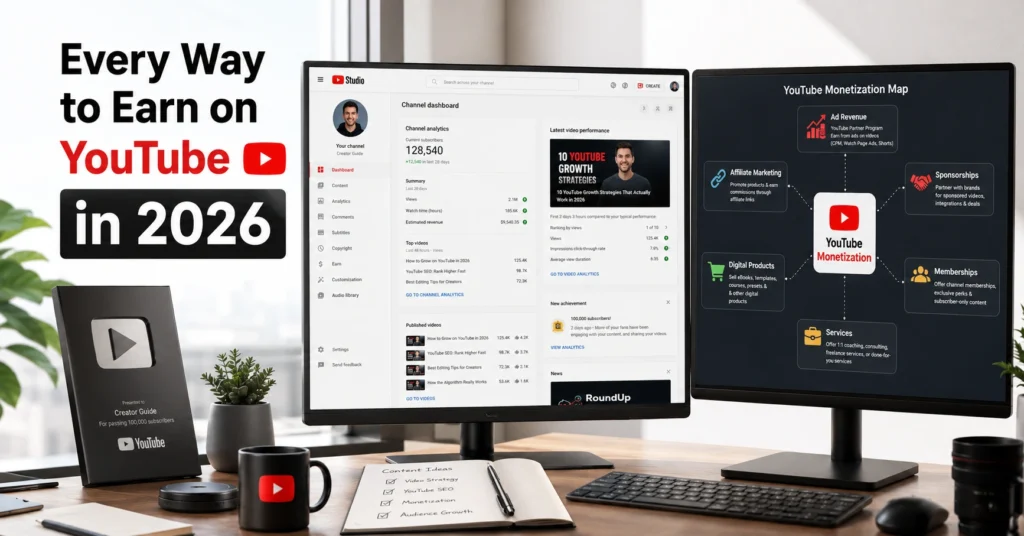
The simplest way to understand youtube monetization is to separate platform income from audience income.
Platform income comes from YouTube itself:
- Ad revenue
- YouTube Premium revenue sharing
- Channel memberships
- Super Chats
- Super Thanks
- Shopping features
Audience income comes from viewers directly or indirectly:
- Affiliate marketing
- Sponsorships
- Digital products
- Online courses
- Consulting
- Coaching
- Freelance services
- Communities
- Software products
The second category matters more than many creators realize.
A channel teaching spreadsheet automation to 5,000 professionals can often earn more than an entertainment channel with 100,000 casual viewers. Audience quality changes the economics.
The common belief is that views create income.
The more accurate version is this:
Relevant viewers create income.
A creator with 20,000 monthly views from business owners often has more monetization options than a creator with 500,000 views from a broad entertainment audience.
That difference becomes important as your channel grows.
Step-by-Step Guide
Step 1: Join the YouTube Partner Program
Most beginners start here.
The YouTube Partner Program (YPP) unlocks YouTube’s native monetization features.
The exact requirements can change over time, so always verify current eligibility rules directly through YouTube Studio.
Once approved, you gain access to revenue-sharing features that can include:
- Video ads
- Premium revenue
- Fan funding features
- Membership tools
- Shopping integrations
Approval is not a business model.
It’s access to business models.
That distinction matters.
Many creators spend a year trying to qualify and then discover they never planned how viewers would generate revenue afterward.
Build both simultaneously.
Step 2: Turn Ad Revenue Into Supplemental Income
Advertising remains the most recognized monetization method.
It is also the most misunderstood.
New creators often calculate income by multiplying views by a random RPM figure found online. The result is usually wrong because revenue depends on factors such as:
- Audience geography
- Viewer demographics
- Topic
- Advertiser demand
- Seasonality
- Watch time
Finance channels and software channels often command higher advertising rates than general entertainment content.
The mechanism is straightforward.
Advertisers pay for access to viewers.
Some viewers are worth more because advertisers can sell higher-value products to them.
Treat ad revenue as a bonus layer, not your entire strategy.
Channels built entirely on ads become vulnerable to algorithm shifts, seasonality, and advertiser demand changes.
Step 3: Add Affiliate Marketing Early
Affiliate marketing is one of the most accessible monetization methods for beginners.
You recommend a product.
Someone purchases through your referral link.
You earn a commission.
Simple.
The real challenge is choosing products that naturally fit the content.
A productivity channel reviewing note-taking software has a natural affiliate opportunity.
A random affiliate link dropped into unrelated content rarely performs.
A workflow that works:
- Create content solving a specific problem.
- Demonstrate the tool.
- Explain where it helps.
- Explain where it doesn’t.
- Include the affiliate link.
The fourth step is usually skipped.
Ironically, honest limitations often increase conversions because viewers trust the recommendation more.
Step 4: Use Sponsorships at the Right Time
Many creators think sponsors arrive after massive growth.
Some do.
Many don’t.
Sponsors care about audience fit.
A channel with 3,000 engaged viewers in a specific industry can attract sponsorship opportunities long before reaching large subscriber numbers.
The practical approach is:
- Build a consistent niche
- Publish regularly
- Demonstrate audience engagement
- Create a simple media kit
- Track channel performance
One sponsorship that fits your audience can outperform months of advertising revenue.
The trade-off is responsibility.
Poor sponsorship decisions damage trust quickly.
Protect audience trust before protecting short-term revenue.
Step 5: Launch Digital Products
Digital products are often the first scalable monetization layer creators fully control.
Examples include:
- Templates
- Checklists
- Spreadsheets
- Notion systems
- Guides
- Mini-courses
- Resource packs
The advantage is obvious.
You build once.
You sell repeatedly.
A creator teaching budgeting can sell budgeting templates.
A creator teaching video editing can sell editing workflows.
A creator teaching YouTube growth can sell thumbnail frameworks.
The product should remove friction that viewers already experience.
Don’t invent products.
Listen to recurring questions.
The product usually reveals itself.
Step 6: Offer Services Before Courses
This is one of the strongest recommendations for beginners.
Sell services before building courses.
Courses take time.
Services generate feedback.
When viewers pay for direct help, they reveal exactly what they struggle with.
That information becomes market research.
I’ve seen creators spend months building a course nobody wanted because they skipped this step.
Meanwhile, creators offering consulting calls learned the audience’s needs within a few weeks.
Services are not always scalable.
But they are excellent validation tools.
Step 7: Build Recurring Revenue
One-time income is useful.
Recurring income changes planning.
Examples include:
- Membership communities
- Paid newsletters
- Coaching programs
- Subscription resources
- Ongoing support groups
Predictable revenue creates stability.
A creator earning $2,000 monthly from recurring subscriptions often has more flexibility than a creator earning $4,000 sporadically from brand deals.
Consistency matters.
Not because consistency is motivational advice.
Because recurring revenue reduces uncertainty.
Tips & Examples
The Small-Channel Monetization Example
Imagine a channel teaching Excel automation.
The creator has:
- 2,500 subscribers
- 8,000 monthly views
Many people would classify that channel as “too small.”
Maybe.
Maybe not.
Possible monetization stack:
- Ad revenue
- Spreadsheet template sales
- Affiliate software links
- Consulting sessions
- Team training workshops
The audience is highly targeted.
That changes everything.
A small audience with a clear problem often monetizes faster than a larger audience with unclear intent.
The Packaging Mistake That Costs Revenue
Many creators focus entirely on content quality.
Content quality matters.
Packaging decides whether anyone sees it.
Packaging includes:
- Titles
- Thumbnails
- Topic selection
- Positioning
A lesson that took six hours to create can fail because the title doesn’t communicate value.
I’ve watched creators spend forty minutes designing a thumbnail and four minutes writing the title.
The ratio should often be reversed.
Titles create curiosity.
Thumbnails reinforce the promise.
The video fulfills it.
That’s the sequence.
Why Most Monetization Problems Start Earlier Than People Think
A monetization issue is often a positioning issue.
If viewers arrive for random topics, monetization becomes difficult.
If viewers arrive for a specific problem, monetization becomes easier.
Examples:
Broad: Productivity
Specific: Productivity systems for freelance designers
Broad: Technology
Specific: AI workflows for accountants
Specific audiences create clearer offers.
Clear offers create stronger monetization.
The Revenue Diversification Rule
Never rely on a single monetization method.
Not because disaster is guaranteed.
Because concentration increases risk.
A creator relying entirely on:
- Ad revenue
- Sponsorships
- Affiliate programs
can experience sudden income changes outside their control.
Diversification reduces that exposure.
A healthy creator business often combines several revenue streams.
Not ten.
Usually three to five strong ones.
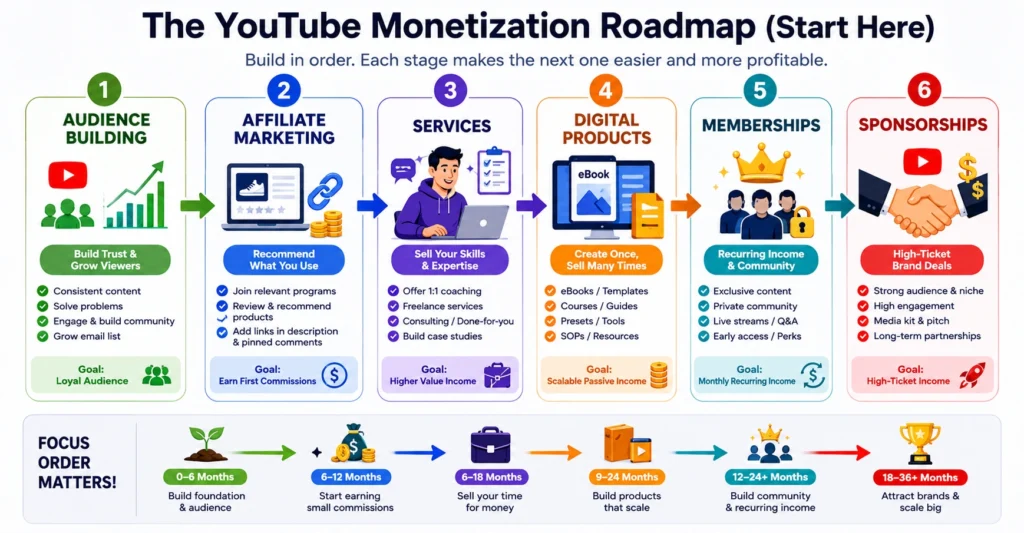
A Practical Monetization Sequence for Beginners
If starting from zero today, this sequence is difficult to beat:
Stage 1:
- Build audience
- Learn packaging
- Publish consistently
Stage 2:
- Add affiliate links
- Validate audience demand
Stage 3:
- Offer services
- Gather customer feedback
Stage 4:
- Create digital products
Stage 5:
- Add memberships or subscriptions
Stage 6:
- Pursue sponsorships selectively
The order matters.
Many beginners attempt Stage 6 before completing Stage 2.
That usually slows progress.
Tools to Use
YouTube Studio
This should become your primary decision dashboard.
Monitor:
- Click-through rate
- Audience retention
- Watch time
- Returning viewers
- Revenue metrics
Most growth decisions become clearer when these numbers are reviewed regularly.
TubeBuddy
Useful for:
- Topic research
- Optimization workflows
- Metadata assistance
The biggest benefit is speed.
Not magic.
No tool replaces understanding what viewers actually want.
VidIQ
Helpful for:
- Keyword discovery
- Competitor analysis
- Content planning
Use it to identify opportunities.
Don’t use it as a substitute for audience research.
Those are different activities.
Notion
Useful for content systems.
Store:
- Video ideas
- Research notes
- Production checklists
- Sponsorship information
- Monetization plans
Simple systems usually survive longer than complicated ones.
Canva
Helpful for thumbnail creation.
Beginners often overcomplicate design.
Strong thumbnails communicate a single idea quickly.
Clarity beats decoration.
Almost every time.
Frequently Asked Questions About YouTube Monetization
How much money can a beginner earn from YouTube monetization?
There is no fixed number. Some channels earn nothing for months. Others generate revenue quickly through affiliates, services, or products before ad revenue becomes meaningful. The audience, niche, and monetization method matter more than subscriber count alone.
Is ad revenue the best way to make money on YouTube?
Usually not. Ad revenue helps, but many creators eventually earn more from sponsorships, affiliate marketing, products, services, or memberships. Ads are often one layer of a broader monetization system.
Can I monetize a channel with fewer than 1,000 subscribers?
Yes. Affiliate marketing, consulting, coaching, freelance services, and digital products can generate revenue before traditional YouTube monetization thresholds are reached. The key is solving a specific audience problem.
Which niche earns the most money on YouTube?
There is no universal winner. Business, finance, software, marketing, and professional skill channels often have strong monetization potential because viewers are connected to high-value products and services.
What is the biggest monetization mistake beginners make?
Waiting too long to learn what their audience will pay for. Many creators focus entirely on views and subscribers while ignoring audience needs. Revenue usually improves when creators understand the problems viewers want solved.
Continue Exploring
- video ideas that actually get clicked: Topic selection influences monetization because revenue starts with audience demand.
- best YouTube tools for creators: The right tools reduce production friction and help you spend more time publishing.