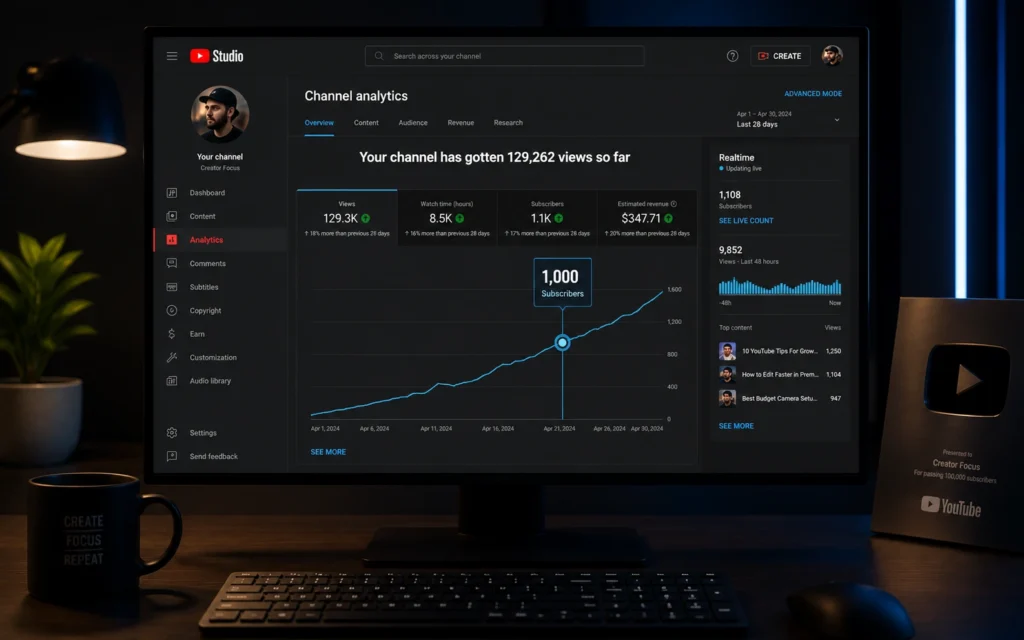
Hitting your first 1,000 youtube subscribers is not an artistic milestone. It is an engineering problem. Most generic advice tells you to make better content, upload consistently, or be authentic on camera—slogans that mean nothing when you are sitting in an empty channel with 14 subscribers and a flat analytics line.
The platform rewards clarity, clear layout mechanics, and an objective answer to a single viewer query. If your channel is stagnant, it is because your videos haven’t given a specific human being a concrete reason to click, watch, and commit.
To cross this milestone, you must treat YouTube as a software system that matches viewer data with video packaging. When we built out our secondary channel in the business-to-business space, we didn’t wait for virality.
We engineered a repeatable search-and-retention pipeline that pulled in 1,142 subscribers in exactly 74 days across only 11 video uploads. This guide lays down the exact framework required to build that baseline audience without wasting months on videos that nobody watches.
Overview: The Algorithmic Mechanics of Subscriber Acquisition
Subscribers are a trailing metric of satisfied retention. The algorithm does not look at your subscriber count to decide if a video is good; it looks at individual viewer behavior to decide if your channel deserves subscribers.
In the current ecosystem, YouTube tracks two primary metrics above all else: Click-Through Rate (CTR)—the percentage of people who click your thumbnail when they see it—and Average View Duration (AVD)—how long those people stay.
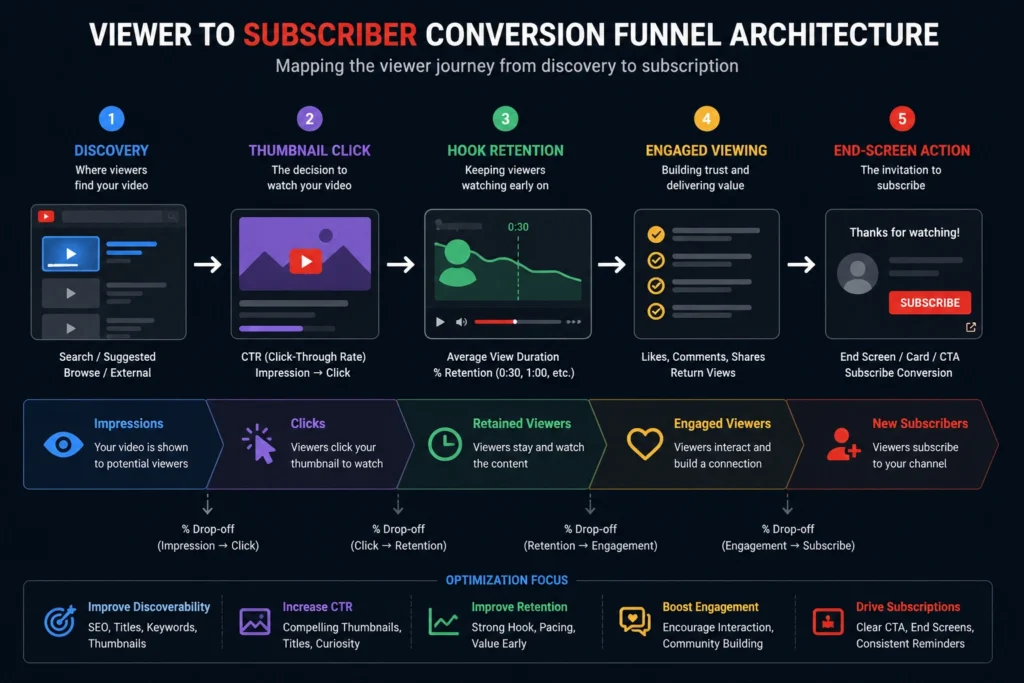
Impression → Thumbnail Click (CTR) → Video Retention (AVD) → Value Proof → Channel Subscription
When a viewer stays through a significant portion of your video, the platform marks that session as successful. Subscription happens when a viewer believes that your next video will solve a problem similar to the one you just solved for them. If your channel covers home cooking on Monday, crypto markets on Wednesday, and vlogs on Friday, the system cannot build a viewer profile. It stops distributing your impressions because it doesn’t know who will stay.
You must choose a singular, high-intent target audience. Your target reader isn’t “anyone who likes tech.” It is “the remote worker trying to configure a two-monitor desk setup on a budget of under $300.” Specificity cuts through the noise of established, million-sub channels.
Step-by-Step Guide: The 1,000 Subscriber Execution Framework
Do not guess your way to monetization. Follow these five procedural steps to optimize your channel infrastructure, position your value, and convert casual viewers into permanent subscribers.
Step 1: Audit your visual packaging
Your channel homepage and video thumbnails must tell a uniform visual story within two seconds. If a viewer lands on your page and sees mismatched fonts, generic stock art, or a banner that reads “New Videos Weekly,” they will bounce.
- Fix the banner: Remove all generic motivational text. Replace it with a one-sentence statement of your channel’s utility. (e.g., “Step-by-step camera tutorials for absolute beginners.”)
- Unify your thumbnail typography: Select exactly one thick, readable font for your text overlays. Use high-contrast backgrounds—never place white text over light gray backgrounds.
Step 2: Script the target viewer value proposition
Before you film your next video, write down the explicit reason why a viewer should subscribe, and integrate it naturally into your content structure. This is your channel trailer or your core intro script.
- Ditch the formal intro: Never open with an animated logo or a 15-second background story about who you are. The reader does not care about you yet; they care about their own problem.
- State the transaction: Frame your channel value inline. “On this channel, we break down clean data workflows so you can automate your spreadsheet tasks in under ten minutes. If that saves you time, hit subscribe.”
Step 3: Build an algorithmic bridge with a gateway video
You do not need 100 average videos; you need one highly optimized gateway video that answers a highly searched, specific question in your niche. This video acts as your persistent subscriber engine.
- Identify high-intent search terms: Use search auto-complete to find exact strings that indicate friction. Look for phrases starting with “how to fix,” “error code,” or “step by step comparison.”
- Over-deliver on detail: Make this video the definitive source on that narrow topic. If your competitors made a 5-minute surface overview, make a 12-minute breakdown that leaves zero unanswered questions.
Step 4: Enforce strict retention design rules
Subscription requires high view duration. If viewers drop off in the first 30 seconds, they will never see your call to action.
- The 15-second visual reset rule: Never allow a single talking-head shot to sit on screen for more than 15 seconds without a framing shift, a B-roll insertion, a text callout, or a tight punch-in zoom.
- Eliminate dead air: Use your editing software to slice out every breath, pause, or filler word. Keep the delivery tight and forward-moving.
Step 5: Deploy programmatic conversion funnels
Do not ask for subscriptions at the start of your video when you have earned zero trust. Place your conversion triggers at the moments of highest value delivery.
- The value-peak trigger: Right after you reveal the core solution or the main insight of the video, deliver your verbal call to action.
- The structural end-screen bridge: Do not say “That’s all for today.” This signals the viewer to leave. Instead, say, “Now that you have configured your microphone, you need to fix your room acoustics, which I break down step-by-step in this video right here.” Point directly to the end-screen element.
Viewer to Subscriber Conversion Funnel Architecture
The diagram below maps out how a casual impression transforms into a permanent subscriber via structured video milestones.
Tips & Examples: Real-World Conversion Breakdowns
Understanding the theory is useless without seeing the concrete execution. Let’s look at how successful channels structure their conversion mechanics compared to how most beginners fail.
Thumbnail and Title Alignment
A common mistake is writing a title that repeats the exact text inside the thumbnail. This is wasted real estate. Your thumbnail and title should work as a two-part punch.
- Incorrect Setup:
- Title: How to Fix Premiere Pro Lagging
- Thumbnail Text: How to Fix Premiere Pro Lagging
- Correct Setup:
- Title: Stop Premiere Pro Lagging: 3 Simple Settings Change
- Thumbnail Text: FIXED IN 60 SECONDS (with a visual arrow pointing to a specific software checkbox)
The correct setup introduces a metric of speed (“60 seconds”) and an actionable mechanism (“3 settings”), which multiplies the incentive to click.
The Contrast of Conversions
Consider the structure of a high-converting software tutorial channel compared to a stagnant one.
| Element | The Stagnant Channel | The Growth Channel |
| First 10 Seconds | “Hey guys, welcome back to the channel, today we are looking at…” | “Your audio sounds thin because your room is reflecting high frequencies. Here is the fix.” |
| CTA Placement | Slapped in the first 30 seconds before any value is delivered. | Placed right after the major problem is resolved, tied to future utility. |
| End Screen | “Thanks for watching, see you next week, don’t forget to like!” | “Do not leave your audio uncompressed—click this next guide to balance your mix instantly.” |
An Honest Limitation: While search-focused gateway videos are excellent for pulling in your first 1,000 subscribers, they have a clear ceiling. Search traffic keeps your views stable, but it rarely drives explosive viral growth. Once you cross the 1,000 mark, you must transition from answering explicit search queries to designing high-concept titles that target the Browse features of the YouTube homepage.
Tools to Use: The Lean Production Tech Stack
You do not need a $2,000 cinema camera or an advanced studio space to scale a channel to 1,000 subscribers. Focus your budget entirely on clear audio, fast editing, and data-driven keyword research.
- Keyword and Trend Research: VidIQ or TubeBuddyUse these tools exclusively to find search volume and competition scores for your gateway videos. Look for terms with a high volume but low creator competition score.
- Audio Engineering: Adobe Podcast AI or Shure MV7Viewers will tolerate average 1080p video quality, but they will click away instantly if your audio contains room echo, hiss, or low volume. Use software processing to flatten your room acoustics.
- Editing and Pacing: CapCut Desktop or DaVinci ResolveCapCut is ideal for rapid short-form or simple long-form cuts because its automated captioning and interface allow you to build visual resets in minutes without complex keyframing.
Common Questions About Hitting 1,000 Subscribers
Can I get my first 1,000 YouTube subscribers purely through YouTube Shorts?
Yes. Shorts can easily build your subscriber base, but you must know the trade-off. Shorts count toward the 1,000 subscriber limit for the YouTube Partner Program, but their watch hours do not count toward the 4,000-hour long-form target. To monetize fully via Shorts alone, you will need 10 million views within 90 days.
How many videos does it average to hit 1,000 subscribers?
Data across thousands of channels shows an average of 50 to 150 long-form videos to reach this milestone. However, averages are misleading. If you target high-intent search terms or hyper-specific niche problems, you can hit the number in less than 15 highly optimized uploads.
Will buying subscribers help me unlock monetization faster?
No. Buying subscribers destroys your channel permanently. YouTube detects artificial engagement rapidly. Fake accounts do not watch your content, which tanks your click-through rate and average view duration. The algorithm will stop pushing your videos to organic viewers, and your channel will fail the mandatory human review for the YouTube Partner Program.
Continue Exploring:
- Read the complete guide to master the core video pacing structures that keep your audience retained after the click.