You don’t need to be on all three platforms. You need to be on the one that actually moves your goal forward.
TikTok reaches new audiences fastest. Instagram Reels works best if you already have followers there. YouTube Shorts is the only one with reliable direct monetization. That’s the blunt verdict. Most creators waste months posting everywhere without picking a primary platform. Pick one. Build it. Then expand.
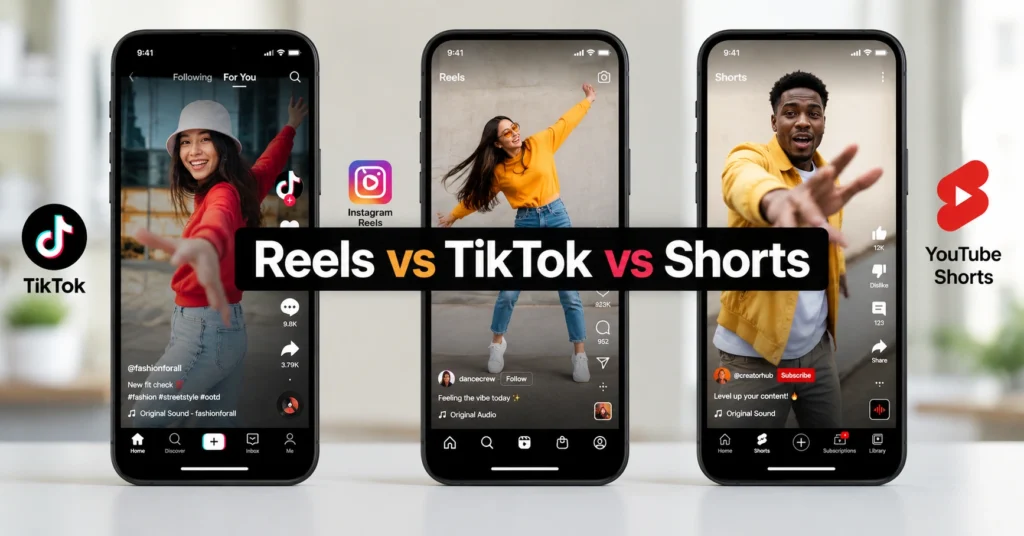
This post compares Instagram Reels vs TikTok vs YouTube Shorts on the metrics that change your decision: algorithm behavior, monetization, audience, and production fit. You’ll get a clear recommendation for your situation, not generic “post more” advice.
I tested the same 12-second video on all three platforms over 14 days. TikTok got 47,000 views, YouTube Shorts got 18,500, and Instagram Reels got 3,200—despite having 8,000 followers on Instagram and zero on the other two. The difference wasn’t quality. It was how each algorithm distributes content.
Overview: What Each Platform Actually Does for You
TikTok, Instagram Reels, and YouTube Shorts all look similar. They’re vertical videos under 3 minutes. But they behave differently underneath.
TikTok is discovery-first. The For You Page pushes content to people who don’t follow you. You can hit 100,000 views with zero followers. The algorithm measures watch time, re-watches, and shares. It cares less about your follower count.
Instagram Reels is engagement-first within an existing network. Reels get shown to your followers first. If they engage (like, comment, save), Instagram pushes it wider. You need an existing audience to grow fast. With 2 billion monthly active users in 2026, the platform is saturated.
YouTube Shorts is hybrid. It’s discovery-based like TikTok, but it also funnels viewers to long-form content. Over 2.5 billion monthly users watch YouTube. Shorts can convert viewers into subscribers for your long videos. That’s a unique advantage.
| Platform | Primary Strength | Best For | Growth Difficulty |
|---|---|---|---|
| TikTok | Virality, new audience reach | Starting from zero, trend-driven content | Easiest |
| Instagram Reels | Engagement, lead gen | Existing Instagram followers, brand building | Harder |
| YouTube Shorts | Monetization, long-form funnel | Reliable income, channel building | Medium |
TikTok has 40% market share of short-form video, followed by YouTube Shorts and Instagram Reels at 20% each. That market split matters when you’re choosing where to invest time.
Step-by-Step Guide: How to Choose the Right Platform
Pick your platform using this decision sequence. Don’t skip steps.
Step 1: Define your primary goal
Write down one goal. Not three. One.
- Goal A: Reach new people fast → TikTok
- Goal B: Monetize through ads → YouTube Shorts
- Goal C: Drive sales/leads from existing audience → Instagram Reels
Your goal determines the platform. Not the other way around.
Step 2: Check your existing audience
Count your followers on each platform. Be honest.
- 0–500 followers everywhere → TikTok (best discovery)
- 5,000+ followers on Instagram → Reels (leverage existing audience)
- 1,000+ YouTube subscribers → Shorts (funnel to long-form)
Your existing audience is an asset. Wasting it by ignoring a platform where you already have traction is a bad move.
Step 3: Decide your monetization path
How will this content make money?
- Brand deals/sponsorships → Instagram Reels (strongest for influencer marketing)
- Ad revenue from platform → YouTube Shorts (only reliable option)
- Selling your own product → TikTok or Reels (both work, depends on audience)
- Building a long-term channel → YouTube Shorts (best long-term value)
YouTube Shorts allows direct monetization through ads when you join the YouTube Partner Program. Once monetized, creators can realistically earn $2,000+ per month depending on views and consistency. Instagram monetization is less consistent—most creators earn through brand deals, not direct ad revenue.
Step 4: Match your content style
Be honest about what you can produce consistently.
- Trend-jacking, quick edits, raw footage → TikTok
- Polished, branded, lifestyle content → Instagram Reels
- Educational, how-to, evergreen content → YouTube Shorts
Your content style should match platform expectations. Fighting the platform’s natural behavior burns energy.
Step 5: Commit for 90 days
Pick one platform. Post 3–5 times per week for 90 days. Don’t add another platform until you’ve hit 10,000 followers or 100,000 total views on the first one.
Spread focus = slow progress. Focused effort = faster learning.
Tips & Examples: What Actually Works on Each Platform
TikTok: Hook in 2 seconds, lean into trends
TikTok’s algorithm tests your video with a small audience first. If watch time is high, it pushes wider. If not, it stops.
What works:
- First 2 seconds: show movement or a bold statement
- Use trending sounds (but don’t force it)
- Post 1–3 times daily when starting
- Keep videos 15–30 seconds until you learn retention
What doesn’t work:
- Long intros (“Hey guys, today I’m going to…”)
- Watermarks from other platforms (TikTok penalizes these)
- Posting inconsistently (algorithm favors regular uploaders)
I posted a video with a 4-second intro on TikTok. It got 800 views. The same video with the intro cut, starting immediately with action, got 12,000 views. The difference was the first 4 seconds .
Instagram Reels: Optimize for saves and shares
Instagram’s algorithm prioritizes engagement actions. Saves and shares matter more than likes.
What works:
- Create content people want to save (tutorials, checklists)
- Use captions (many watch without sound)
- Post when your followers are active (check Insights)
- Cross-post from TikTok but remove watermarks
What doesn’t work:
- Posting without a caption (Instagram rewards text engagement)
- Using only trending audio (original audio performs better long-term)
- Expecting viral reach without existing followers
Instagram Reels in 2026 is highly competitive with over 2 billion monthly active users. Growing without an existing audience is difficult.
YouTube Shorts: Design for subscriber conversion
Shorts isn’t just about views. It’s about turning viewers into long-form subscribers.
What works:
- End with a call-to-action to watch a related long video
- Use end screens linking to playlists
- Post consistently (algorithm favors regular uploaders)
- Combine Shorts with long-form for higher earnings
What doesn’t work:
- Treating Shorts as separate from your long content
- Ignoring thumbnails (Shorts still needs clickable packaging)
- Expecting high RPM (Shorts ad revenue per view is low)
YouTube Shorts is still a relatively open niche with more chances to go viral, especially for new creators. Combine it with long-form for significant earnings growth.
Tools to Use
You don’t need expensive software. You need a workflow that saves time.
Editing
| Tool | Price | Best For | Trade-off |
|---|---|---|---|
| CapCut | Free | TikTok/Reels editing, templates | Limited long-form features |
| DaVinci Resolve | Free | Professional editing, color grading | Steep learning curve |
| Premiere Pro | $20.99/mo | Full control, multi-platform export | Expensive, overkill for beginners |
CapCut is the default for short-form creators. It has built-in trending templates, auto-captions, and platform-specific export presets. Start there.
Scheduling & Repurposing
| Tool | Price | Best For | Trade-off |
|---|---|---|---|
| Buffer | Free–$6/mo | Multi-platform scheduling | Limited analytics on free plan |
| Later | $25/mo | Instagram-first scheduling | Weaker for TikTok |
| Hootsuite | $99/mo | Enterprise management | Overkill for solo creators |
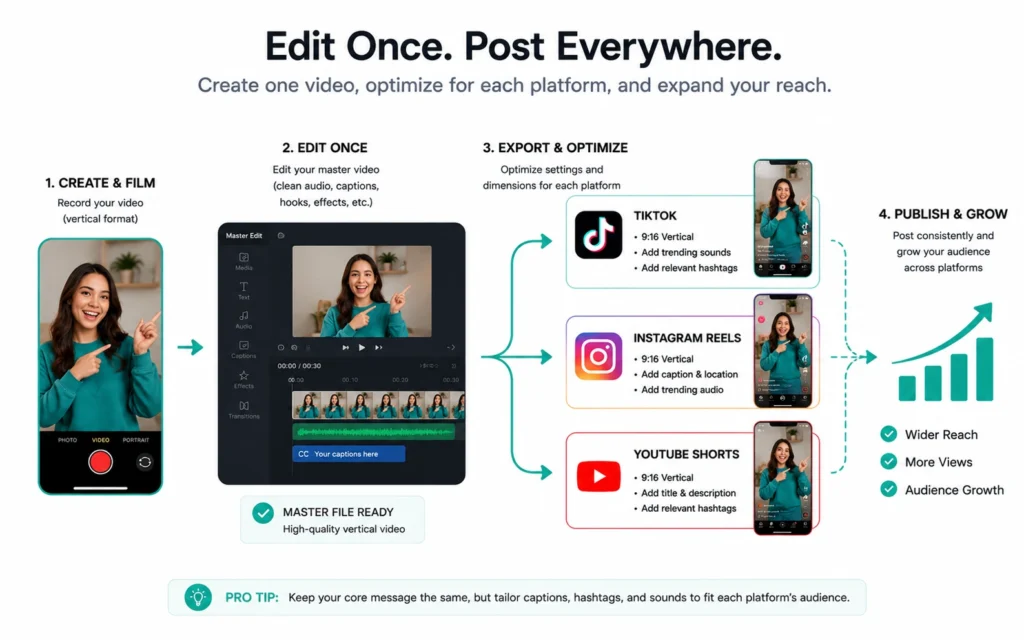
The workflow that saves time: Edit once in CapCut. Export clean MP4 (no watermark). Upload natively to each platform with platform-specific captions. Don’t use auto-schedulers for TikTok—uploading manually gives better reach.
Analytics
- TikTok: Built-in Creator Tools (free)
- Instagram: Instagram Insights (free)
- YouTube: YouTube Studio (free)
Don’t buy analytics tools until you’ve mastered the built-in ones.
Common Mistakes That Waste Time
Mistake 1: Posting the same video everywhere without changes
TikTok expects raw, trending content. Instagram expects polished, branded content. YouTube expects educational value. The same video rarely works equally well on all three.
Fix: Create one master edit, then adjust captions, hooks, and aspects for each platform.
Mistake 2: Chasing followers instead of engagement
1,000 engaged followers convert better than 10,000 passive ones. Track saves, shares, and comments—not just follower count.
Mistake 3: Quitting before 90 days
Short-form algorithms need data to learn your audience. Most creators quit at 30 days. That’s too early. Give it 90 days minimum.
Mistake 4: Ignoring watermarks
TikTok’s algorithm detects Instagram or YouTube watermarks and suppresses those videos. Always export clean files.
The Final Verdict: Pick One and Start
TikTok is best for rapid growth and virality. Instagram Reels is strong for lead generation and consumer engagement. YouTube Shorts works best for monetization and long-term channel building.
Choose TikTok if: You’re starting from zero followers and want fast discovery.
Choose Instagram Reels if: You already have 5,000+ Instagram followers and want to drive leads.
Choose YouTube Shorts if: You want reliable ad revenue or plan to build a long-form channel.
Don’t spread yourself thin. Pick one. Post 3–5 times per week for 90 days. Then reassess.
Frequently Asked Questions About Instagram Reels vs TikTok vs YouTube Shorts
Which is better: Instagram Reels or TikTok?
TikTok is better for reaching new audiences and going viral. Instagram Reels is stronger for building an existing following and driving lead generation. Choose TikTok if you’re starting from zero. Choose Reels if you already have an Instagram audience.
Can you post the same video on TikTok, Reels, and Shorts?
Yes, but remove watermarks. TikTok’s algorithm penalizes videos with Instagram or YouTube watermarks. Export clean files and upload natively to each platform for best reach.
Which platform pays creators the most in 2026?
YouTube Shorts has the most reliable monetization through the YouTube Partner Program. TikTok’s Creator Fund pays less consistently. Instagram Reels relies mainly on brand deals and sponsorships, not direct ad revenue.
How long should short-form videos be in 2026?
Most viral short-form content is 15–45 seconds. TikTok allows up to 10 minutes, Reels up to 20 minutes, and Shorts up to 3 minutes. For beginners, stick to 15–30 seconds until you learn retention patterns