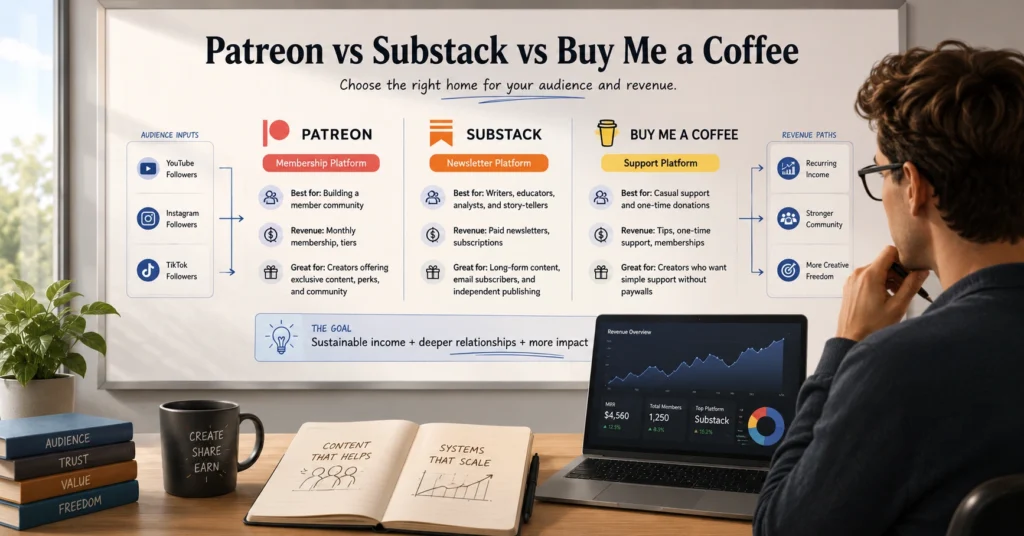
Not because the platform is bad. Because each platform assumes a different business model, and most beginners don’t notice that until they’ve already built content around it.
I’ve seen creators spend six months growing a newsletter before realising they actually wanted a membership community. I’ve also seen creators launch a Patreon only to discover that their audience wanted occasional support rather than a monthly commitment.
That’s the real decision behind patreon vs substack. You’re not choosing software. You’re choosing how money moves from your audience to your work.
And that decision affects what content you make, how often you publish, what you sell, and how much effort goes into maintaining the system.
This guide breaks down Patreon, Substack, and Buy Me a Coffee through the lens that matters most: practical creator workflows.
Overview
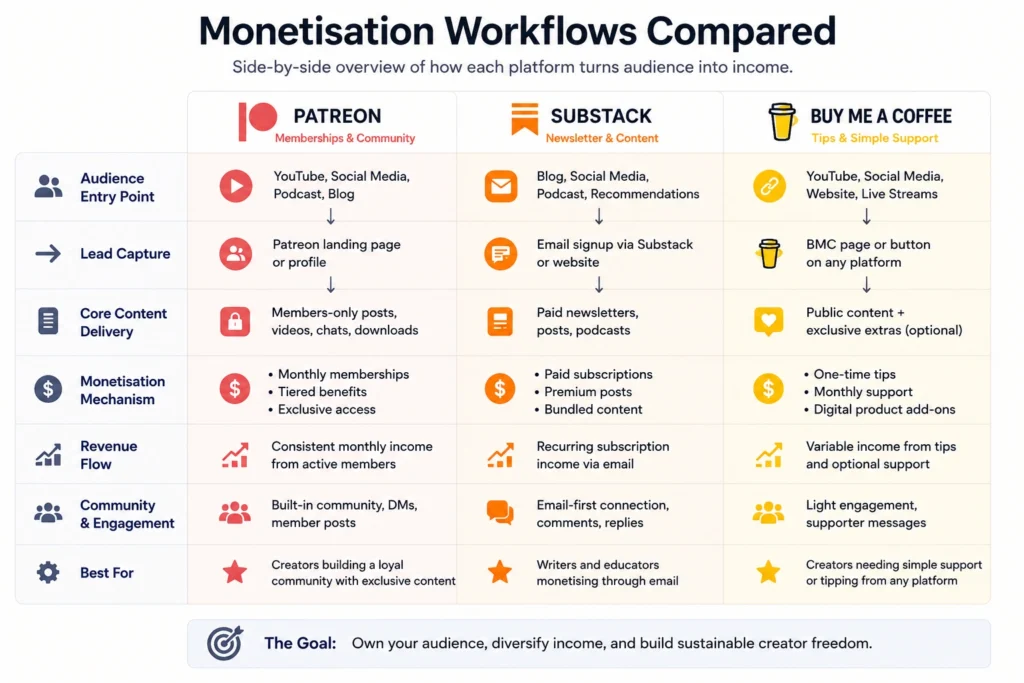
Patreon, Substack, and Buy Me a Coffee solve different monetisation problems.
Many comparison articles treat them as interchangeable. They aren’t.
Here’s the shortest version:
| Platform | Best For | Revenue Model |
|---|---|---|
| Patreon | Membership businesses | Recurring subscriptions |
| Substack | Writers and newsletter creators | Paid newsletters |
| Buy Me a Coffee | Casual audience support | One-time payments and simple memberships |
The mistake beginners make is evaluating features before evaluating business models.
A creator publishing weekly essays has different needs than a YouTuber releasing two videos per month. A podcast host has different needs than a designer selling templates.
Patreon assumes your audience wants ongoing membership benefits.
Substack assumes your content itself is the product.
Buy Me a Coffee assumes your audience wants a lightweight way to support your work.
That’s why two creators with identical audience sizes can see completely different results on each platform.
Here’s a practical example.
A newsletter writer with 5,000 engaged subscribers may generate more revenue on Substack because the paid newsletter sits directly inside the reading experience.
A gaming creator with 5,000 YouTube subscribers often performs better on Patreon because exclusive content, Discord access, and membership perks fit the audience expectation.
A hobby blogger with occasional readers might earn more through Buy Me a Coffee because asking for a small contribution creates less friction than pitching a recurring subscription.
The platform matters less than the audience behavior.
And audience behavior is where the decision starts.
Step-by-Step Guide
The easiest way to choose between Patreon, Substack, and Buy Me a Coffee is to answer four questions.
Step 1: Identify What People Actually Consume
Start with the content itself.
Substack works best when readers consume your work through email or long-form writing.
Patreon works best when people follow a creator rather than a specific piece of content.
Buy Me a Coffee works best when support is occasional and low commitment.
If most engagement happens through written content, Substack deserves serious consideration.
If people follow you because they want ongoing access, Patreon usually fits better.
If your audience arrives through search, social shares, or occasional visits, Buy Me a Coffee often creates the least resistance.
Step 2: Decide Whether Content or Access Is the Product
This distinction changes everything.
On Substack, content is usually the product.
People pay because they want premium articles, newsletters, research, commentary, or analysis.
On Patreon, access is usually the product.
People pay for community access, bonus episodes, behind-the-scenes updates, live sessions, or direct interaction.
The difference sounds small. It isn’t.
One requires consistently publishing valuable content.
The other requires maintaining an ongoing relationship.
Many creators discover they enjoy one and dislike the other.
Step 3: Measure Your Publishing Capacity
A platform should match your production reality.
This is where many monetisation plans fail.
In 2025, I reviewed dozens of creator funnels that looked impressive on paper but collapsed because the creator couldn’t sustain the publishing schedule required to justify subscriptions.
Substack rewards consistency.
Patreon rewards ongoing engagement.
Buy Me a Coffee rewards visibility.
If you can reliably produce one strong newsletter every week, Substack becomes attractive.
If you enjoy building communities and maintaining member benefits, Patreon becomes attractive.
If your content schedule fluctuates, Buy Me a Coffee can reduce pressure.
That trade-off rarely gets enough attention.
Step 4: Calculate Revenue Complexity
Beginners often assume more features equal more revenue.
Usually the opposite happens.
A simple monetisation system maintained for two years often outperforms a complex system abandoned after three months.
Substack offers one of the simplest paths:
Create content → grow newsletter → convert readers.
Patreon adds operational complexity:
Create content → maintain memberships → manage rewards → support community.
Buy Me a Coffee stays lightweight:
Create content → add support link → receive contributions.
More complexity can produce more revenue.
But only if you’ll maintain it.
Tips & Examples
Most creators don’t fail because they chose the wrong platform.
They fail because they copied someone else’s monetisation model.
That’s a different problem.
Example 1: Newsletter-First Creator
A finance writer publishes detailed weekly breakdowns.
The audience arrives through search, referrals, and email subscriptions.
Substack fits naturally because the newsletter is already the core product.
Adding Patreon here creates extra work without solving a real problem.
The membership layer becomes a distraction.
Example 2: YouTube Creator
A creator publishes long-form educational videos.
The audience wants additional resources, community access, and bonus content.
Patreon often performs better because subscribers aren’t paying for email content. They’re paying for deeper access.
This is one of the clearest examples in the substack vs patreon discussion.
The same creator can technically use either platform.
Only one aligns with audience expectations.
Example 3: Blog Owner
A niche blogger receives 30,000 monthly visits.
Readers find articles through search.
Most visitors read one article and leave.
A full membership program may struggle.
A simple Buy Me a Coffee button often works better because it matches the audience relationship.
The ask is smaller.
The commitment is smaller.
The friction is smaller.
A Mistake That Costs Revenue
One pattern appears repeatedly.
Creators launch Patreon tiers before understanding what recurring value they’ll provide.
The first month feels exciting.
Month three becomes difficult.
Month six becomes exhausting.
Now the creator owes subscribers benefits every month.
The platform isn’t the problem.
The promise is.
A recurring payment creates recurring expectations.
Never ignore that reality.
Tools to Use
The monetisation platform is only one piece of the system.
Several supporting tools make the workflow easier.
Email Marketing
Even if you choose Patreon or Buy Me a Coffee, build an email list.
Platform audiences are rented.
Email audiences are portable.
A creator with 2,000 email subscribers often has more long-term stability than a creator relying entirely on platform algorithms.
Analytics
Track:
- Conversion rate
- Subscriber retention
- Revenue per subscriber
- Monthly recurring revenue
- Content performance
Most beginners monitor follower counts instead.
Follower counts don’t pay invoices.
Retention does.
Content Planning Systems
Use a simple content calendar.
Nothing elaborate.
The best planning system is the one you’ll actually update.
I’ve seen creators spend 17 minutes planning next week’s content and outperform creators spending two hours building dashboards.
Execution matters more than organisation theatre.
Payment and Offer Tracking
Document:
- Pricing tiers
- Offer descriptions
- Subscriber benefits
- Upgrade paths
When monetisation grows, confusion becomes expensive.
Clear offers convert better than clever offers.
That’s true across Patreon, Substack, and Buy Me a Coffee.
The Real Alternative Many Creators Miss
There is a fourth option.
Your own website.
It requires more setup.
It requires more maintenance.
But it gives maximum control.
For beginners, I wouldn’t start there.
For established creators, it’s worth evaluating once monetisation becomes meaningful.
That’s one of the biggest trade-offs often missing from the patreon compared to substack conversation.
Neither platform offers complete ownership.
They offer convenience.
Convenience is useful.
Ownership becomes useful later.
Which Platform Wins in 2026?
For most beginners evaluating patreon vs substack 2026, there isn’t a universal winner.
There is only audience-platform fit.
Choose Substack if:
- Writing is your primary format.
- Email is your main distribution channel.
- Premium content is the product.
Choose Patreon if:
- Community matters.
- Membership benefits matter.
- Audience connection matters.
Choose Buy Me a Coffee if:
- You want simplicity.
- You want optional support.
- You don’t want heavy membership obligations.
Here’s the blunt verdict.
The majority of beginners should start simpler than they think.
A lightweight monetisation system maintained consistently beats an ambitious membership ecosystem that never survives past month four.
Frequently Asked Questions About Patreon vs Substack
Is Patreon better than Substack?
Patreon is better when your audience values access, community, and membership benefits. Substack is better when written content is the primary product. The platform should match the way your audience consumes your work rather than the feature list.
Can I use Patreon and Substack together?
Yes. Many creators use Substack for newsletters and Patreon for memberships. The challenge is operational overhead. Running both systems requires maintaining two subscriber experiences, two content flows, and two conversion paths.
Is Buy Me a Coffee easier than Patreon?
Yes. Buy Me a Coffee requires less setup and fewer ongoing obligations. That’s why many beginners start there. The trade-off is lower monetisation depth compared with a structured membership program.
How much audience do I need before monetising?
There’s no fixed number. A small but engaged audience often converts better than a large passive audience. Focus on engagement quality, publishing consistency, and audience trust before chasing subscriber volume.
What is the biggest mistake new creators make?
Launching subscriptions before defining the recurring value. Subscribers don’t pay for a platform. They pay for outcomes, access, information, entertainment, or community. The offer must exist before the payment button.
Continue Exploring
- Creator monetisation hub: Start with the wider monetisation framework before adding subscriptions, memberships, or paid products. It helps you match revenue models to audience behavior.
- creator tools comparison: Compare the software that supports publishing, audience growth, and monetisation before expanding your creator stack.