
Most blog post ideas lists waste your time. They suggest “10 Ways to Stay Productive” or “My Morning Routine” without explaining why those topics would rank, who would search for them, or what makes them worth writing in 2026.
I learned this the hard way. In my first year of blogging, I published 47 posts based on what felt interesting. Three of them got more than 50 visits in six months. The problem wasn’t the writing—it was the topic selection.
Finding blog post ideas that drive traffic requires a different approach. You need to understand search intent, assess competition realistically, and match topics to what you can actually execute. This guide walks through the exact process: how to generate ideas systematically, validate them before you write, and structure them so they have a real shot at ranking.
What most blog post ideas lists get wrong
The standard advice tells you to brainstorm based on your passions, check Google Trends, or spy on competitors. That’s not wrong—it’s just incomplete.
Here’s what actually matters: a topic needs search volume, attainable competition, and a clear angle that separates it from the 50 other posts already ranking. If any of those three pieces is missing, you’re writing for yourself, not for traffic.
I use a simple filter now. Before I write a single word, I check three things in Ahrefs or Ubersuggest: does this keyword get at least 100 searches per month, is the top-ranking content weak enough that I can beat it, and can I add something genuinely useful that the current results don’t cover?
This takes about 15 minutes per idea. It’s saved me hundreds of hours of writing posts that would never rank.
How to find blog post ideas people actually search for
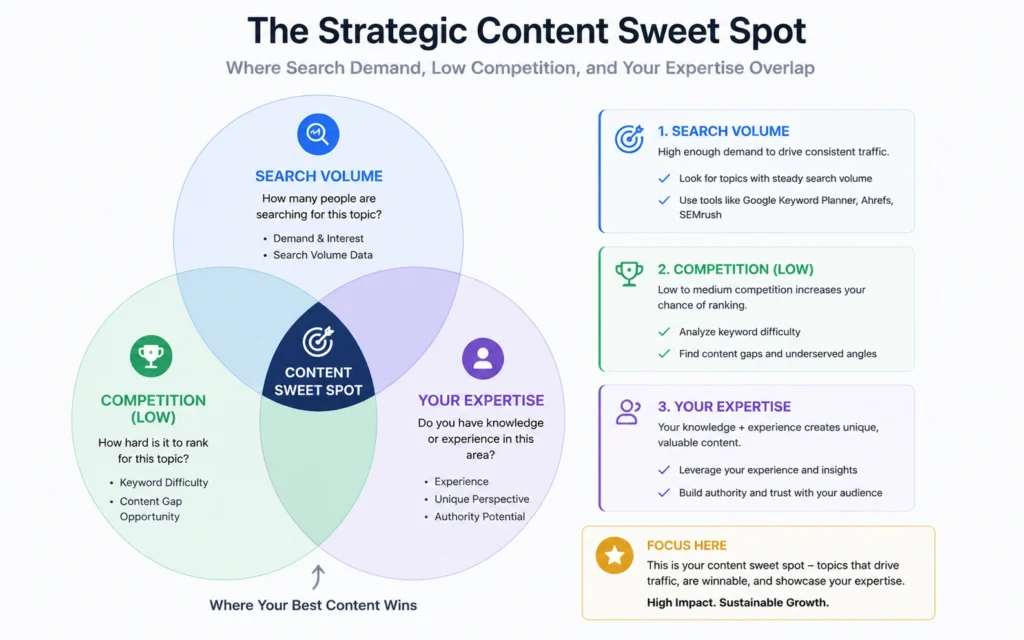
Start with your reader’s problems, not your expertise. The topics that drive traffic answer questions people are actively typing into Google.
Use these four methods to generate ideas:
1. Answer the Public and Google’s “People Also Ask”
Type your main topic into Google and scroll to the “People Also Ask” box. These are real questions with real search volume. Click a few to expand the list—you’ll get dozens of related questions. Do this for five seed topics and you’ll have 50+ blog post ideas in under 20 minutes.
2. Competitor gap analysis
Pick three blogs in your niche that are slightly ahead of where you are. Use a tool like Ahrefs’ Content Gap or Ubersuggest to see which keywords they rank for that you don’t. Filter for keywords with difficulty under 30 and volume over 100. These are proven topics that your competitors have validated.
3. Forum and community mining
Go to Reddit, Quora, or niche-specific forums. Search for your topic and sort by “top” or “most upvoted.” Look for recurring questions, frustrations, or “how do I” posts. These indicate genuine information gaps. When someone asks the same question 47 times in a subreddit, that’s a blog post waiting to happen.
4. Keyword modifier combinations
Take your core topic and add modifiers: “best,” “how to,” “vs,” “alternatives,” “for beginners,” “2026,” “step by step,” “mistakes,” “tools.” Each modifier represents a different search intent. “Blog post ideas” and “best blog post ideas” attract different readers at different stages of their journey.
The validation checklist before you write
Don’t write a single word until you’ve run your idea through this checklist:
Search volume: 100+ monthly searches minimum
Below 100 searches and you’re writing for a handful of people. Yes, long-tail keywords matter, but if you’re starting out, you need topics with enough volume to justify the effort.
Keyword difficulty under 40
If you’re a new blog, avoid keywords with difficulty scores above 40. You won’t rank. Check the domain ratings of the top 10 results—if they’re all DR 60+ sites, pick a different angle or a more specific long-tail variation.
Clear search intent
Type your keyword into Google. Are the top results how-to guides, listicles, product reviews, or opinion pieces? Your post needs to match that format. If you write a personal essay when everyone else is publishing step-by-step tutorials, you won’t rank—even if your writing is better.
An angle that adds value
Read the top three results. What do they miss? Maybe they’re outdated (from 2022 or earlier), maybe they skip the actual implementation details, maybe they’re too broad. Your angle could be: more current (blog post ideas 2026), more specific (for a particular audience), more actionable (with templates or examples), or more comprehensive (covering what the others skip).
If you can’t identify a clear angle in 30 seconds, the topic is too saturated or you haven’t found the right entry point yet.
100 blog post ideas organized by category
Use these as templates. Swap in your niche, audience, or specific topic.
How-to and tutorial posts (25 ideas)
- How to [achieve specific outcome] in [timeframe]: A step-by-step guide
- How to [solve common problem] without [common obstacle]
- How to [use tool/platform] for [specific use case]
- How to [complete task] if you’re a complete beginner
- How to [achieve goal] on a budget of [specific amount]
- How to [do something] faster: [number] time-saving techniques
- How to [fix problem] when [common tool] doesn’t work
- How to [complete complex task] without [prerequisite skill]
- How to [optimize/improve] your [process] in [timeframe]
- How to [achieve outcome] using only [free/accessible tools]
- How to [do something] the right way (and avoid [common mistake])
- How to [complete task] in [year]: Updated for [recent change]
- How to [solve problem] when you have [specific constraint]
- How to [achieve goal] without [typical requirement]
- How to [use strategy] for [specific audience type]
- How to [complete task] step by step (with screenshots)
- How to [fix issue] in [platform/tool]: A troubleshooting guide
- How to [achieve outcome] from scratch (no experience needed)
- How to [do something] efficiently: A workflow that saves [time/money]
- How to [complete complex process] without getting overwhelmed
- How to [solve problem] using [specific method/framework]
- How to [achieve goal] when [common assumption] isn’t true
- How to [do something] correctly: Common mistakes to avoid
- How to [complete task] in [year]: What’s changed and what still works
- How to [achieve outcome] with [specific constraint]: A realistic guide
List posts (20 ideas)
- [Number] best [tools/resources] for [specific purpose] in [year]
- [Number] [topic] mistakes that are costing you [consequence]
- [Number] ways to [achieve goal] (that actually work)
- [Number] [topic] trends to watch in [year]
- [Number] free [tools/resources] for [specific audience]
- [Number] [topic] hacks that save [time/money]
- [Number] signs you’re [doing something wrong]
- [Number] [topic] alternatives to [popular option]
- [Number] [topic] examples you can copy
- [Number] [topic] statistics you need to know in [year]
- [Number] [topic] tools compared: Which one should you use?
- [Number] [topic] strategies for [specific situation]
- [Number] [topic] resources I wish I knew about sooner
- [Number] [topic] myths that need to die in [year]
- [Number] [topic] tips from [expert/successful person]
- [Number] [topic] checklists for [specific task]
- [Number] [topic] templates you can download and use
- [Number] [topic] case studies (and what we learned)
- [Number] [topic] questions you should be asking
- [Number] [topic] predictions for [year]
Comparison and “versus” posts (15 ideas)
- [Tool A] vs [Tool B]: Which is better for [specific use case]?
- [Method A] vs [Method B]: The honest comparison
- [Option A] or [Option B]: How to choose for [your situation]
- [Popular tool] alternatives: [Number] options worth considering
- [Strategy A] vs [Strategy B]: When to use each one
- Free vs paid [tools/resources]: Is the upgrade worth it?
- [Tool] vs [competitor]: Feature-by-feature breakdown
- DIY vs hiring out [task]: Cost and time comparison
- [Old method] vs [new method]: What’s actually better?
- [Platform A] vs [Platform B] for [specific goal]
- [Approach A] vs [Approach B]: Pros, cons, and when to use each
- [Tool] review: Is it worth the hype in [year]?
- [Popular option] vs [underdog option]: The real differences
- [Method] vs [alternative]: Which gets better results?
- [Option A], [Option B], or [Option C]: Decision framework included
Problem-solving posts (20 ideas)
- Why [common problem] happens (and how to fix it)
- [Problem] solved: A step-by-step troubleshooting guide
- What to do when [specific issue] won’t go away
- How to fix [problem] without [typical solution]
- [Problem] checklist: Diagnose and solve in [timeframe]
- Why your [effort] isn’t working (and what to do instead)
- [Problem] prevention: How to avoid it before it starts
- What causes [problem] and how to eliminate it for good
- [Problem] emergency guide: Quick fixes that work
- Why [solution] doesn’t work for [specific situation]
- How to troubleshoot [issue] when nothing else works
- [Problem] root cause analysis: Find and fix the real issue
- What to do when [tool/platform] breaks or stops working
- [Problem] workaround: Get results without the usual method
- Why [common advice] makes [problem] worse
- [Problem] recovery plan: Get back on track in [timeframe]
- How to prevent [problem] from happening again
- [Problem] warning signs you shouldn’t ignore
- What to do when [expected outcome] doesn’t happen
- [Problem] decision tree: Choose the right solution
Framework and strategy posts (20 ideas)
- The complete [topic] framework for [year]
- [Topic] strategy: A step-by-step planning guide
- How to build a [topic] system that scales
- [Topic] roadmap: What to do in your first 30/60/90 days
- The [topic] methodology: A proven approach
- [Topic] planning template (free download)
- How to create a [topic] workflow that saves time
- [Topic] strategy for [specific audience]: A tailored approach
- The [topic] blueprint: From start to finish
- [Topic] optimization: How to improve your results
- [Topic] automation: What to automate and what to keep manual
- [Topic] metrics: What to measure and why it matters
- [Topic] audit checklist: Evaluate your current approach
- [Topic] prioritization framework: What to focus on first
- [Topic] scaling guide: Grow without burning out
- [Topic] integration: How to combine with [related process]
- [Topic] documentation: Create systems others can follow
- [Topic] review process: Evaluate and improve quarterly
- [Topic] contingency planning: What to do when things go wrong
- [Topic] mastery path: From beginner to advanced
Tools to generate and validate blog post ideas
You don’t need expensive software to find good topics, but the right tools make it faster.
Free options:
Google Keyword Planner shows search volume and competition. It’s designed for ads, but it works for content research too. You’ll need a Google Ads account (free), but you don’t need to run ads.
Answer the Public generates visual maps of questions people ask about any topic. Type in “blog post ideas” and you’ll get hundreds of related questions organized by who, what, where, when, why, and how.
Google Trends shows whether interest in a topic is growing or declining. Use it to avoid writing about dying trends unless you’re specifically addressing that decline.
AlsoAsked.com pulls “People Also Ask” data and shows you the question chains. It reveals how people drill deeper into topics, which helps you structure comprehensive posts.
Paid tools worth considering:
Ahrefs ($99/month) gives you keyword difficulty scores, competitor analysis, and content gap reports. If you’re serious about blogging, this pays for itself within a few months.
Ubersuggest ($29/month) is a budget-friendly alternative. It’s not as powerful as Ahrefs, but it’s solid for beginners who need keyword data without the enterprise price tag.
SEMrush ($129/month) offers similar features to Ahrefs with stronger competitive intelligence. Choose this if you’re doing heavy competitor research.
My actual workflow:
I start with Answer the Public (free) to generate 30-50 raw ideas. Then I take the top 10 into Ahrefs to check volume and difficulty. I validate search intent by Googling each keyword and reading the top three results. Finally, I pick the one with the best combination of volume, low competition, and a clear angle I can execute.
This takes about 90 minutes per post idea. It’s slower than just writing whatever comes to mind, but my posts actually rank now.
Common questions about blog post ideas
How many blog post ideas should I brainstorm before choosing one?
Aim for 20-30 raw ideas, then narrow to 3-5 validated options. From there, pick the one with the best combination of search volume, attainable competition, and your genuine interest. Don’t overthink it—perfectionism kills publishing momentum.
Should I focus on trending topics or evergreen content?
Evergreen content drives consistent traffic for years. Trending topics give you short-term spikes but fade quickly. For a new blog, prioritize evergreen topics with steady search volume. Once you have traffic, add trending content to capture timely searches.
How do I know if a blog post idea is too competitive?
Check the domain ratings of the top 10 Google results. If they’re all DR 50+ with thousands of backlinks, the keyword is too competitive for a new blog. Look for results with DR under 30, thin content, or outdated information—these are your opportunities.
Is it better to write broad topics or niche-specific posts?
Niche-specific posts rank easier and attract more qualified traffic. “Blog post ideas for fitness coaches” will convert better and rank faster than “blog post ideas.” Start specific, then expand to broader topics once you have authority.
How often should I publish new blog post ideas?
Consistency matters more than frequency. One high-quality post per week beats four rushed posts. Pick a schedule you can maintain for six months without burning out, then adjust based on results.
Continue Exploring:
- Learn more about blogging strategy to understand how these ideas fit into a complete content system.
- Master keyword research fundamentals to validate your ideas with data before you write.