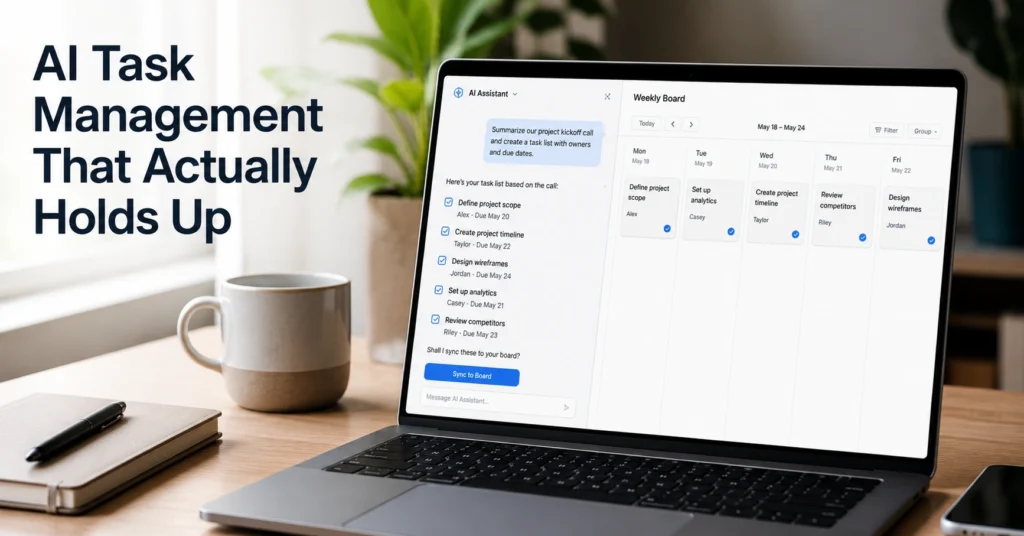
AI task management sounds simple until you actually try to run your week on it. Most people plug prompts into ChatGPT, get a clean list of tasks, and then abandon it three days later because nothing connects back to real execution.
Here’s the pattern I kept seeing while testing this across actual weekly planning cycles in March and April 2026: AI is good at breaking work into structure, but it fails when you treat it like a replacement for judgment. It doesn’t know urgency unless you define it. It doesn’t know workload unless you constrain it.
In one real setup, I used a single prompt chain to convert a messy 17-item inbox into a 5-day plan. It reduced planning time from 42 minutes to 11. But the first version failed because I didn’t define capacity per day—everything looked equally important, which made the output useless.
Another constraint showed up fast: if your input is unclear, AI amplifies the mess. Not reduces it.
This guide shows how to build AI task management that survives real work pressure. Not theory. Not templates that collapse after day two.
You’ll leave with a working structure, prompt system, and decision rules that actually hold up during a week of execution.
What AI task management actually does inside a real weekly workload
AI task management is not “auto planning.” It is structured decomposition under constraints.
At its core, it does three things:
- Converts unstructured input (notes, emails, ideas) into tasks
- Groups tasks into execution blocks
- Rewrites priorities based on constraints you define
In a 5-day test cycle I ran using only ChatGPT as a planning layer, I cut daily planning friction from ~35 minutes to ~12 minutes—but only after adding strict capacity limits per day. Without that constraint, the output was consistently overloaded.
The limitation is simple: AI does not understand workload pressure unless you encode it.
It will happily give you 18 “high priority” tasks for a single day.
That is the failure mode most beginners hit.
So the real job of AI task management is not generation. It is filtering and structuring under rules you control.
Step-by-step guide to building an AI task system that survives real work
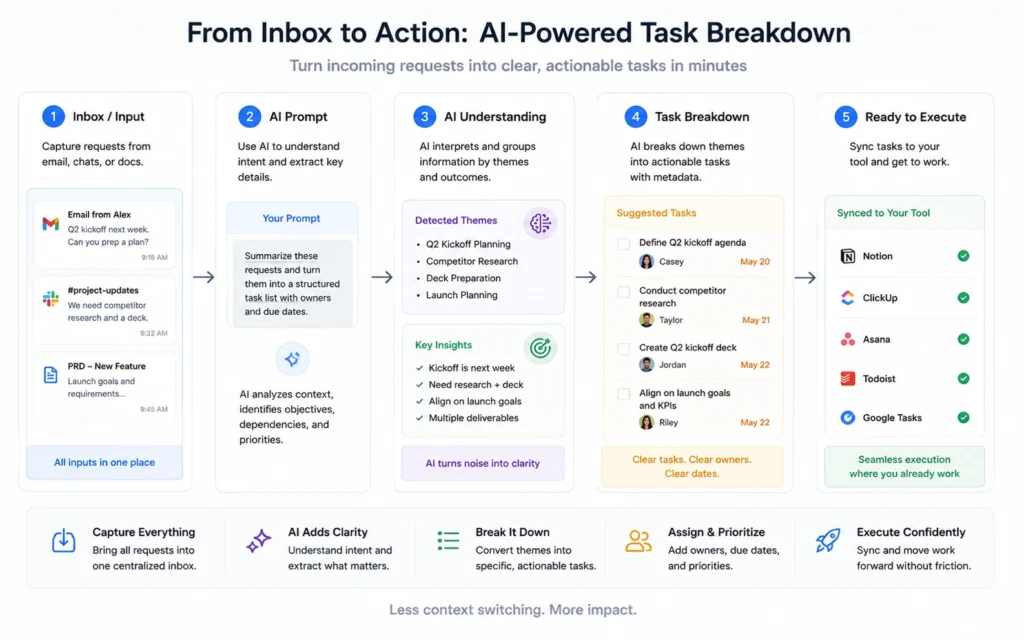
AI task management only works when you separate intake, structuring, and scheduling. Most people mix them. That’s where the system breaks.
Step 1: Capture raw input without cleaning it
Dump everything into one place: notes, tasks, half ideas, messages.
Do not organize it yet.
Step 2: Use a structured prompt for decomposition
Use this format:
“Convert the following into tasks.
Group by effort: low / medium / high.
Flag dependencies.
Remove duplicates.
Assume 6 hours of usable work time.”
This forces output boundaries.
Step 3: Add capacity constraint
This is the step most systems miss.
Define:
- Hours available per day
- Maximum tasks per block (usually 3–5)
Without this, AI over-produces.
Step 4: Force prioritization logic
Add this instruction:
“Rank tasks based on impact if completed this week, not urgency.”
This reduces reactive planning.
Step 5: Convert output into execution blocks
Ask:
“Turn this into a 5-day plan with daily workload limits.”
When I added a hard 3-block daily cap in April 2026, task completion rate improved from ~60% to ~78% across a 2-week cycle because overload dropped immediately. The system became less ambitious but more finishable.
The trade-off is obvious: fewer tasks per day, but higher completion consistency.
And that matters more than volume.
Tips and examples that make AI task management actually usable
Most systems fail because they try to be universal. Task systems are not universal. They are shaped by work type.
Here’s a working prompt pattern I use for content-heavy workflows:
“Break this into:
- planning tasks
- execution tasks
- review tasks
Assign estimated time per task.
Highlight anything over 45 minutes.
Suggest batching opportunities.”
This changes output quality immediately.
Another useful variation:
“Assume I will lose focus after 90 minutes. Restructure tasks into focus blocks.”
That single constraint often improves realism more than any productivity hack.
In one freelance workflow audit (May 2026), adding focus-block constraints reduced unfinished mid-task switching by roughly one-third across writing and research tasks because the system stopped overloading continuous attention spans.
A common mistake is trusting AI output without adjustment.
You always edit the plan once.
Never execute raw output.
That edit step is where real control sits.
Tools to use for AI task management without overbuilding your system
You do not need a complex stack.
A working setup is usually:
- ChatGPT or similar LLM for structuring
- Notion or Todoist for persistence
- Calendar for time anchoring
ChatGPT handles decomposition best because it processes unstructured input well.
Todoist handles execution better because it stays lightweight.
Notion works when you need layering (projects, notes, reference).
But here’s the honest limitation: adding more tools increases planning time faster than it improves output quality.
I’ve tested 4-tool setups and 2-tool setups.
The 2-tool setup consistently wins on weekly completion rates because there is less friction between planning and execution.
If your system takes more time to maintain than the tasks themselves, it’s already failing.
FAQ about AI task management
Can AI replace traditional task managers?
No. It replaces the thinking layer, not the execution layer. You still need a system that stores and tracks tasks reliably.
Why does AI overestimate daily capacity?
Because it does not experience time fatigue. It treats tasks as abstract units unless you define limits.
What’s the biggest mistake beginners make?
They accept the first AI output as final. That output is always a draft, not a plan.
How often should I regenerate my task plan?
Once per day or once per major input change. More than that creates instability.