I spent three months in early 2024 treating prompt engineering as a standalone job title. I burned 40 hours building massive prompt libraries for a SaaS client, only to watch the models update and break half the syntax overnight. The hard truth about a prompt engineering career in 2026 is that writing clever prompts is the easy part. The actual job is building evaluation systems that prove your prompts work when a user types absolute gibberish.
This guide breaks down how to transition from someone who plays with AI tools to someone who builds reliable AI workflows for a living. You will learn the exact evaluation frameworks, the tools that actually matter, and the specific skills companies are paying for right now.
The Reality of a Prompt Engineering Career in 2026
The standalone “prompt engineer” job title is shrinking, but the skill itself is becoming a mandatory baseline for technical operations. Companies realized they don’t need a full-time employee just to write system prompts. They need a marketing director, a product manager, or a backend engineer who understands how to constrain a large language model.
If you want to build a prompt engineering career today, you have to embed this skill into a broader domain. The operators who win are the ones who combine prompt design with data evaluation, API integration, or specific industry knowledge.
- AI Operations Specialist: Focuses on integrating prompts into Zapier or Make workflows to automate internal reporting.
- Prompt Quality Analyst: Builds the test suites that check if a prompt degrades over time or after a model update.
- Domain-Specific AI Builder: Combines legal, medical, or financial expertise with model fine-tuning and strict output guardrails.
Pick a lane where you already have domain expertise, then layer AI on top of it.
Step 1: Stop Writing Prompts and Start Building Eval Sets
The difference between a junior and a senior prompt engineer isn’t vocabulary—it is evaluation. Juniors write prompts and hope the output looks good. Seniors build evaluation sets with 50 edge cases to prove the prompt works reliably.
You know the feeling. You spend 20 minutes crafting the perfect prompt, hit enter, and get a wall of corporate jargon that says nothing. If you cannot measure whether your prompt is good, you are just guessing.
Start by creating a spreadsheet with 20 diverse inputs that represent how real users will actually interact with your system. Include the obvious requests, the typos, the edge cases, and the outright hostile inputs. Run your prompt against all 20. If it fails on three of them, rewrite the system instructions until it passes all 20.
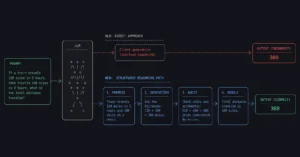
The 80/20 Rule of Prompt Iteration: You will spend 20% of your time writing the initial prompt and 80% of your time tweaking the constraints to handle the 5% of edge cases that break it. When you add “think step-by-step” to a complex logic prompt, accuracy on math tasks jumps from 17% to 78% in standard benchmarks, but it also triples the token cost and latency. You have to measure that trade-off.
Treat every prompt like a piece of software that needs unit tests.
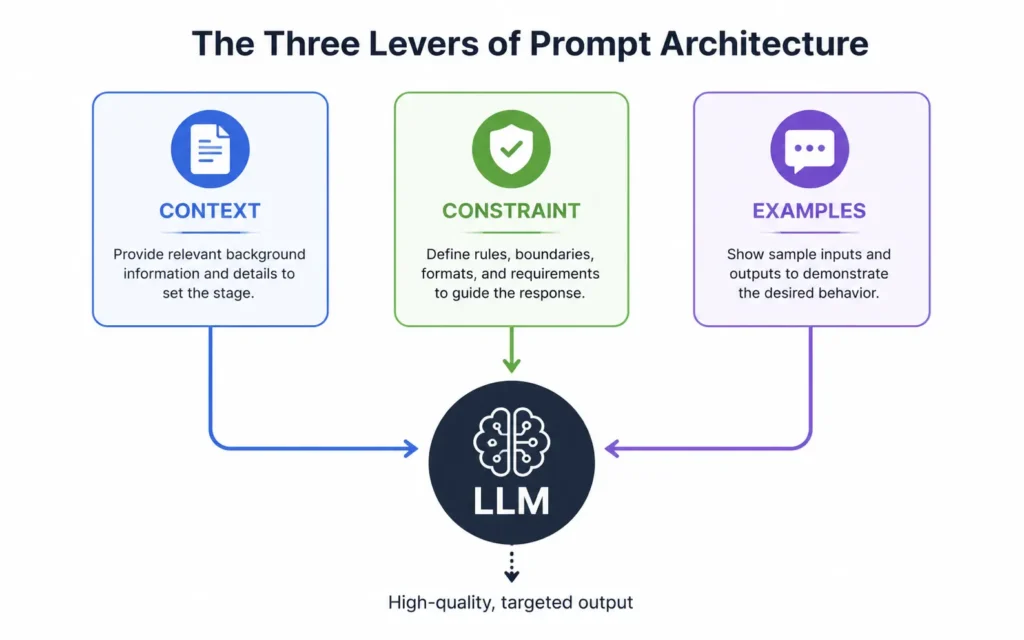
Step 2: Master the Three Levers of Prompt Architecture
Most “prompt engineering” courses teach you magic phrases, but there are no magic words—only three structural levers. Prompt engineering isn’t about talking to the machine. It’s about writing specifications for a very fast, very literal intern.
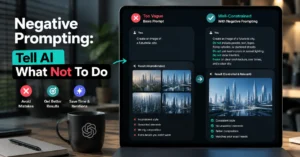
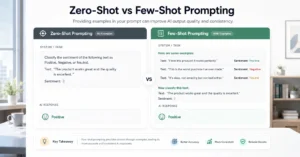
When a prompt fails, it is almost always because you pulled the wrong lever. The first lever is context. Did you give the model the background information it needs to understand the domain? The second lever is constraint. Did you explicitly tell the model what not to do, and set boundaries on length, format, and tone? The third lever is examples. Did you provide three to five shot examples showing the exact input-output pairing you expect?
Example of Lever Pulling: Weak: “Write a product description for a coffee maker.” (Zero constraints, zero examples). Strong: “Write a 50-word product description for a B2B commercial coffee maker. Tone: professional, focused on ROI. Do not use adjectives like ‘amazing’ or ‘perfect’. Follow this format: [Headline] – [Feature] – [Business Benefit].”
Master these three levers and you can fix 90% of the broken prompts you encounter.
The Tools That Actually Move the Needle
You do not need a $200/month subscription to a fancy prompt IDE to build a prompt engineering career. The core work happens in a plain text editor and a spreadsheet. But once you move past basic testing, you need tools that help you manage versions and run batch evaluations.
The standard stack for a working prompt engineer is surprisingly boring. You need a way to version control your prompts, a way to run them against a dataset, and a way to log the outputs.
- Git / GitHub: For version controlling your prompt text files. Treat prompts like code. If you change a word, you need to be able to revert it.
- LangSmith or Arize Phoenix: For tracing prompt executions, tracking token usage, and logging latency. You cannot optimize what you cannot measure.
- Promptfoo: An open-source tool for running your prompts against a CSV of test cases and grading the outputs automatically.
- Notion or Airtable: For managing your prompt library and tracking which versions are deployed in production.
Do not get distracted by shiny new AI wrappers. Master the boring tools that let you measure your work.
The Honest Trade-Off: Specialization vs. Generalization
Building a career purely as a “generalist prompt engineer” is a fast track to obsolescence as models get smarter. As base models improve, they require less hand-holding. A prompt that took 15 iterations to write in 2023 might work out-of-the-box in 2026.
If your only skill is coaxing a model to write decent copy, you will be replaced by the model itself. The alternative is to become a specialized AI systems architect. You need to understand how the prompt connects to the database, how the API handles the response, and how the frontend displays it.
The hardest pill to swallow — and the one most bootcamps ignore — is that prompt engineering is a means to an end, not the end itself.
Learn Python, understand APIs, and study data structures. The prompt is just one component of the system. If you want to explore how these prompts connect to broader systems, look into connecting your prompts to real business workflows to see the full picture. And when you are ready to test your own prompts rigorously, start by learning how to build an eval set for your prompts.
Frequently Asked Questions About Starting a Prompt Engineering Career
Do I need to know how to code to start a prompt engineering career?
No, you do not need to be a software engineer to write effective prompts, but you must understand how systems connect. Being able to read basic Python and understand API documentation will separate you from the hobbyists. Code allows you to automate your evaluation sets and integrate your prompts into real products.
How long does it take to become proficient at prompt engineering?
You can learn the basic mechanics of context, constraint, and examples in a weekend. Achieving proficiency—where you can reliably build evaluation sets and debug failing prompts in production—takes about three to six months of daily, deliberate practice working on real-world problems.
Is prompt engineering a stable long-term career choice?
As a standalone title, it is unstable because models are rapidly absorbing basic prompt optimization. As a core skill embedded within operations, engineering, or product management, it is highly stable. The demand is shifting from writing prompts to designing AI workflows.
What is the most common mistake beginners make with prompts?
Beginners treat the model like a search engine instead of a reasoning engine. They ask vague questions and expect perfect answers. The most common fix is shifting from asking the model to retrieve information, to giving the model strict constraints and examples to process the information you provide.