Most new creators spend weeks debating channel names, logos, and editing styles. Then they publish into a niche that has weak advertiser demand, poor search volume, or content requirements they can’t sustain.
I’ve seen creators publish 60 videos in six months and quit because every video required ten hours of research. I’ve also seen channels reach monetisation with simple screen recordings because the niche matched both audience demand and creator capability.
That’s the real job of niche selection.
Not finding the biggest market. Finding the market you can repeatedly serve.
The best youtube niches in 2026 combine three things:
- Growing audience demand
- Sustainable content production
- Strong monetisation opportunities
The rest of this guide focuses on those three factors.
Overview
Many niche lists rank channels based only on CPM.
That’s incomplete.
A niche with a $30 CPM is not automatically better than one with a $7 CPM. If publishing one video requires three days of work, growth becomes difficult for beginners.
A more useful framework looks at:
| Niche | Growth Potential | CPM Potential | Beginner Difficulty |
|---|---|---|---|
| AI Tools | High | High | Medium |
| Personal Finance | High | Very High | High |
| Software Tutorials | High | High | Medium |
| Productivity Systems | Medium-High | High | Medium |
| Career Development | High | High | Medium |
| Business Education | Medium | Very High | High |
| Cybersecurity | High | Very High | High |
| Digital Marketing | Medium-High | High | Medium |
| Health Education | High | Medium | High |
| Tech Reviews | Medium | Medium-High | High |
The strongest opportunities in 2026 sit where audience growth and advertiser demand overlap.
AI, software education, career advancement, productivity, and finance continue to attract both viewers and advertisers because they influence purchasing decisions.
Advertisers pay more when viewers are close to spending money.
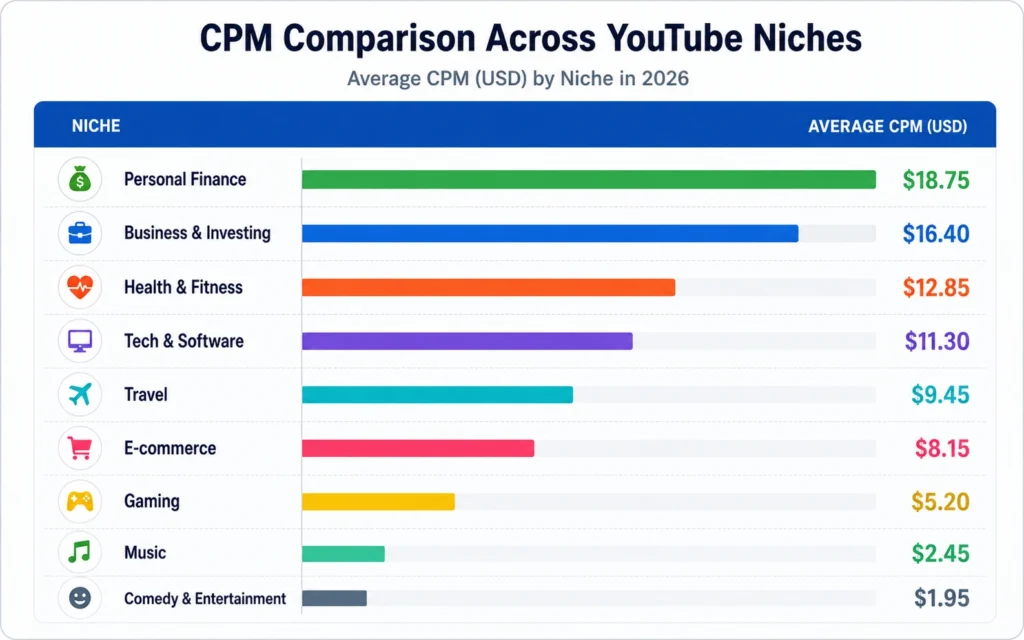
That’s why finance channels often outperform entertainment channels in revenue per thousand views.
Step-by-Step Guide
Step 1: Start with your repeatable content source
Most niche selection mistakes happen here.
Creators choose topics based on earnings screenshots rather than content supply.
A better question:
“What can I make 100 videos about without running out of ideas?”
For example:
- AI workflow tutorials
- Excel automation
- Career advice for engineers
- Freelancing systems
- Small business operations
Each topic naturally generates dozens of content angles.
If you struggle to list 50 future video ideas, the niche is probably too narrow.
Step 2: Evaluate advertiser demand
CPM follows commercial intent.
A viewer researching software tools, investments, insurance, certifications, or business services is more valuable to advertisers than a viewer watching random entertainment clips.
Strong CPM categories include:
- Personal finance
- Investing
- SaaS software
- Business operations
- Career development
- Cybersecurity
- AI tools
The mechanism matters.
Advertisers aren’t paying for views.
They’re paying for buying intent.
Step 3: Check growth signals
A niche can pay well and still grow slowly.
Growth signals include:
- Search demand increasing
- New products entering the market
- New audiences entering the space
- Regular news cycles
- Frequent software releases
AI tools illustrate this perfectly.
Every week introduces updates, launches, integrations, and workflow experiments.
That creates endless content opportunities.
Compare that with a static niche where major developments happen twice per year.
One creates content velocity.
The other creates content drought.
Step 4: Match production requirements to your reality
This step gets ignored.
Then creators burn out.
A channel requiring:
- studio lighting
- product inventory
- expensive cameras
- complex editing
is harder to sustain than:
- screen recordings
- tutorials
- commentary
- educational breakdowns
My own observation from reviewing creator workflows is simple:
Channels fail from production friction more often than audience problems.
The audience never gets a chance to respond if publishing becomes painful.
Step 5: Build a monetisation ladder
Ad revenue should not be the entire plan.
The strongest niches create multiple revenue streams.
Example:
AI Tools Channel
Level 1:
- Ad revenue
Level 2:
- Affiliate commissions
Level 3:
- Templates
Level 4:
- Consulting
Level 5:
- Courses
One audience.
Multiple monetisation layers.
That’s stronger than relying entirely on AdSense.
Tips & Examples
AI Tools: The fastest-growing creator opportunity
AI content continues to expand because tools change faster than creators can document them.
The opportunity isn’t generic AI news.
It’s practical implementation.
Examples:
- AI workflows for marketers
- AI automation for small businesses
- AI tools for students
- AI systems for content creators
The channels growing fastest often solve one specific problem rather than covering every AI announcement.
Personal Finance: High CPM, higher responsibility
Finance remains one of the highest-paying YouTube categories.
But it carries a trade-off.
Research standards must be higher.
Viewers act on financial information.
That means accuracy matters.
Many beginners see finance CPM screenshots and underestimate the workload behind them.
The money is real.
So is the responsibility.
Software Tutorials: Quietly one of the best niches
This category rarely appears in flashy creator discussions.
It keeps producing results.
A tutorial answering a specific software problem can generate search traffic for years.
Examples:
- Excel tutorials
- Notion workflows
- Google Sheets automation
- CRM implementation
- Project management tools
A tutorial published today can still generate views two years later.
That’s difficult to achieve in trend-driven niches.
Productivity Systems: Easier than productivity motivation
Most productivity channels fail because they publish advice.
The stronger channels publish systems.
Difference:
Weak:
“Wake up at 5 AM.”
Strong:
“How I reduced weekly planning from 90 minutes to 18 using Notion templates.”
One is opinion.
The other is process.
Processes age better.
Career Development: Growing because work keeps changing
Career content performs when it solves a concrete problem.
Examples:
- Interview preparation
- Salary negotiation
- Resume reviews
- Certifications
- Industry transitions
A channel helping people earn more money often attracts both viewers and advertisers.
That’s a useful combination.
Tools to Use
The right tools won’t pick a niche for you.
They help validate demand before you invest months creating content.
TubeBuddy
Useful for:
- Keyword research
- Competition analysis
- Search opportunity discovery
Best when you’re evaluating video topics inside a niche.
VidIQ
Useful for:
- Trend analysis
- Competitor monitoring
- Content opportunities
Particularly helpful for identifying emerging topics before they become saturated.
Google Trends
One of the simplest validation tools available.
Search the niche.
Compare it against alternatives.
Look for steady growth rather than temporary spikes.
Many creators mistake short-term excitement for long-term demand.
Google Trends helps separate the two.
ChatGPT
Useful for:
- Idea generation
- Content planning
- Outline creation
- Research assistance
Not for replacing expertise.
For accelerating workflow.
There’s a difference.
YouTube Search Suggestions
Still one of the most underrated research tools.
Start typing.
Watch autocomplete suggestions.
Those suggestions represent real searches happening on the platform.
Simple.
Useful.
Free.
Frequently Asked Questions About Best YouTube Niches
What is the highest CPM YouTube niche in 2026?
Personal finance, investing, business software, cybersecurity, and insurance-related content remain among the highest CPM categories. High CPM alone does not guarantee better earnings if content production becomes difficult or audience growth stays slow.
Which YouTube niche grows the fastest?
AI tools, software education, and career development continue to show strong growth because they align with changing technology and workforce trends. Growth happens when the content solves a specific problem rather than covering broad topics.
Is it better to choose a high CPM niche or a high-growth niche?
For most beginners, a balance is better. A moderate CPM niche with strong publishing consistency often outperforms a high CPM niche that requires heavy research and causes burnout after a few months.
Can I change my YouTube niche later?
Yes. Many creators refine their focus over time. The smoother transition is usually narrowing the niche rather than completely changing topics. Audience overlap matters.
How many videos should I publish before judging a niche?
A useful benchmark is 30 to 50 videos. Early performance is often too noisy to evaluate accurately. Consistent publishing provides enough data to identify patterns in retention, click-through rate, and audience response.
Continue Exploring
- building a repeatable YouTube content strategy: A niche creates direction. A content strategy creates momentum.
- finding topics people already search for: Most channels don’t fail from bad editing. They fail from weak topic selection.