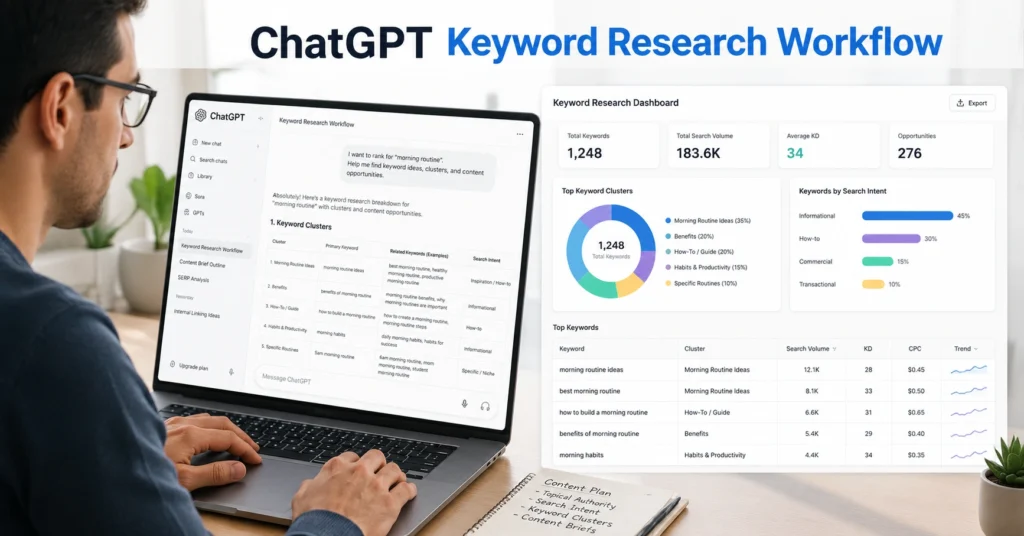
They open a chat window, ask for “high-volume keywords,” copy the list into a spreadsheet, and start planning content. The problem is simple: ChatGPT does not have live search volume data. It doesn’t know what people searched yesterday, last week, or this morning.
That doesn’t make it useless for SEO.
In practice, ChatGPT becomes valuable when you stop treating it as a keyword database and start using it as a research assistant. The tool is exceptionally good at generating angles, uncovering topic relationships, organizing messy keyword lists, identifying search intent, and building content structures.
The biggest improvement I saw after integrating ChatGPT into keyword research wasn’t finding more keywords. It was reducing the time spent organizing them. A clustering task that used to take roughly 45 minutes in a spreadsheet often drops to under 10 minutes when the prompts are structured correctly.
This is where chatgpt keyword research becomes useful: not replacing SEO tools, but helping you get more value from the data they provide.
Why ChatGPT Works Better as a Research Assistant Than a Keyword Tool
Keyword research has two different jobs.
The first job is discovering what people search.
The second job is understanding what those searches mean.
SEO tools handle the first job well. ChatGPT helps with the second.
That’s an important distinction because many AI tutorials blur the line between them.
When you use a dedicated SEO platform, you’re working with measured data: search volume, keyword difficulty, SERP competition, click estimates, and ranking trends.
When you use ChatGPT, you’re working with language patterns.
That difference changes how the tool should be used.
Good uses include:
- Topic expansion
- Keyword clustering
- Search intent analysis
- Content angle generation
- FAQ generation
- Content brief creation
- Semantic keyword discovery
Poor uses include:
- Estimating search volume
- Predicting rankings
- Identifying live trends
- Measuring keyword difficulty
The blunt verdict: if you’re asking ChatGPT for keyword metrics, you’re using the wrong tool for the job.
What To Set Up Before You Start Any ChatGPT Keyword Research Session
The quality of the output depends heavily on the information you provide.
Most weak results begin with weak context.
Instead of writing:
Give me keywords about SEO.
Provide operating constraints.
For example:
Act as an SEO strategist. My website teaches beginners how SEO works. Generate topic clusters for people learning SEO for the first time. Focus on informational search intent.
The difference is immediate.
ChatGPT performs better when it understands:
- Industry
- Audience
- Experience level
- Search intent
- Business model
- Content goal
A useful setup template looks like this:
You are helping with SEO content planning.
Audience: Beginner marketers.
Goal: Generate informational content opportunities.
Focus area: Keyword research.
Exclude advanced technical SEO topics.
Organize output into topic clusters.
The prompt is not complicated.
It is simply specific.
And specificity usually beats cleverness.
The Workflow That Produces Useful Keywords Instead of More Noise
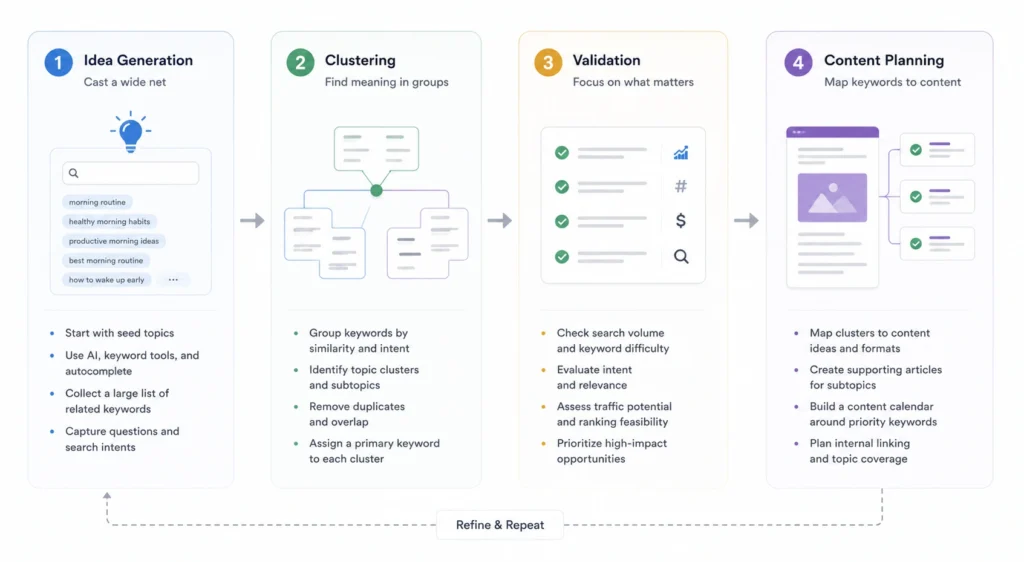
Most keyword workflows break because they start with AI and end with assumptions.
A better sequence looks like this:
Step 1: Collect Seed Keywords
Start with actual data.
Use:
- Google Search Console
- Google autocomplete
- SEO tools
- Existing rankings
- Customer questions
- Competitor content
Your goal is not perfection.
You only need enough starting points to understand the topic landscape.
Step 2: Expand the Topic Map
Now bring ChatGPT into the process.
Example prompt:
Here are 25 seed keywords related to SEO. Generate additional subtopics, related questions, beginner concerns, advanced concerns, and content opportunities. Group results by theme.
This often uncovers content directions that traditional keyword tools miss because users phrase questions differently than keyword databases categorize them.
A common example:
A keyword tool may show:
- keyword research tools
- keyword research software
ChatGPT may surface:
- how many keywords should a page target
- why keyword research feels overwhelming
- keyword research mistakes beginners make
Those aren’t always high-volume keywords.
They are often useful content opportunities.
Step 3: Cluster Keywords by Search Intent
This is where ChatGPT saves real time.
Paste a keyword list and use:
Group these keywords into clusters. Identify the primary topic for each cluster. Label search intent as informational, commercial, navigational, or transactional.
The output will not be perfect.
But it is usually accurate enough to eliminate a large amount of manual sorting.
I’ve tested this workflow repeatedly when building content maps. The first draft almost always needs editing, but the structure is usually 80% complete.
That 80% matters.
Step 4: Identify Content Gaps
Ask:
Based on these keyword clusters, what topics are missing from this content strategy?
This prompt often reveals blind spots.
Not because ChatGPT knows the market better than you do.
Because it can review hundreds of related ideas faster than most humans can.
And sometimes speed creates visibility.
Step 5: Build Content Briefs
Once clusters are finalized, use ChatGPT to transform them into content plans.
Prompt:
Create a content brief targeting the keyword cluster below. Include search intent, key questions, recommended headings, audience pain points, and conversion opportunities.
This stage reduces planning time significantly.
It doesn’t eliminate editorial work.
But it removes much of the repetitive structure-building.
How To Use ChatGPT Without Turning It Into a Fancy Search Bar
This is where many people lose value.
They treat ChatGPT like Google.
ChatGPT is not optimized for retrieval.
It is optimized for reasoning across information you provide.
The shift sounds small. It isn’t.
Bad prompt:
What keywords should I target?
Better prompt:
Here are my current keyword rankings, competitor topics, and target audience. Identify content gaps and opportunities.
The second prompt gives the model something to analyze.
The first asks it to guess.
And guesses rarely outperform data.
Prompt Patterns That Consistently Produce Better SEO Results
After dozens of keyword planning sessions, a few prompt structures show up repeatedly.
The Cluster Prompt
Group these keywords into topical clusters and identify the best pillar page for each cluster.
Useful when planning site architecture.
The Intent Prompt
Classify each keyword by likely search intent and explain why.
Useful for preventing mismatched content.
The Content Gap Prompt
Compare these keyword clusters against these published articles and identify missing coverage.
Useful during content audits.
The FAQ Prompt
Generate real-world questions a beginner would ask after reading an article on this topic.
Useful for FAQ sections and People Also Ask targeting.
The Internal Linking Prompt
Suggest internal linking opportunities between these article topics and explain the relationship.
Useful when building topical authority.
Where ChatGPT Fails During Keyword Research
Every useful workflow has boundaries.
This one does too.
ChatGPT struggles when the task requires current market data.
It also struggles when users expect certainty from incomplete information.
Common failure points include:
- Search volume estimation
- Difficulty scoring
- Trend prediction
- Competitive analysis without supplied data
- Local search demand estimates
An honest limitation matters here.
I’ve seen people spend an hour refining prompts trying to force keyword volume estimates out of ChatGPT. Five minutes inside an SEO platform would have produced a better answer.
Use the right tool for the right layer of the process.
ChatGPT helps interpret information.
It does not replace information.
What ChatGPT Keyword Research Looks Like in 2026
The biggest change in chatgpt keyword research 2026 workflows is not better keyword generation.
It’s workflow integration.
AI tools increasingly sit between data collection and content production.
A practical workflow now looks like this:
- Collect keyword data.
- Export results.
- Analyze with ChatGPT.
- Build clusters.
- Create briefs.
- Draft content.
- Review manually.
- Publish.
The AI layer is becoming organizational rather than authoritative.
That’s an important distinction because it changes expectations.
The fastest teams aren’t using AI to replace SEO thinking.
They’re using AI to remove repetitive sorting, structuring, and drafting work.
What To Skip — And What To Do Instead
Skip asking ChatGPT for “the best keywords.”
Instead, provide seed data and ask for analysis.
Skip asking for search volume.
Instead, pull real metrics from SEO software.
Skip generic prompts.
Instead, define audience, intent, constraints, and goals.
Skip trusting first outputs.
Instead, treat them as working drafts.
The highest-value use of ChatGPT in SEO isn’t discovery.
It’s acceleration.
That’s where the time savings appear.
And that’s where most professionals are seeing practical gains.
Frequently Asked Questions About ChatGPT Keyword Research
Can ChatGPT replace keyword research tools?
No. ChatGPT does not provide reliable search volume, keyword difficulty, or ranking data. It works best alongside SEO tools by helping organize, expand, and interpret keyword information.
Is ChatGPT keyword research accurate?
It is accurate for language analysis, topic relationships, and keyword clustering. It is not reliable for live keyword metrics or current search trends.
What is the best use of ChatGPT during keyword research?
Keyword clustering is one of the strongest applications. It helps organize large keyword lists by topic and search intent far faster than manual sorting.
Does ChatGPT help with SEO content planning?
Yes. It can generate content briefs, identify search intent, suggest FAQs, and help map content clusters once keyword opportunities have been identified.
Is ChatGPT keyword research worth using in 2026?
Yes, when paired with real keyword data. The strongest workflows use ChatGPT to analyze and organize information rather than replace keyword research platforms.
CONTINUE EXPLORING
- SEO content briefs with ChatGPT: Once you’ve organized keywords, the next step is turning them into structured briefs your writers can execute quickly.
- prompt engineering for marketers: Better prompts produce better research outputs. Understanding prompt structure improves every AI-assisted workflow.