Most new creators start by asking how much TikTok pays per view.
That’s usually the wrong question.
The creators earning meaningful income from TikTok rarely rely on one payment source. They combine multiple revenue streams: platform rewards, affiliate commissions, sponsorships, products, services, memberships, and audience-driven offers.
I learned this lesson after watching small creators with fewer than 20,000 followers earn more than accounts ten times larger. The difference wasn’t reach. It was monetization design. One creator treated every video as content. The other treated every video as part of a business system.
That’s the real topic behind tiktok monetization. The platform matters. The income architecture matters more.
If you’re trying to understand how creators earn on TikTok in 2026, the goal isn’t finding the highest-paying feature. The goal is identifying which monetization model fits your audience, content style, and production capacity.
Overview: Why Most TikTok Income Comes From More Than One Source
TikTok has matured into a creator ecosystem rather than a simple video app.
That changes the earning equation.
Many beginners assume platform payouts are the primary revenue source. In practice, direct platform payments often represent only one part of a creator’s income. For many niche creators, sponsorships, affiliate offers, and products generate more revenue than platform rewards.
A finance creator might earn from affiliate links to investing tools. A fitness creator might sell training plans. A business creator might generate consulting leads. The video is often the acquisition channel rather than the final product.
This is where many people waste months.
They spend hours chasing views while ignoring the mechanism that converts attention into revenue.
The blunt verdict: views are useful only when they connect to a monetization path.
Common TikTok revenue streams include:
- Creator rewards programs
- Brand sponsorships
- Affiliate marketing
- TikTok Shop commissions
- Digital products
- Coaching or consulting
- Membership communities
- Physical products
- Lead generation for businesses
- Cross-platform audience building
Not every creator needs all of them. Most don’t.
The goal is choosing the few that fit your audience.
Step-by-Step Guide: Build Monetization Before You Need It
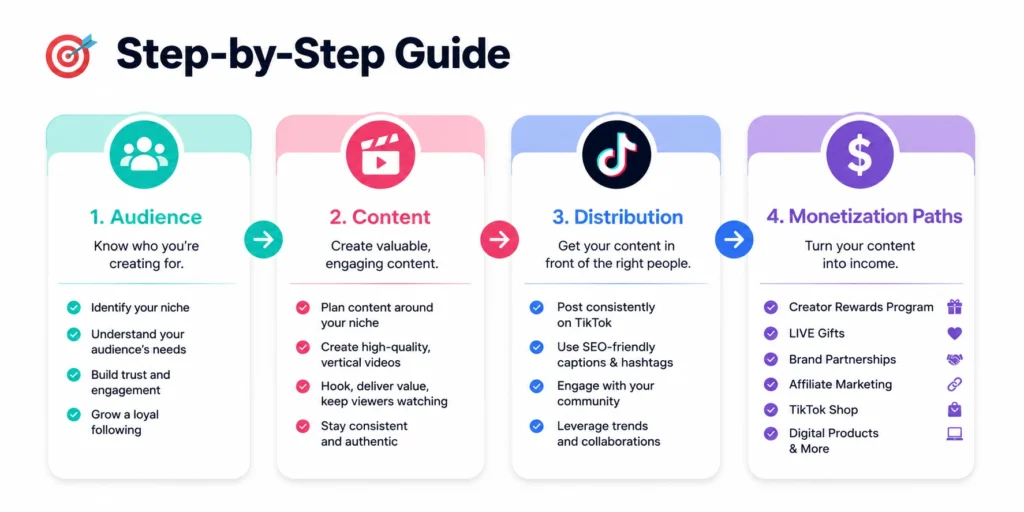
The fastest route to earning is creating content with a monetization destination already defined.
Step 1: Pick a Revenue Model First
Many creators do the opposite.
They publish for six months and then ask how to make money.
Start with the end point.
Examples:
| Content Type | Monetization Goal |
|---|---|
| Fitness | Coaching, programs, affiliates |
| Personal finance | Sponsorships, affiliates |
| Software tutorials | Affiliate commissions |
| Marketing | Consulting leads |
| Education | Courses, memberships |
| Product reviews | TikTok Shop sales |
A clear revenue model shapes your content choices.
Step 2: Create Videos Around Commercial Questions
The highest-value content often answers buying questions.
Examples:
- Which microphone should beginners buy?
- Best budgeting app for freelancers?
- How much does a standing desk improve posture?
These topics naturally support affiliate links, sponsorships, and product recommendations.
And they help viewers make decisions.
That alignment matters.
Step 3: Build Audience Trust Before Selling
A common beginner mistake is promoting products too early.
People follow creators because the content helps them.
The sales opportunity arrives after trust develops.
A practical ratio many creators use is roughly:
- 80% helpful content
- 20% monetized content
Not because it’s a magic formula.
Because audiences notice when every video becomes a sales pitch.
Step 4: Add Multiple Revenue Streams Gradually
The first monetization stream is usually the hardest.
The second becomes easier because the audience already exists.
A practical progression looks like:
- Creator rewards
- Affiliate links
- Sponsorships
- Products or services
- Memberships
Each layer reduces dependence on a single income source.
Tips & Examples: What Actually Generates Revenue
Follower count is often a poor predictor of income.
Audience intent matters more.
A creator teaching spreadsheet automation to 15,000 followers may earn more than an entertainment account with 500,000 followers.
Why?
Because business-focused audiences frequently make purchasing decisions.
That’s a monetization advantage.
Example: Affiliate-Driven Creator
A creator reviews productivity software.
Revenue sources:
- Affiliate commissions
- Sponsored reviews
- Consulting inquiries
The content remains useful even when no direct sale happens.
That’s the strength of affiliate-focused content.
Example: Service-Based Creator
A freelance designer posts short design breakdowns.
Videos generate:
- Client leads
- Portfolio visibility
- Workshop sales
The videos themselves are marketing assets.
Not products.
Example: Product-Based Creator
A creator sells templates.
Content demonstrates:
- The problem
- The workflow
- The result
Then the template becomes the shortcut.
That conversion path is straightforward and repeatable.
The Mistake That Delays Monetization
Many creators chase trends unrelated to their niche.
The videos gain views.
The audience becomes difficult to monetize.
I’ve seen creators spend months accumulating followers from random viral clips only to discover those followers have little interest in the offers they eventually want to sell.
Traffic and audience fit are different things.
Don’t confuse them.
Tools to Use: The Stack That Makes Monetization Easier
The best creator tools don’t create income.
They remove friction.
Analytics Tools
Use analytics to identify:
- Retention patterns
- Watch time
- Top-performing topics
- Audience interests
Revenue often follows content patterns already visible in your analytics.
The data usually tells you what to create next.
Affiliate Platforms
Affiliate networks simplify monetization because they remove product creation.
You recommend products.
You earn commissions when sales occur.
This works best when recommendations are tied directly to your content.
Link Management Tools
Once monetization expands, you’ll likely need:
- Landing pages
- Link hubs
- Tracking links
- Campaign organization
Without organization, it becomes difficult to understand which content generates revenue.
Content Planning Systems
A content calendar helps align publishing with monetization goals.
One useful framework:
- Monday: Educational content
- Wednesday: Case study
- Friday: Product-related content
- Weekend: Community-focused content
Simple systems outperform complicated ones.
A spreadsheet that gets used beats a complex dashboard that doesn’t.
What I’d Skip Early
Many beginners buy expensive creator software before earning their first dollar.
Don’t.
A phone, editing app, analytics access, and a simple planning system are enough to start.
The tool isn’t usually the bottleneck.
The publishing volume is.
What TikTok Monetization Rewards — And What It Punishes
TikTok rewards creators who solve recurring audience problems.
It punishes inconsistency in topic selection.
That’s different from saying every creator needs one niche forever.
But audiences need a reason to return.
When videos jump randomly between finance, gaming, fitness, and travel, monetization becomes harder because the audience lacks a common interest.
Revenue grows when:
- Audience intent is clear
- Content themes repeat
- Offers match viewer needs
- Publishing stays consistent enough to gather feedback
Revenue slows when:
- Topics change constantly
- Every video targets a different audience
- Monetization appears disconnected from content
The mechanism is simple.
Audience trust compounds.
Random attention doesn’t.
Frequently Asked Questions About TikTok Monetization
How many followers do I need for TikTok monetization?
The exact requirement depends on the monetization method. Affiliate marketing, services, and products can generate revenue before reaching large follower counts. Platform reward programs typically require eligibility thresholds set by TikTok.
Is TikTok monetization worth it in 2026?
Yes, if you view TikTok as part of a broader creator system. Most sustainable creator income comes from combining platform features with affiliate offers, sponsorships, products, or services rather than relying on one source.
What is the best monetization method for beginners?
Affiliate marketing is often the easiest starting point because it doesn’t require creating products. The key is recommending products that naturally fit your content and audience needs.
Can small creators make money on TikTok?
Yes. Smaller creators often monetize through niche audiences, consulting, coaching, services, affiliate partnerships, and digital products. Audience relevance usually matters more than raw follower counts.
How long does it take to earn money on TikTok?
Some creators generate income within weeks through services or affiliate sales. Others spend months building audience trust before revenue appears. The timeline depends more on monetization design than follower growth alone.
Continue Exploring
- Short-Form Video hub: If you’re deciding which short-form formats deserve your attention next, the category hub maps the major content types and workflows together.
- short-form video hooks: Better hooks increase retention, and retention is often the first metric that improves monetization opportunities.