TikTok growth starts with distribution. The platform decides who sees a video before it decides whether your account deserves more reach. That’s why brand-new creators with zero followers can get thousands of views, while accounts with 20,000 followers sometimes struggle to reach their own audience.
One of the biggest mistakes I see is people treating TikTok like older social platforms. They focus on follower counts, profile aesthetics, and posting schedules before they understand the mechanism that creates growth in the first place.
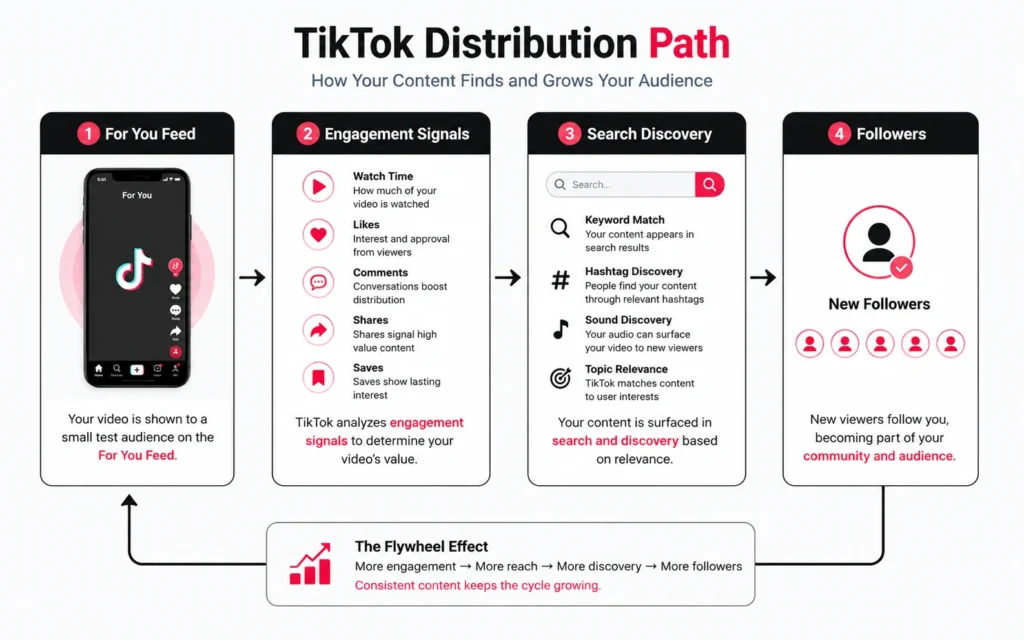
The TikTok Algorithm Mechanics Model is simpler than most people realize. A video gets tested through the For You feed, gains engagement signals, earns search visibility, and then converts viewers into followers. Get that sequence right and growth becomes much easier to understand.
This guide explains how to grow on TikTok in 2026 by understanding how the platform works, what beginners should focus on first, and which growth strategies deserve your attention.
What Is Grow On TikTok?
Growing on TikTok means increasing your reach, views, followers, and audience attention over time through content that consistently earns distribution.
That definition matters because many beginners focus only on followers.
Followers are a result.
Distribution is the cause.
A TikTok account grows when videos repeatedly reach people who have never seen the creator before. Every successful account, regardless of niche, relies on the same basic process.
The platform evaluates:
- Watch time
- Completion rate
- Rewatches
- Shares
- Saves
- Comments
- Profile visits
- Search relevance
Many creators spend weeks chasing follower growth when the real goal should be improving video performance.
A practical example:
Creator A gains 50 followers from one video.
Creator B gains 50 followers from ten videos.
Creator A has a stronger growth system because the content converts viewers more efficiently.
Growth is not follower collection.
Growth is audience acquisition through repeated content distribution.
Why It Matters
TikTok remains one of the few major platforms where beginners can reach large audiences without an existing following.
That’s the opportunity.
The challenge is that many people misunderstand how discovery works.
The TikTok Algorithm Mechanics Model
Think of TikTok as three connected systems:
System 1: For You Distribution
Every video enters a testing phase.
TikTok shows it to a small group of viewers who match likely interests.
If performance metrics exceed platform expectations, distribution expands.
System 2: Search Discovery
TikTok has become a search engine.
People actively search for:
- Product reviews
- Tutorials
- Recommendations
- How-to content
- Local information
Videos optimized for search can continue receiving views months after publication.
System 3: Follower Conversion
Followers appear after trust.
People rarely follow because one video was decent.
They follow because several videos prove the account consistently solves a problem, entertains them, or teaches something useful.
The beginner mistake is optimizing only for followers.
The better approach is optimizing for distribution first.
That shift changes everything.
Short-form video fundamentals helps explain why audience attention behaves differently on TikTok than on longer-form platforms.
How to Get Started
The fastest way to grow on TikTok for beginners is to choose one topic category and publish consistently within it.
Not because niches are magical.
Because viewers need pattern recognition.
When somebody lands on your profile, they should immediately understand why the account exists.
A cooking creator posts recipes.
A fitness creator posts training advice.
A productivity creator posts workflow demonstrations.
Simple.
The first setup process looks like this:
Choose One Content Direction
Don’t start with five.
Start with one.
A common beginner problem is mixing unrelated topics:
- Travel
- Productivity
- Gaming
- Motivation
- Tech news
All on the same account.
That makes audience retention harder because viewers don’t know what to expect next.
Pick one primary content lane for the first 30 videos.
Then evaluate.
Study Existing Winners
Don’t copy.
Reverse-engineer.
Look at creators producing content in your chosen category.
Pay attention to:
- Hook structure
- Video length
- Camera style
- Editing pace
- Caption style
- Topic selection
One observation from reviewing hundreds of short-form videos: beginners often analyze viral videos while ignoring repeatable videos.
A creator with 500 videos earning consistent views teaches more than someone who had one lucky hit.
Create a 30-Video Plan
This removes decision fatigue.
Instead of asking what to post every day, create a simple list.
For example:
- Beginner mistakes
- Common myths
- Quick tutorials
- Tool reviews
- Before-and-after examples
The goal isn’t perfection.
The goal is repetition.
Publish Before You Feel Ready
Many first-time creators spend more time preparing than publishing.
That’s backward.
The first 20 videos usually exist to teach you what your audience responds to.
Not the other way around.
Best Practices
Most ways to grow on TikTok come back to a handful of principles.
The platform changes.
Human attention doesn’t.
Make the First Three Seconds Carry the Video
Viewers decide quickly.
A weak opening destroys retention before the content has a chance.
Compare:
“Hey guys, welcome back to my account.”
Versus:
“I wasted 37 minutes doing this manually before I automated it.”
The second creates curiosity immediately.
The hook earns attention.
The rest of the video earns retention.
Design for Completion
One of the most overlooked TikTok growth metrics is completion rate.
The platform likes videos people finish.
That means:
- Remove long introductions
- Cut pauses
- Deliver the point earlier
- Keep momentum moving
A creator who gets 75% completion often outperforms someone with a larger audience but weaker retention.
Build Search Into Your Content
TikTok search continues growing every year.
Use searchable phrases naturally:
- How to edit videos
- Best budget microphone
- Beginner workout routine
- Productivity apps for students
Say the phrase in the video.
Use it in captions.
Use it in on-screen text.
This improves discoverability beyond the For You feed.
Create Series Instead of Isolated Posts
Series create return viewers.
Return viewers create stronger audience signals.
Examples:
- 30 days learning video editing
- Beginner investing mistakes
- Website building from scratch
- Daily content experiments
A viewer who watches episode one has a reason to watch episode two.
That’s a stronger growth engine than constantly chasing unrelated ideas.
Common Mistakes
Most TikTok accounts don’t fail because creators lack talent.
They fail because they spend effort on low-impact activities.
Obsessing Over Hashtags
Hashtags help categorization.
They don’t rescue weak content.
I’ve seen creators spend 20 minutes researching hashtags for videos that took five minutes to plan.
That’s upside down.
Spend more time improving the video itself.
Changing Niches Every Week
Growth needs enough data to reveal patterns.
Switching topics constantly resets audience expectations.
Give a content direction at least 30 videos before making major changes.
Copying Viral Trends Without Context
Trends can help.
Blind imitation usually doesn’t.
The question isn’t:
“What trend is popular?”
The better question is:
“How does this trend connect to my audience?”
If the connection is weak, skip it.
Ignoring Analytics
Analytics reveal audience behavior.
Many creators avoid them because numbers feel intimidating.
Focus on:
- Average watch time
- Completion rate
- Traffic sources
- Follower conversion
Those four metrics explain most growth outcomes.
Quitting Too Early
This is the mistake that hides behind all the others.
A creator posts seven videos.
Nothing happens.
They stop.
Meanwhile another creator publishes 100 videos and discovers what works around video 42.
The difference isn’t talent.
It’s exposure to feedback.
When to Use TikTok — And When Another Platform Makes More Sense
TikTok is strong when you want:
- Fast audience testing
- Broad discovery
- Short-form education
- Entertainment content
- Consumer attention
But it isn’t always the best starting point.
If your goal is long-term search traffic, blogging may offer stronger compounding effects.
blogging systems for beginners explains why search-based content behaves differently from algorithm-driven distribution.
If your goal is deeper audience relationships, long-form video can be more effective.
YouTube video creation fundamentals covers how retention and audience building differ between platforms.
The best creators eventually build across multiple channels.
They don’t rely on one algorithm forever.
Key Takeaways
If you’re learning how to grow on TikTok in 2026, focus on the mechanism before the tactics.
The platform works through a sequence:
For You Distribution → Search Discovery → Follower Conversion
Everything else supports that system.
The practical priorities are simple:
- Choose one content direction.
- Publish at least 30 videos before major changes.
- Improve hooks and retention.
- Study analytics.
- Build searchable content.
- Create repeatable content series.
- Let audience questions guide future videos.
The blunt verdict:
Most creators don’t need better growth hacks.
They need more repetitions through a system that gives the algorithm clear signals about who should see their content.
Do that consistently and growth becomes much easier to understand.
Frequently Asked Questions About TikTok Growth
How long does it take to grow on TikTok?
Most creators need dozens of videos before meaningful patterns emerge. Some accounts gain traction quickly, while others require 50–100 posts before consistent growth appears. Focus on learning signals rather than timelines.
How many times should I post on TikTok?
Start with a schedule you can sustain. One quality video daily is usually better than attempting five daily posts and burning out after two weeks.
Do hashtags still matter on TikTok in 2026?
Yes, but less than most beginners think. Hashtags help categorize content. Retention, watch time, engagement, and search relevance have a much larger impact on distribution.
Can you grow on TikTok without showing your face?
Yes. Tutorial accounts, animation channels, screen recordings, product demonstrations, and educational formats can all grow without face-to-camera content if the information is useful and engaging.