Using ChatGPT for search optimization rewards strict control and penalizes lazy automation. When you ask a general model to write an article for you, it returns a generic wall of text that fails modern quality checks. This happens because language models mirror the average data they were trained on, and average text rarely ranks on competitive search pages.
The trick is to stop treating the interface like an automated content spinner. To get real results with chatgpt for seo, you must use it as a highly specialized data engine that categorizes intent, uncovers structural gaps, and cleans up messy lists.
This guide outlines an operational approach to chatgpt for seo 2026 tasks. You will learn the exact prompts, parameters, and systemic constraints needed to build reproducible workflows that protect your search performance instead of trashing it.
Why Language Models Penalize Laziness But Reward Specific Data Work
Most optimization strategies drop in quality because people confuse language fluency with search engine authority. A model can construct grammatically pristine paragraphs about enterprise server monitoring all day long, but it cannot interview a network architect or analyze original performance benchmarks.
Search algorithms detect this missing depth by evaluating user behavior signals and checking against programmatic quality systems.
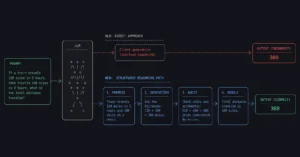
[Generic Phrase Input] ──> [Standard LLM Output] ──> [Regurgitated Public Web Text] ──> [Algorithmic Quality Filtering]

[Data Set + Constraints] ──> [Structured Loop] ──> [Highly Segmented Custom Matrix] ──> [Production-Grade SEO Assets]
When you use language models for search work, focus heavily on processing data rather than generating bulk text. Large models excel at scanning 50 competitor titles, pulling out formatting patterns, and finding the specific angles those articles missed. They are incredibly useful for sorting 2,000 raw keyword variants into thematic buckets in seconds—a task that used to take hours of manual filtering in Excel sheets.
This approach balances speed with rigorous quality control. By using the model to analyze context, build content frameworks, and manage structured data, you protect your site from shallow, automated text. This puts your focus back where it belongs: adding original data points that models cannot invent on their own.
The Data Processing and Semantic Clustering Pipeline
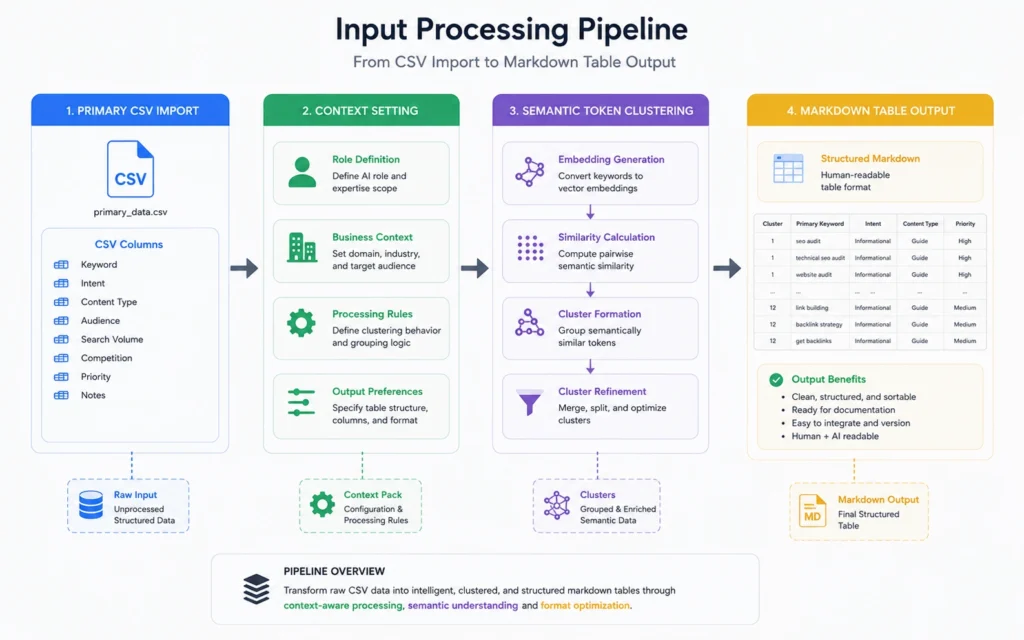
To run a reliable optimization workflow, you need to use advanced reasoning models like GPT-4o or o1-mini. These models handle complex logic and track constraints across long conversations much better than earlier variants.
Before pasting data into the prompt box, strip out raw vanity metrics like search volume estimates or click-through approximations. This keeps the model focused entirely on the semantic relationships between words.
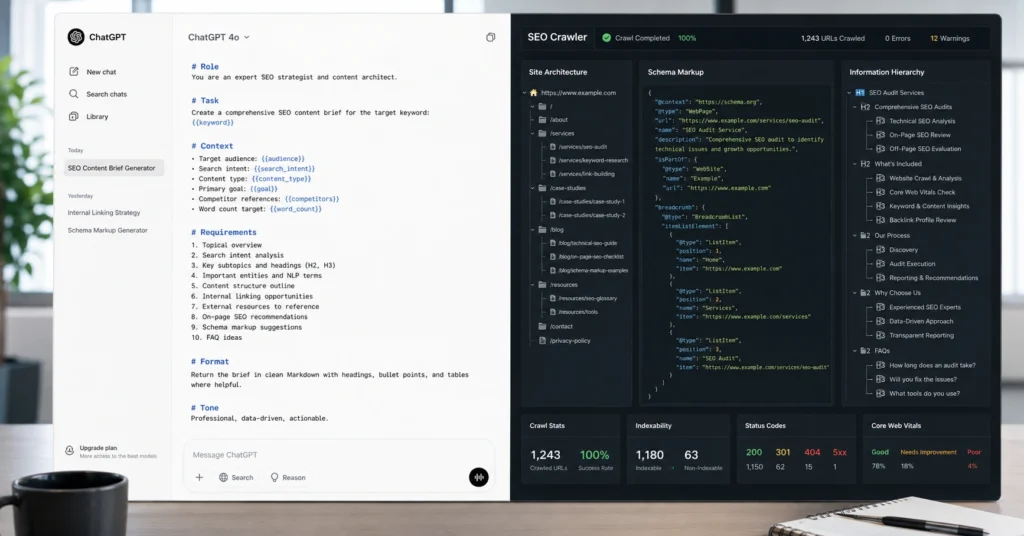
Here is the exact template you should use to cluster raw keywords by user intent. It uses clear instructions to prevent the model from slipping into generic marketing speak:
Plaintext
SYSTEM ROLE: You are a strict data analysis engine designed to process search information.

DATASET:
[Paste your raw keyword list here, one phrase per line]

INSTRUCTIONS:
1. Analyze the provided dataset for semantic intent similarity.
2. Group the phrases into distinct topical clusters based on what a searcher wants to accomplish.
3. Disregard estimated traffic numbers or pay-per-click values.
4. Output the completed analysis exclusively as a clean Markdown table with these columns: "Topical Cluster", "Core Intent Phrase", "Intent Classification (Informational, Commercial, or Transactional)", and "Underlying User Problem".
5. Do not include introductory text, meta-commentary, or summary explanations. Start directly with the Markdown table.
When you run this script, the engine reads past simple phrase matches to group keywords by the real user problems behind them. For example, it correctly groups “fix oil leak dashboard light” and “why is my car dripping oil” into the same troubleshooting bucket, even though they share very few letters. This gives you a clean, highly organized sheet of search intent topics without any chatbot fluff.
The Operational Workflow for Page Architecture and Gap Discovery
Once you have organized your keyword groups, use the model to build structural outlines for your content. Do not let the assistant choose your page sections blindly. Instead, give it exact competitor data so it can find the useful points your rivals missed.
Start by copying the top three ranking competitor outlines into the prompt window. You can grab these quickly using scraping tools or simple browser plugins.
Plaintext
CONTEXT ANALYSIS FRAMEWORK:
Target Keyword Cluster: [Insert your primary keyword cluster here]
Competitor A Outline: [Paste H2 and H3 structure]
Competitor B Outline: [Paste H2 and H3 structure]
Competitor C Outline: [Paste H2 and H3 structure]

TASK:
1. Contrast these competitor outlines to find missing structural subtopics.
2. Identify specific technical questions a user would have that these competitors fail to answer directly.
3. Build a comprehensive new page blueprint using H2 and H3 tags.
4. Highlight the unique data points or expert perspectives this page must include to beat the competition.
5. Format the final output as a clean structural checklist.
This structural analysis helps you spot clear weaknesses in existing search engine results pages. If the top three competitors only offer basic explanations, the system will highlight the exact technical details and process steps they skipped.
Using this output as a guide, you can write articles that directly address real user problems. This ensures your content earns its place at the top of search rankings by being genuinely useful, rather than just filling space.
Advanced Systems for Structural Optimization and Schema Enforcement
Writing your content is only half the battle; you also need to ensure it is properly optimized for search engine crawlers. ChatGPT is excellent at technical tasks like checking copy against structural requirements and generating error-free code blocks.
On-Page Element Auditing
To audit an existing article, paste your draft into the interface alongside your target keywords and use this structured prompt:
Plaintext
AUDIT OBJECTIVE: Review this draft against structural optimization requirements.

TARGET PHRASE: [Insert primary keyword]
SECONDARY KEYWORDS: [Insert 3-5 secondary keywords]

DRAFT COPY:
[Paste your full article draft here]

EVALUATION PARAMETERS:
1. Verify the primary keyword appears naturally within the first 100 words.
2. Check that subheadings are descriptive and informative rather than generic labels.
3. Flag any instances of repetitive phrasing or unnatural keyword stuffing.
4. List the precise technical terms or missing context needed to improve the depth of the piece.
5. Provide your feedback as a concise, bulleted list of actionable edits.
Automated Schema Mark-up Generation
Clean code helps search engines understand the structure of your site. You can generate custom schema blocks instantly by feeding your page details into this template:
Plaintext
CONTEXT: You are a technical web optimization engineer.

PAGE INFORMATION:
- Article Title: [Insert Title]
- Author Name: [Insert Author or Team]
- Publisher Name: [Insert Organization]
- Core FAQ Question 1: [Insert Question] / Answer: [Insert Answer]
- Core FAQ Question 2: [Insert Question] / Answer: [Insert Answer]

OUTPUT REQUIREMENT:
Generate a single, combined JSON-LD schema block that includes both Article and FAQPage structures. Ensure the code is valid, fully structured, and contains no trailing commas or markdown commentary. Wrap the output strictly in a standard code block.
Running these technical prompts protects your site from common deployment mistakes. Instead of guessing whether your content meets search guidelines, you get a clear checklist of improvements and valid code blocks ready to paste straight into your content management system.
Operational Limits and Alternative Approaches
Even the most advanced language models have hard limits when it comes to live search tracking. ChatGPT does not have an active index of historical search metrics, and it cannot calculate backlink profiles or monitor algorithm changes in real time. If you rely on it to guess search volumes, it will return inaccurate, hallucinated numbers that can ruin your strategy.
| Task Category | ChatGPT Performance | Recommended Alternative Tool |
| Intent Categorization | Excellent semantic grouping and data sorting | Manual spreadsheet organization |
| Keyword Metric Tracking | Poor (Often hallucinates old or inaccurate volumes) | Ahrefs, Semrush, or Keyword Insights |
| Technical Schema Output | Excellent formatting and syntax validation | Official Schema.org Validator |
| Content Auditing | Strong structural and contextual analysis | Clearscope or Surfer SEO |
If you need accurate search volume trends, live click-through data, or detailed backlink analysis, skip the language model entirely. Use professional databases like Ahrefs, Semrush, or Screaming Frog to collect your raw data. Once you have that verified information, pass it to ChatGPT to handle the heavy lifting of sorting, classifying, and structuring.
Frequently Asked Questions About ChatGPT for SEO
Does Google penalize content generated by ChatGPT?
Google prioritizes information quality and satisfying user intent over the production method. Automated text that adds no new values or exists solely to manipulate ranking thresholds gets caught by automated core quality systems. Review, edit, and append original dataset proof to prevent content filtering.
Can ChatGPT replace traditional keyword metrics from Ahrefs or Semrush?
No. Large language models calculate phrase probabilities rather than pulling continuous active web search volume indexes or live link graph data points. Use search engine intelligence engines to find baseline search volume data, then apply ChatGPT to classify search intent categories or map conceptual gaps.
How do you scale prompt operations across 100 pages without degradation?
Avoid huge individual multi-task instructions. Separate your work into clear pipelines. Run clustering first, generate outlines second, and evaluate schema markup third. Using distinct systemic steps ensures uniform formatting and limits the context hallucination that happens during massive single-pass operations.
Continue Exploring
- To build more advanced content systems, read our guide on
operational prompt engineering frameworks. This resource will help you design highly accurate, multi-step prompt workflows for complex content tasks. - If you want to discover more ways to automate your daily work, browse our
AI Tools hub. You will find a collection of tested tutorials and tool breakdowns to help you choose the right systems for your business.