Publishing exceptional content on a lightning-fast domain is no longer enough to guarantee top rankings. If your pages sit in isolation without external verification, modern discovery engines will systematically favor older, more established competitors. To solve this visibility bottleneck, you must understand exactly what are backlinks, how algorithms process domain authority signals, and how to execute link-building systems that survive continuous algorithm updates.
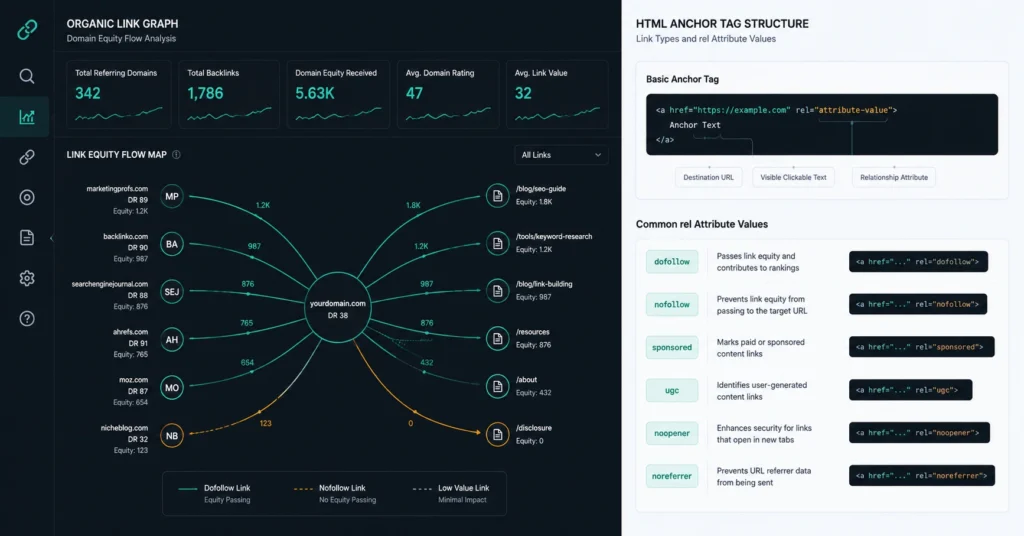
A backlink—or an inbound link—is created when an external website points its visitors to your URL using a standard HTML anchor element. In the infrastructure of search, these connections function as independent editorial validations.
Industry indexing benchmarks show that 96.6% of web content gets zero external links, and that pages occupying position one on Google possess an average of 3.8 times more links than positions two through ten. Links establish the trust required to rank for competitive commercial phrases.
What the Link Building Skill Rewards — and What It Punishes Intolerantly
Earning external citations rewards systematic relationship management and data-driven asset creation. If you publish original proprietary statistics, unique interface screenshots, or deep step-by-step code playbooks, other content creators will naturally reference your pages as primary data sources. This organic accumulation builds an enduring foundation that algorithm shifts rarely disrupt.
Conversely, the landscape brutally punishes automated shortcut tactics. Buying mass packages of low-quality profile citations, using automated comment networks, or joining private blog networks will burn your indexing integrity.
Modern real-time identification layers process historical domain relationships instantly, stripping equity from suspicious nodes without warning. If your link collection process relies entirely on automated software scripts rather than human editorial decisions, your domain exposure will collapse.
What to Know Before You Start Reaching Out for Links
Before sending a single outreach email, you must ensure your internal site foundation justifies an external recommendation. If an external editor clicks your link and finds a generic article patched together from basic search results, they will delete your message immediately. Your asset must provide an obvious value upgrade over whatever currently ranks on the first page.
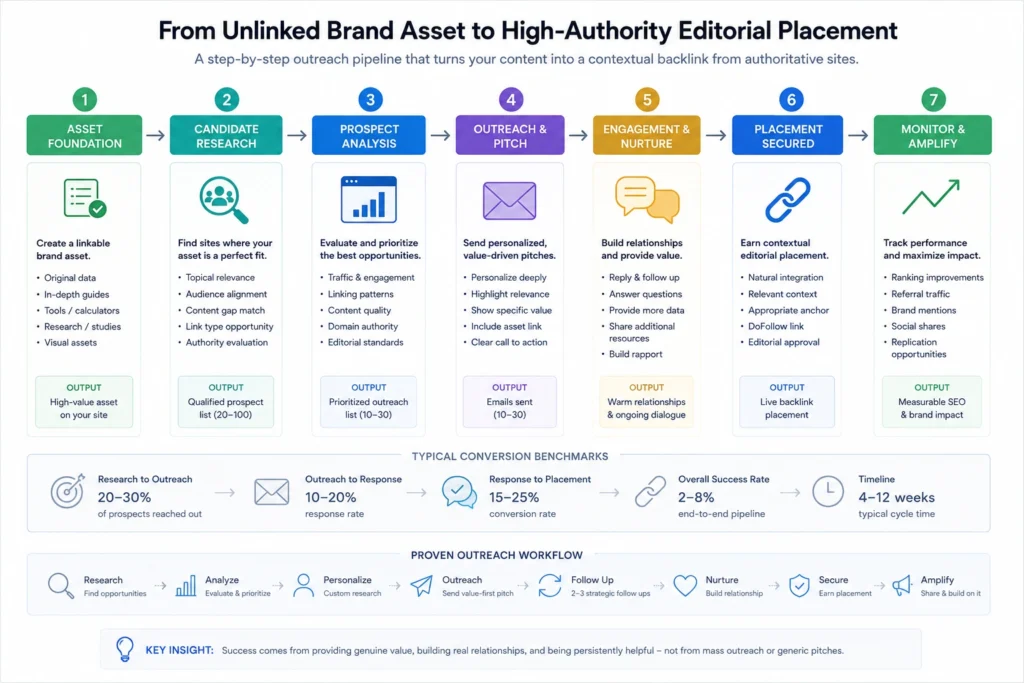
You must also understand that link building is an asymmetric numbers game. A typical, highly targeted cold outreach campaign using personalized templates yields an average response rate of roughly 8.5%. This means for every 100 high-quality, manually reviewed domain targets you contact, you will secure between 2 and 5 live contextual links. You must accept this conversion baseline before allocating capital or time to outreach workflows.
The Concepts That Matter Most — Named and Specific
To manage an external optimization strategy without wasting resources, you must understand the four primary link relationship attributes that search engine crawlers scan.
The Original Google PageRank Algorithm Core
The core framework of modern search still derives from the mathematical model where each hyperlink acts as a weighted vote. The algorithmic value of a link is not binary. It depends heavily on the authority of the originating page. A single citation from an authoritative domain with hundreds of its own trusted sources passes more structural weight than fifty links from fresh, unindexed hobby sites.
Dofollow Links vs. Nofollow Attributes
By default, standard links are dofollow links. This means they pass link equity directly to your target URL, explicitly signaling to search engines that you endorse the destination.
HTML
<a href="https://yoursite.com/resource">Data Guide</a>

<a href="https://yoursite.com/resource" rel="nofollow">Data Guide</a>
If an editor appends rel="nofollow", rel="ugc" (User Generated Content), or rel="sponsored", the link still routes human traffic, but it instructs search crawlers to bypass the passing of algorithmic authority signals.
Contextual Relevance and Niche Alignment
The thematic alignment between the two connecting domains alters how heavily a link weighs. If your technology site receives a recommendation from a major cybersecurity publication, the crawling layer registers a strong, authentic industry alignment. If that same link originates from an unrelated regional cooking forum, the contextual connection weakens significantly, rendering the link near-worthless for competitive phrase tracking.
Anchor Text Optimization Boundaries
Anchor text is the visible, clickable text contained within the HTML tags. It tells crawlers exactly what the destination page contains.
HTML
<a href="https://yoursite.com/email-tools">best email marketing software</a>
While descriptive anchor text provides an intense semantic signal, abusing it will trigger a penalty. If 80% of your incoming links use the exact match keyword you want to rank for, automated quality checks will flag the profile as artificial. A clean profile consists primarily of brand variations, natural phrases, and raw URLs.
Where People Get Stuck: Critical Errors, Myths, and False Starts
The most common point of failure for beginners is pursuing raw link metrics over actual contextual traffic. Many site owners purchase domain rating shortcuts, focusing entirely on climbing proprietary third-party tool scores rather than securing placements on websites that real humans read. A link from a site with zero organic traffic provides no value, regardless of what its automated domain metrics claim.
Another widespread myth is that you must completely avoid linking out to other authorities to preserve your own page equity. This concept, often called “PageRank hoarding,” causes people to build isolated pages that contain zero external citations.
Direct Contradiction: Google’s official documentation explicitly notes that linking out to authoritative external sources helps establish your own domain’s trustworthiness and document context. Hoarding links doesn’t save your authority; it just tells search engines that your article was written without referencing credible real-world data.
Tools, Workflows, and Outreach Templates That Actually Work
To execute this process efficiently, you need a software stack capable of analyzing competitor footprints, scraping contact addresses, and running personalized email campaigns.
The Standard Operator Tool Stack
- Ahrefs or Semrush: Used to review the exact backlink profiles of pages currently ranking in positions 1 through 3 for your target phrase.
- Hunter.io or RocketReach: Used to discover the direct professional email addresses of the managing editors or content managers holding administrative access to target domains.
- BuzzStream or Pitchbox: Used to manage your pipeline, schedule automated follow-up steps, and track live email open statistics.
The Unlinked Brand Mention Workflow
This is the highest-converting link acquisition process because the target organization already knows who you are.
- Set up a tracking alert using a monitoring tool to notify you whenever your brand name or proprietary tool asset is mentioned across the web.
- Filter the incoming alerts to isolate pages that mentioned your brand but forgot to insert a live hyperlink back to your site.
- Locate the author or managing editor’s direct email address using your discovery tools.
- Send a concise, zero-pressure alignment message within 48 hours of the article’s publication date.
The Contextual Editorial Outreach Template
Do not send generic, multiparagraph pitches that praise the target’s site before begging for a link. Keep your messages operational, brief, and focused on helping their reader.
Plaintext
Subject: Fix for your [Topic] guide

Hi [Name],

I was reading your framework on [Topic Page URL] while checking some resource links for my team.

I noticed you referenced the older baseline data from 2021 when discussing industry churn rates. We spent the last month tracking these shifts across 400 setups and mapped out the updated metrics for what are backlinks 2026.

The updated breakdown is completely open here if you want to take a look: [Your URL]

It might make a useful update for your readers if you revise that section. Either way, keep up the clean work on the guide.

Best,

[Your Name]
[Your Title]
What It Costs: Real Budgets, Time Commitments, and Resource Scarcity
Executing a competitive link acquisition process requires significant resource allocation. If you choose to manage the process internally using in-house resources, your entry-level monthly software stack costs run across a clear baseline:
| Tool Category | Specific Platform | Minimum Monthly Cost (USD) |
| Competitor & Profile Analysis | Ahrefs (Lite/Standard) | $129 – $249 |
| Contact Information Scraping | Hunter.io (Starter) | $49 |
| Pipeline & Outreach Management | BuzzStream (Growth) | $124 |
| Total Operational Stack Baseline | Combined Systems | $302 – $422 |
Beyond pure software expenses, consider the manual time cost. Researching 50 verified target domains, identifying the correct editors, verifying their email addresses, and writing distinct personalizations takes a trained operator approximately 6 to 8 hours of uninterrupted labor.
If you decide to outsource this operation to a premium digital PR agency, high-authority editorial placements typically cost between $350 and $600 per earned link. Any service offering links for $50 is selling mass-produced network spam that will damage your long-term visibility.
When to Use an Active Link Acquisition Strategy and When to Stand Down
You should launch an active outreach campaign only when you are attempting to break into competitive commercial categories where the top search results all possess established authority backbones.
If your business depends on ranking for high-value transactional keywords like “best project management tools,” you cannot win on content quality alone. You must actively build links to clear the competitive authority bar.
Do not invest time or capital into aggressive link acquisition if you are targeting niche, low-competition informational queries. If your primary goal is ranking for long-tail phrases like “how to clean git history after accidental push,” optimizing your internal on-page execution and heading hierarchy is typically enough to secure position one. Focus your time on expanding your topical coverage rather than chasing unnecessary external links.
What to Skip Entirely — And What to Execute Instead
Skip manual registration across generic web directories, dead blog communities, and low-tier press release syndication engines. These distribution channels pass zero authority because search engines have indexed their footprints as automated distribution noise for over a decade.
Instead of spending hours submitting your platform link to obscure directories, invest that time into building an exchange asset. Spend that day assembling a single high-value data graphic or a functional utility tool—like a custom pixel-counter for metadata lines.
Once published, share that tool directly with authors currently writing how-to guides in your industry. A single live link from an operational guide where a writer says “use this tool to calculate your boundaries” will pass more long-term authority than five hundred directory drops.
Frequently Asked Questions About Backlinks
How long does it take for a new backlink to impact my rankings?
A new link typically shifts ranking positions within 14 days to 6 weeks. The timeline depends entirely on how frequently Googlebot recrawls the specific hosting page where your link was added.
Can I protect my site if a toxic or spammy directory links to me?
Google’s modern SpamBrain system ignores automated low-quality links automatically. You do not need to use the manual disavow tool unless you received a formal manual action notification in Search Console.
Is it safe to buy cheap foundational links from freelance marketplaces?
No. Buying link packages consisting of profile drops or forum signatures violates core search policies. Automated updates filter these footprints instantly, rendering your expenditure useless and burning your domain setup.
Continue Exploring
- Keyword Research — Identify the high-value commercial phrases that justify an active outreach budget.
- On-Page SEO — Fix your content structure and heading alignment before driving external authority to your URLs.