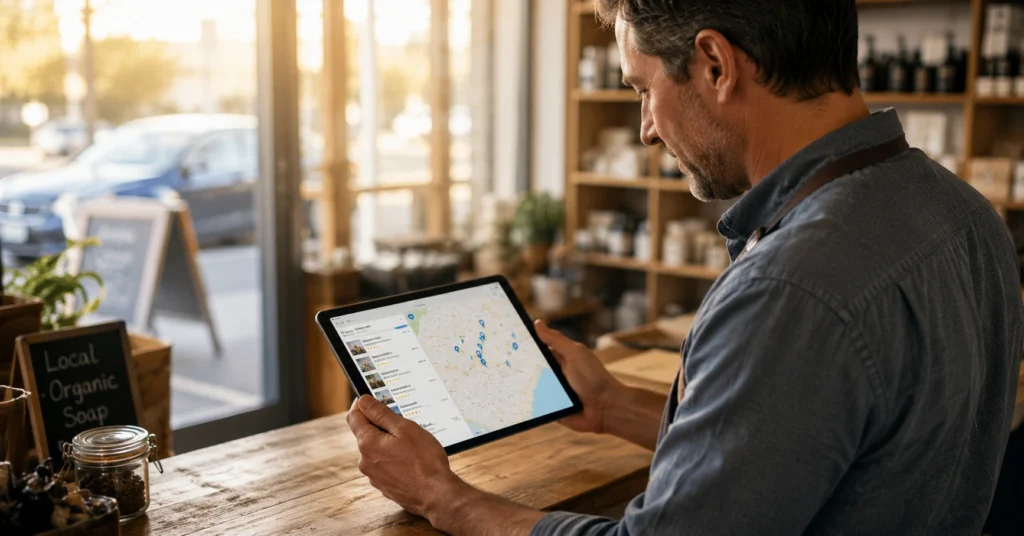
Local SEO is not about tricking an algorithm. It is about proving to a machine that your physical business actually exists and is the most relevant answer for someone standing three blocks away holding a phone.
I spent my first year in local search chasing algorithm updates, wasting 14 hours a week tweaking meta descriptions for a plumbing client who just needed his Google Business Profile phone number verified. The algorithm didn’t care about his meta tags. It cared that his competitor had 40 reviews mentioning “emergency pipe repair” while he had zero.
Local SEO rewards operational consistency and punishes anyone who treats it as a one-time setup task. This guide breaks down the exact mechanics of ranking in the local pack, assuming you have never touched a search console in your life. You will learn the specific levers to pull, the tools that actually work, and the exact time it takes to see results.
What Local SEO Rewards — and What It Punishes
You have probably stared at the map pack on your phone, wondering why the plumber with the worse website is ranked higher than yours. It feels arbitrary. It isn’t.
The map pack is not a traditional ranking. It is a trust filter. Google is trying to protect its users from sending them to businesses that are closed, moved, or terrible at their job. When you approach local SEO for beginners, you need to understand that the system rewards verifiable reality. If your business name, address, and phone number (NAP) are identical across 40 different directories, the algorithm trusts that you actually exist at that location.
The Punishment for Inconsistency If your address is listed as “123 Main Street” on your website, but “123 Main St, Suite B” on Yelp, and “123 Main St.” on Facebook, the algorithm hesitates. It doesn’t know which is real. That hesitation drops your ranking.
The Reward for Operational Consistency When your data is perfectly synchronized, and you consistently ask for reviews after every job, the algorithm stops hesitating. It starts recommending you.
Most business owners treat their online presence like a billboard. They put it up and walk away. Local search requires you to treat it like a living employee. It needs daily attention, constant verification, and regular updates. If you are not willing to log in and update your profile when your hours change for a holiday, you will lose to the competitor who does.
The Baseline: What to Know Before You Claim Your Profile
Claiming your Google Business Profile (GBP) is the starting gun, not the finish line. Most businesses claim it, fill in the hours, upload three blurry photos, and never log in again. That is exactly why they stay invisible.
Your GBP is your digital storefront. It is the single most important asset you own in local search. Before you touch any other tool or strategy, you need to optimize this specific profile.
The Verification Hurdle Google will not just let you claim a business. You have to prove you control the physical location. They usually do this by mailing a postcard with a verification code to your address, or by requiring a video walkthrough of your workspace. Do not skip this. An unverified profile is invisible in the map pack.
The Category Trap When you set up your profile, you must choose a primary business category. This is the single strongest relevance signal you can send. If you are a personal injury lawyer, do not choose “Lawyer” as your primary category. Choose “Personal Injury Attorney.” The primary category dictates what searches you show up for. You can add secondary categories later, but the primary one anchors your entire local presence.
The Service Area Definition If you visit customers (like a roofer or cleaner) and don’t want your home address public, you can set up a Service Area Business (SAB). You hide your address and draw a radius around the cities you serve. Keep this radius realistic. Setting a 50-mile radius when you only actually drive 15 miles will hurt your conversion rate and confuse the algorithm about your true proximity to searchers.
The Concepts That Actually Move the Needle
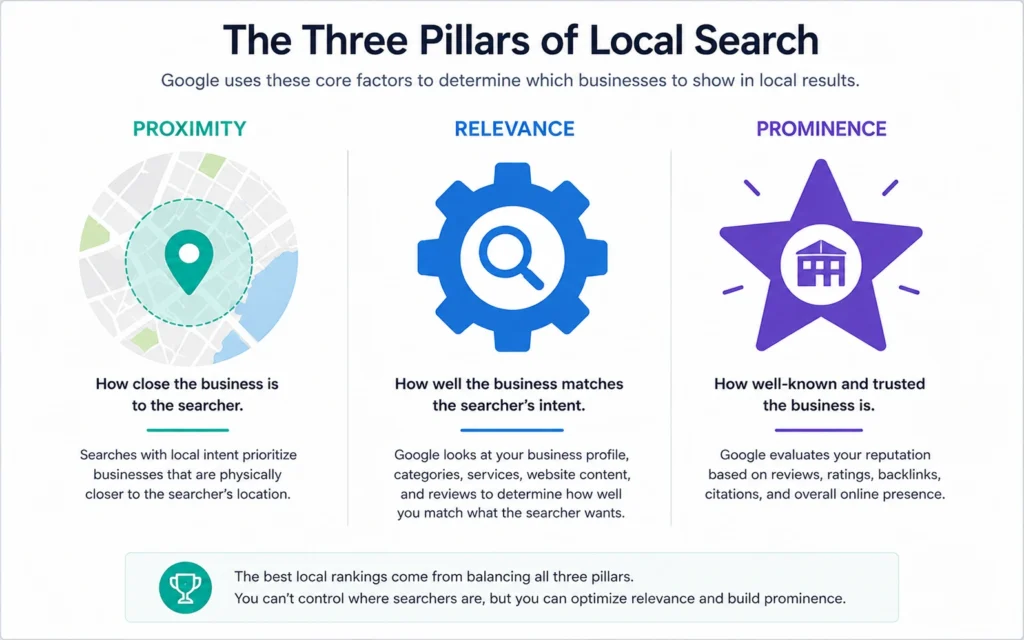
To understand how to rank, you need to understand the three forces that govern local search: Proximity, Relevance, and Prominence.
Proximity is a Hard Constraint This is the physical distance between the searcher and your business. If someone searches for “coffee shop” while standing in downtown Chicago, a shop in the suburbs is not going to rank, no matter how good its SEO is. You cannot optimize your way out of physics. However, you can win on the other two factors to dominate your specific neighborhood.
Relevance is About Matching Intent This measures how well your profile matches what the user is actually looking for. If someone searches for “vegan bakery,” and your profile mentions “gluten-free options” in your services but never mentions vegan, you lack relevance. You build relevance by ensuring your business description, services list, and website content explicitly name the specific problems you solve.
Prominence is Your Digital Reputation This is where most small businesses win or lose. Prominence is how well-known you are, both offline and online. Google measures this through your review count, your star rating, the number of times your profile is clicked in the map pack, and the number of authoritative websites linking to your business.
Note: I spent months trying to force a client to rank in a zip code three towns over. We optimized everything perfectly. We still didn’t rank. The proximity constraint was too strong. We shifted our focus to dominating their home zip code instead, and their revenue doubled. Know your physical limits.
Where Beginners Get Stuck: The “Set and Forget” Myth
The biggest mistake in local SEO 2026 is assuming that once your profile is optimized, the work is done. It isn’t. The map pack is dynamic. Your competitors are actively trying to take your spot.
The Review Velocity Trap Many beginners panic when their review count stalls. They turn to automated review generation tools or, worse, buy fake reviews. This is a fatal error. Google’s algorithm detects unnatural review velocity and generic text patterns. Getting caught results in a hard suspension that wipes your profile clean, taking your ranking with it.
The Honest Alternative Stop looking for software to automate your reputation. Build a manual, post-service review workflow. When a job is done, the technician or cashier should look the customer in the eye and say, “It would help us immensely if you mentioned the specific service we did in a quick Google review.” Then, hand them a printed card with a direct, pre-shortened link to your review page. Do not send an automated email three days later when they have already forgotten you.
The Photo Dump Mistake Uploading 20 blurry photos of your logo does not help your prominence. Google’s computer vision analyzes the actual content of your images. Upload high-quality, well-lit photos of your actual work, your team, and the exterior of your building. Tag them with descriptive file names before you upload them.
Tools, Workflows, and Examples That Actually Help
You do not need an expensive enterprise suite to manage local search. You need a few specific tools that solve specific problems.
1. The Native Google Business Profile App This is your daily driver. Use it to post weekly updates, respond to reviews, and upload photos directly from your phone. It is free and it is the only tool that communicates directly with the map pack.
2. A Grid-Based Rank Tracker (Local Falcon or BrightLocal) Standard rank trackers tell you where you rank for a keyword in a specific city. That is useless for local search. You need a grid tracker. It drops a 3×3 or 5×5 grid over your target area and tells you exactly where you rank on every single street corner. This shows you if you are dominating your immediate block but invisible two miles away.
3. Data Aggregator Audits (Localesize or Moz Local) Most beginners manually check 50 random directories to see if their NAP is consistent. This is a waste of time. Google pulls its baseline data from three major data aggregators: Foursquare, Neustar (formerly Localeze), and Data Axle. If your data is wrong at the aggregator level, it will eventually corrupt your directory listings. Use a tool to check and fix your data at the aggregator source first.
4. Review Response Templates (Native or Simple Text File) Do not overthink review responses. Keep them brief, thank the customer, and repeat the service they mentioned. “Thanks, John. Glad we could fix that leaking water heater quickly.” This naturally injects keywords into your profile without looking spammy.
What It Costs: Time, Money, and Attention
Local SEO is not free, but it is significantly cheaper than paid ads. Here is the real cost of doing it yourself.
Time Cost Expect to spend 3 hours a week on local SEO once your profile is fully set up.
- 30 minutes: Responding to reviews and answering Q&A.
- 30 minutes: Uploading new photos and writing a Google Post.
- 2 hours: Building local citations, checking rank tracker data, and updating website content.
Money Cost
- Google Business Profile: $0.
- Grid Rank Tracker (Local Falcon/BrightLocal): $30 to $50 per month.
- Citation Building Service (if you don’t want to do it manually): $100 to $200 one-time fee.
Attention Cost This is the hidden cost. You have to care about what people are saying about you. You have to read the negative reviews, figure out what went wrong operationally, and fix it. If you cannot handle public feedback, local SEO will be a miserable experience.
When to Use This Approach and When Not To
Local SEO is highly specific. It does not apply to every business on the internet.
Use Local SEO If:
- You have a physical storefront (retail, restaurants, clinics).
- You travel to your customers (plumbers, electricians, landscapers, consultants).
- Your customers are searching for you with geographic modifiers (e.g., “near me,” “in [City Name]”).
Do Not Use Local SEO If:
- You sell physical products online to a national audience (E-commerce).
- You sell software or digital services globally (SaaS).
- You do not have a verifiable physical address or a defined local service area.
If you fall into the “do not use” category, stop reading this guide and start researching national organic SEO or e-commerce conversion optimization. Trying to force a local strategy on a national business will waste your time and confuse your marketing.
What to Skip — and What to Do Instead
The local search space is full of bad advice inherited from 2015. Here is what you need to ignore.
Skip: Keyword Stuffing Your Business Name Do not name your profile “Bob’s Plumbing – Best Plumber in Chicago.” This is a direct violation of Google’s guidelines. It might get you a temporary ranking bump, but it will eventually trigger a manual action that suspends your profile.
Do Instead: Keep your business name exactly as it appears on your storefront and legal documents. Put your keywords in your business description, your services list, and your website content.
Skip: Building Hundreds of Low-Quality Directory Links Getting listed on 500 random, obscure web directories does not build prominence. It looks like spam.
Do Instead: Focus on the top 20 authoritative directories (Yelp, YellowPages, industry-specific associations) and ensure your data is 100% perfect. Then, focus on earning links from local news sites, sponsorships, and local blogs. One link from a local newspaper is worth 100 links from random directories.
Skip: Ignoring the Q&A Section Most businesses leave the “Questions & Answers” section of their GBP blank. Users can ask questions, and anyone can answer them—including your competitors, who might give wrong information.
Do Instead: Populate the Q&A section yourself. Ask common questions from your own personal account, and answer them from your business account. “Do you offer emergency services on weekends?” “Yes, we are available 24/7 for emergency pipe repairs.” This controls the narrative and adds highly relevant keyword text to your profile.
Frequently Asked Questions About Local SEO
How long does it take to see results from local SEO?
Most businesses see initial movement in the map pack within 4 to 8 weeks of optimizing their profile and building citations. Significant ranking shifts and increased call volume typically take 3 to 6 months of consistent effort.
Do I need a physical storefront to rank in local search?
No. Service-area businesses like plumbers or consultants can hide their address and define a specific service radius. However, you still need a verified physical presence or service area to qualify for a Google Business Profile.
What is the most important factor for local SEO in 2026?
Relevance and proximity remain the primary drivers, but behavioral signals like click-through rates from the map pack and the velocity of genuine, detailed customer reviews now carry significantly more weight than they did in previous years.
Should I pay for fake reviews to boost my ranking?
Never. Google’s algorithm detects unnatural review velocity and generic text patterns. Getting caught results in a hard suspension that wipes your profile clean. Focus entirely on manual, post-service review requests.
Continue Exploring:
- optimize your Google Business Profile to learn the exact weekly posting schedule that drives map pack clicks.
- build a review generation workflow to set up a manual system that gets you more 5-star ratings without violating guidelines.