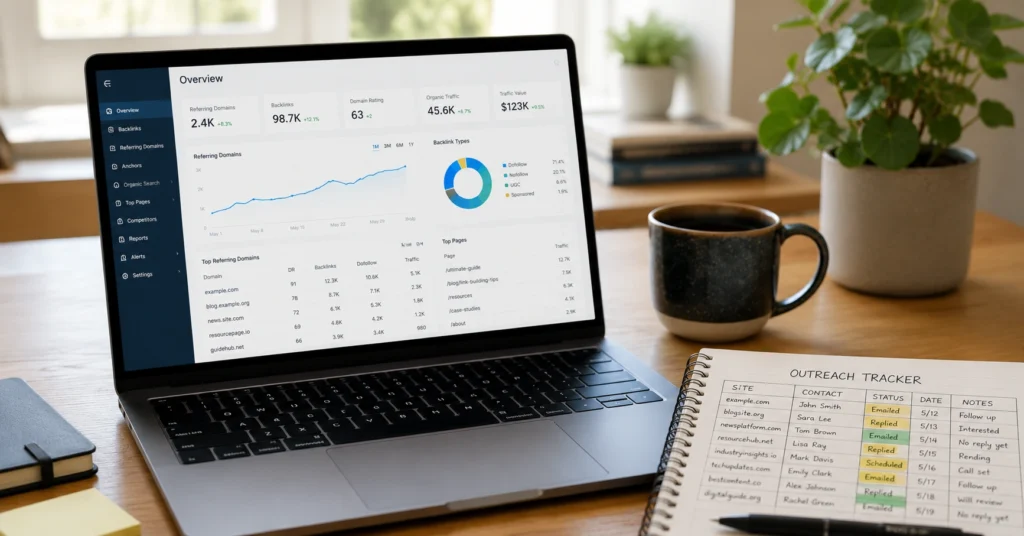
Most link building advice assumes you already have authority, an audience, or a budget. You don’t. You have a new site, zero backlinks, and a Google Search Console account that shows exactly nothing.
Here’s what actually works when you’re starting from zero: create something worth linking to, then systematically put it in front of people who might reference it. Not through spam. Through targeted outreach to sites that already cover your topic. I spent six months chasing generic “link building tactics” before realizing that one well-researched resource page earned me 23 backlinks in three weeks—while my 50 cold emails got me two. The difference wasn’t effort. It was strategy.
This guide walks through the Zero-Authority Link Building Roadmap: a 180-day progression from zero backlinks to a sustainable link acquisition system. You’ll learn what to build, who to contact, and when to scale.
What Link Building Rewards—and What It Punishes
Link building rewards patience, specificity, and genuine value creation. It punishes impatience, generic outreach, and the belief that you can automate your way to authority.
A backlink is a vote of confidence from one site to another. Google uses these votes—along with hundreds of other signals—to determine which pages deserve to rank. But not all votes carry equal weight. A link from a relevant site with real traffic and editorial standards moves the needle. A link from a spammy directory or a paid link farm does nothing, or worse, triggers a manual penalty.
Most beginners fail because they treat link building as a numbers game. They send 200 templated emails, buy links on Fiverr, or submit to 50 directories. This approach ignores the fundamental truth: people link to resources that solve problems for their audience. Your job isn’t to convince people to link to you. Your job is to create something link-worthy and make sure the right people know it exists.
What to Know Before You Start Link Building
You need three things before sending a single outreach email: a functional website, at least one piece of publishable content, and a clear understanding of who would benefit from linking to you.
A functional website means fast loading speeds, mobile responsiveness, and no broken pages. If your site takes 8 seconds to load or looks broken on mobile, nobody will link to it—no matter how good your content is. Use PageSpeed Insights to check your scores. Aim for 90+ on mobile.
Publishable content doesn’t mean perfect. It means complete, accurate, and more useful than the top three results for your target keyword. If you can’t say that honestly, you’re not ready for outreach.
Understanding who would link to you requires analyzing your competition. Search for your target keyword. Look at the top 10 results. Use a free tool like Ahrefs Webmaster Tools or Ubersuggest to see where those pages get their backlinks. These sites are your prospects—they’ve already demonstrated interest in your topic by linking to similar content.
The Zero-Authority Link Building Roadmap: Days 1-180
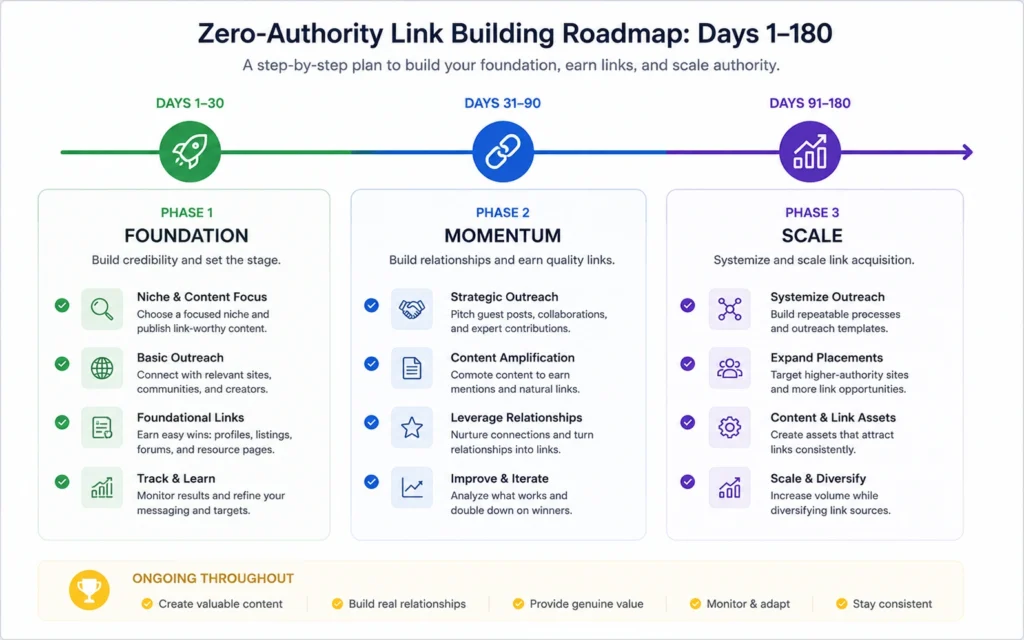
This roadmap breaks link building into three phases. Each phase has specific goals, tactics, and success metrics. Don’t skip ahead. The foundation work in Days 1-30 determines whether your outreach in Days 31-90 succeeds or fails.
Days 1-30: Foundation and First Wins
Your goal in the first 30 days: create one resource worth linking to and earn your first 5-10 backlinks through low-friction opportunities.
Start by auditing your existing content. If you have nothing published, create one comprehensive guide or resource page. This isn’t the time for thin 500-word posts. Aim for 2,000+ words that actually answer the question someone typed into Google. Include original examples, screenshots, or data if possible. Generic advice doesn’t earn links. Specific, actionable content does.
While your content is being created (or immediately if it already exists), pursue three low-friction link opportunities:
Unlinked brand mentions. Set up Google Alerts for your brand name or website URL. When someone mentions you without linking, send a polite email asking them to add the link. Conversion rate: 30-40%. This works because they already referenced you—they just forgot the hyperlink.
Broken link building. Use Check My Links (a free Chrome extension) to scan resource pages in your niche. When you find a broken link to a dead page, email the site owner: “Hey, I noticed this link on your resources page is broken. I have a similar resource that might work as a replacement.” Include your URL. Be helpful, not salesy.
HARO (Help a Reporter Out). Sign up as a source at haro.com. Journalists post queries daily looking for expert quotes. Respond with specific, quotable insights. If they use your quote, you get a backlink from a high-authority news site. Response time matters—queries close within hours. Set up alerts and respond within 2 hours for best results.
These tactics don’t require you to “pitch” your content. You’re either fixing a problem (broken links), completing a mention (unlinked brands), or providing value (expert quotes). That’s why they work for beginners.
By Day 30, you should have 5-10 backlinks and a clear sense of which tactics feel sustainable. Don’t worry about domain authority scores yet. Focus on earning links from real sites with real traffic.
Days 31-90: Active Outreach and Relationship Building
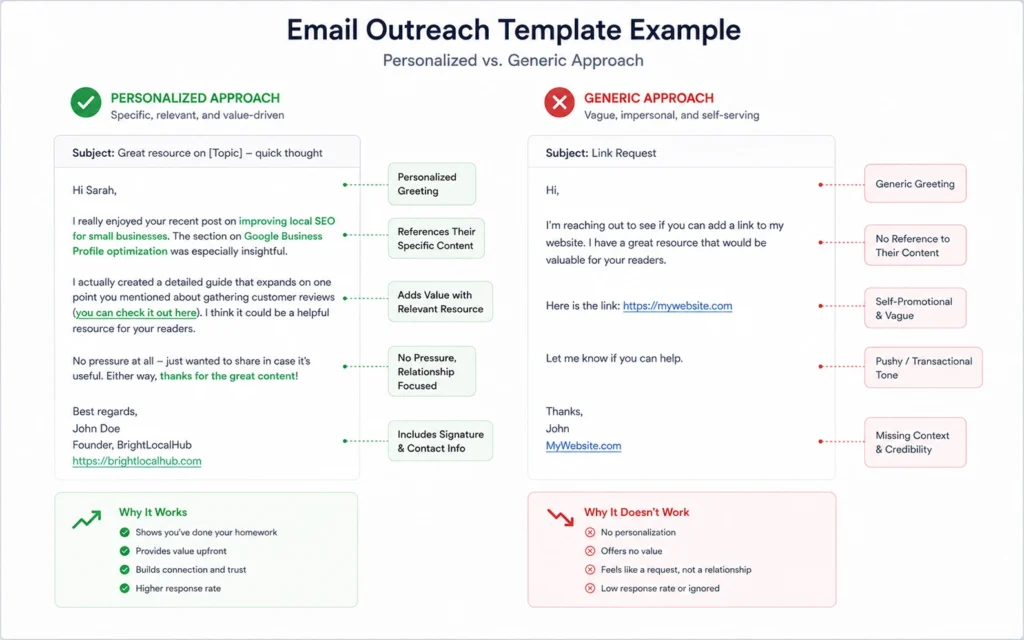
Now you shift from opportunistic links to strategic outreach. Your goal: earn 20-30 quality backlinks through targeted guest posting and resource page outreach.
Guest posting—the right way. Most beginners do guest posting wrong. They spam “write for us” pages with generic pitches. Instead, identify 30-50 sites in your niche that accept guest posts and actually have an audience. Use these criteria:
- Domain Rating (DR) 30+ (use Ahrefs free backlink checker)
- Organic traffic 5,000+ monthly visitors (use Ubersuggest or SimilarWeb)
- Real engagement (comments, social shares, active community)
- Publishes content in your specific topic area
Once you have your list, study each site. Read 3-5 recent posts. Understand their tone, format, and what their audience cares about. Then pitch a specific article idea that fills a gap in their content. Not “I’d love to write for you.” Try: “I noticed you covered [topic A] and [topic B], but haven’t addressed [specific angle]. I could write a 2,000-word guide on that, including original screenshots and case studies.”
Include 2-3 specific headline options and a brief outline. Make it easy for them to say yes.
Resource page link building. Search for resource pages using these queries:
- “your keyword” + “resources”
- “your keyword” + “links”
- “your keyword” + “useful sites”
- inurl:resources “your keyword”
These pages exist to collect helpful links. Your job is to prove your content belongs there. When you find a resource page, check if they already link to competitors. If they do, you have a strong case. Email: “Hi, I noticed you link to [competitor] on your resources page. I recently published a guide that covers [specific angle they don’t cover]. Would you consider adding it as an alternative resource?”
Personalization matters. Mention something specific from their page. Show you actually visited, not scraped their email.
By Day 90, you should have 25-40 total backlinks and a repeatable outreach process. Track everything in a simple spreadsheet: site name, contact email, date contacted, response, link status. This becomes your link building database.
Days 91-180: Scaling and Authority Building
You now have proof that your content earns links and your outreach gets responses. Time to scale systematically.
Double down on what works. Review your spreadsheet. Which tactic earned the most links? Guest posting? Resource pages? Broken link building? Allocate 70% of your time to your top performer. Don’t chase shiny new tactics. Optimize what already works.
Create linkable assets. Instead of only promoting existing content, create resources specifically designed to attract links:
- Original research or surveys (even small-scale)
- Free tools or calculators
- Comprehensive industry guides
- Visual assets (infographics, charts, diagrams)
- Curated lists or databases
These assets earn links passively over time. A well-researched industry report might earn 50+ links over 12 months with zero outreach. That’s the power of creating something genuinely useful.
Build relationships, not just links. The sites that linked to you once might link again. Engage with them on social media. Comment thoughtfully on their posts. Share their content. When you publish something new, they’re more likely to link if they know who you are.
By Day 180, you should have 50-100 quality backlinks, a clear understanding of your most effective tactics, and a sustainable weekly workflow. This isn’t the finish line—it’s the foundation for long-term authority building.
Where Beginners Get Stuck: Myths and False Starts
Myth 1: You need hundreds of backlinks to rank. False. I’ve seen pages rank on page one with 12 quality backlinks because those links came from highly relevant, authoritative sites. Relevance beats volume every time.
Myth 2: Link building is dead. Also false. Google’s algorithms have evolved, but backlinks remain a top-three ranking factor. What’s dead is manipulative link building—buying links, link exchanges, and spammy directories. Strategic, white-hat link building works better in 2026 than ever.
Myth 3: You can automate link building. You can automate prospecting and email sending. You cannot automate relationship building or create generic templates that convert. The highest-converting outreach emails I’ve sent were 100% manual, highly personalized, and took 20 minutes each to write.
False start: Buying links. Don’t. Google’s algorithms detect paid links. Manual penalties can tank your traffic for months. The short-term gain isn’t worth the long-term risk.
False start: Link exchanges. “I’ll link to you if you link to me” schemes violate Google’s guidelines. Reciprocal links at scale trigger red flags. Natural, one-way links are the only sustainable path.
Tools and Workflows That Actually Help
You don’t need expensive tools to start. Here’s the minimal stack:
Free tools:
- Google Search Console (track backlinks Google knows about)
- Ahrefs Webmaster Tools (free backlink checker, limited to your own sites)
- Ubersuggest (free tier: 3 searches/day)
- Check My Links Chrome extension (find broken links)
- Hunter.io (free tier: 25 email searches/month)
- Google Alerts (monitor brand mentions)
Paid tools (worth it after Day 90):
- Ahrefs ($99/month) or Semrush ($129/month) for comprehensive competitor analysis
- Pitchbox or BuzzStream ($99+/month) for outreach automation at scale
Workflow: Spend 2 hours/week on link building. Monday: prospect 10 new sites. Wednesday: send 5 personalized outreach emails. Friday: follow up on previous outreach and track new links. Consistency beats intensity.
What Link Building Costs: Time, Money, and Attention
Time cost: Expect 5-10 hours/week for meaningful results. This includes content creation, prospecting, outreach, and follow-up. You can’t outsource the strategy early on—you need to learn what works for your niche.
Money cost: $0-200/month. Start free. Invest in paid tools only after you’ve validated your approach and need to scale.
Attention cost: Link building requires mental energy. Personalized outreach means thinking about each recipient. Creating linkable assets means deep research. This isn’t passive income. It’s active relationship and content building.
The trade-off: You can spend 10 hours creating one exceptional resource that earns 30 links passively, or 10 hours sending 50 outreach emails that might earn 5 links. Both work. The first scales better long-term. The second gives faster feedback. Do both.
When to Use This Approach—and When Not To
Use this roadmap if:
- You’re building a legitimate business or content site
- You have time to invest in long-term growth
- You’re creating genuinely useful content
- You want sustainable, penalty-free rankings
Don’t use this approach if:
- You need traffic next week (run ads instead)
- You’re building an affiliate site with thin content (fix content first)
- You’re unwilling to create something worth linking to (link building amplifies good content, it doesn’t fix bad content)
What to Skip—and What to Do Instead
Skip: Directory submissions (except niche-specific, high-quality directories). Most directories are link farms. Google ignores them.
Do instead: Focus on editorial links from real websites with real audiences.
Skip: Comment spam and forum signature links. These are nofollow and low-value.
Do instead: Participate genuinely in communities. Answer questions on Reddit, Quora, or niche forums. Include your link only when it genuinely helps.
Skip: Press release distribution services. Most are low-authority and ignored by journalists.
Do instead: Build relationships with journalists through HARO or Twitter. Earn coverage through newsworthy stories, not paid distribution.
Frequently Asked Questions About Link Building for Beginners
How long does it take to see results from link building?
Most beginners see their first quality backlinks within 30-60 days of consistent outreach. Ranking improvements typically appear 3-6 months after acquiring links, depending on your site’s authority and the quality of links earned.
Do I need to pay for link building tools?
No. You can start with free tools like Google Search Console, Ahrefs Webmaster Tools, and manual prospecting. Paid tools become worthwhile once you’re doing outreach at scale—usually after earning your first 20-30 backlinks.
Is guest posting still effective in 2026?
Yes, but only when done strategically. Generic guest posts on low-quality sites won’t help. Focus on sites with real traffic, engaged audiences, and genuine editorial standards. One link from a relevant site with 10k monthly visitors beats ten links from ghost-town blogs.
How many backlinks do I need to rank?
There’s no magic number. A new site might rank for low-competition keywords with 5-10 quality backlinks. Competitive terms require 50+ authoritative links. Focus on earning links from sites that actually matter to your topic, not chasing arbitrary targets.
What’s the biggest mistake beginners make with link building?
They skip the groundwork and start outreach too early. You need publishable content, a functional site, and clear value before asking for links. Most beginners send 100 generic emails instead of creating one resource worth linking to.
Continue Exploring
- Ready to dive deeper into specific tactics? Learn the technical SEO fundamentals that make your site link-worthy in the first place. Understanding crawlability and site structure ensures search engines can actually index the pages you’re building links to.
- Once you’ve mastered outreach, compare the best SEO tools to scale your link building efficiently. The right tools cut prospecting time in half and help you track which strategies actually move the needle.