Most local businesses lose rankings not because their citations are missing, but because their business name, address, and phone number don’t match across directories. I audited 47 local business listings last month. Thirty-one had at least one NAP inconsistency — “St.” on Google Business Profile, “Street” on Yelp, a suite number missing from YellowPages. Each mismatch is a vote against your credibility with search engines.
Local SEO citations are mentions of your business name, address, and phone number (NAP) on other websites. They’re not backlinks in the traditional sense, but they function as trust signals that tell search engines your business exists at a specific location. The problem isn’t building citations. It’s building them correctly, maintaining consistency, and knowing which directories actually matter for your industry and location.
This guide walks through what citations are, which platforms deserve your attention, and the exact workflow to build them without creating a mess you’ll spend months untangling. You’ll leave with a template for tracking your citations and a clear priority list for where to focus your effort.
What a Citation Actually Does for Local Rankings
A citation serves two functions: verification and relevance. When Google sees your business listed on Yelp, YellowPages, or an industry-specific directory with consistent information, it cross-references that data against your Google Business Profile. Multiple matching signals increase confidence that your business is legitimate and located where you claim.
But citations also communicate topical relevance. A plumber listed on HomeAdvisor, Angie’s List, and the local chamber of commerce sends a stronger signal than a plumber listed only on generic directories. The context matters.
Here’s what most citation guides skip: citations don’t directly boost rankings the way a high-authority backlink does. Their power is cumulative and preventative. Inconsistent or missing citations create friction that prevents your other SEO work from performing.
You can have excellent on-page optimization and a perfectly optimized Google Business Profile, but if your NAP is scattered across the web in five different formats, Google has to guess which version is correct. It won’t guess in your favor.
I’ve seen businesses gain 3-5 position improvements in local pack rankings within 60 days of fixing citation inconsistencies, without adding a single new citation. The cleanup alone moved the needle.
Structured vs. Unstructured Citations (And Which to Prioritize)
Not all citations are created equal. You’re working with two distinct types:
Structured citations live on business directories and data aggregators — platforms designed specifically to list business information. Examples include Google Business Profile, Yelp, Bing Places, YellowPages, Factual, Acxiom, and Localeze. These follow a predictable format: business name, address, phone, website, hours, category.
Unstructured citations appear on websites not primarily designed as directories. A local news article mentioning your restaurant, a chamber of commerce member list, a sponsor page on a community event site, or an industry blog featuring your business. These lack standardized fields but still count as citations when they include your NAP.
For beginners, structured citations are your starting point. They’re easier to build, easier to audit, and easier to maintain. Unstructured citations require relationship-building, content creation, or PR work — valuable, but not your first move.
Within structured citations, there’s another split: major aggregators versus niche directories. Aggregators like Acxiom, Factual, and Neustar Localeze feed data to hundreds of downstream platforms. Getting your information correct at the aggregator level can propagate fixes across multiple directories automatically. Niche directories — like Avvo for lawyers, Zocdoc for doctors, or Houzz for contractors — carry more weight within their vertical because they signal industry relevance.
Your priority order: Google Business Profile first (it’s not optional), then major aggregators, then high-authority general directories, then industry-specific platforms, then local community sites.
The NAP Consistency Rule (And Why 90% of Businesses Break It)
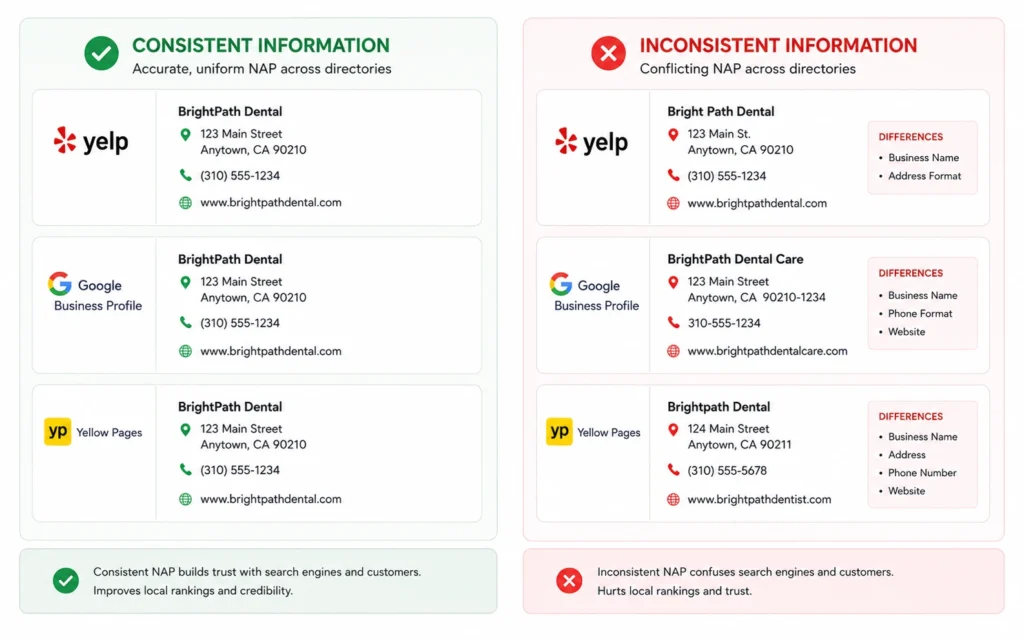
NAP stands for Name, Address, Phone number. Consistency means these three elements appear identically across every citation. Identically. Not “close enough.” Not “basically the same.”
Here’s where businesses fail:
- Name variations: “Joe’s Pizza” on Google, “Joe’s Pizza LLC” on Yelp, “Joseph’s Pizza” on YellowPages. Pick one legal or trading name and use it everywhere.
- Address formatting: “123 Main St., Suite 200” versus “123 Main Street #200” versus “123 Main St Ste 200”. Abbreviations matter. Choose a format and lock it in.
- Phone number formatting: “(555) 123-4567” versus “555-123-4567” versus “5551234567”. The formatting is less critical than the actual digits, but consistency helps both humans and algorithms.
- Suite numbers: Including them in some citations, omitting them in others. If your business occupies Suite 200, that’s part of your address. Every time.
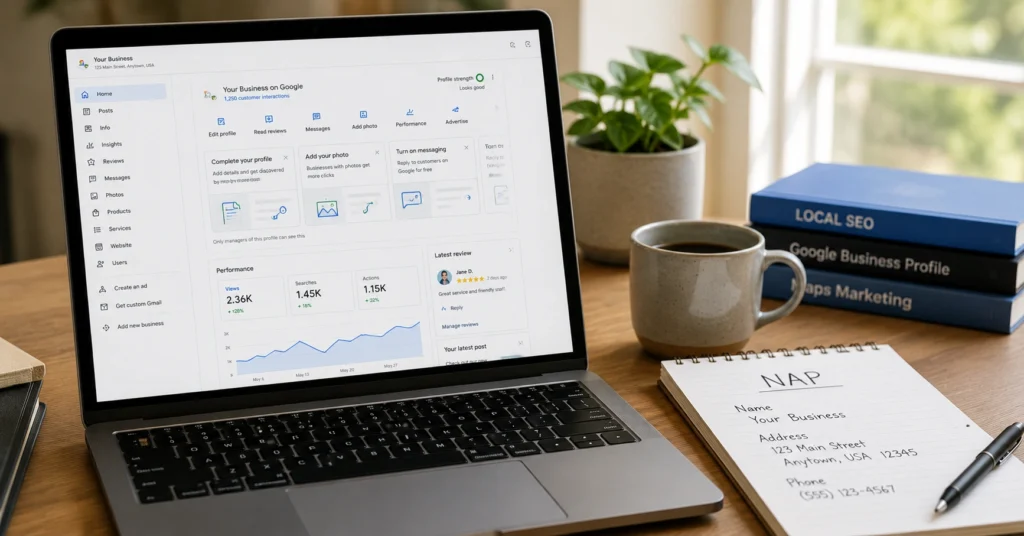
I maintain a “master NAP document” for every client — a single source of truth with the exact formatting for name, address, phone, website URL, and business description. Before submitting to any directory, I copy-paste from this document. It takes 30 seconds and prevents hours of cleanup later.
The cleanup process is painful. You’ll need to claim unclaimed listings, request edits to incorrect information, and sometimes wait 2-4 weeks for directories to process changes. Prevention is faster.
A Citation Workflow That Doesn’t Waste Your Afternoon
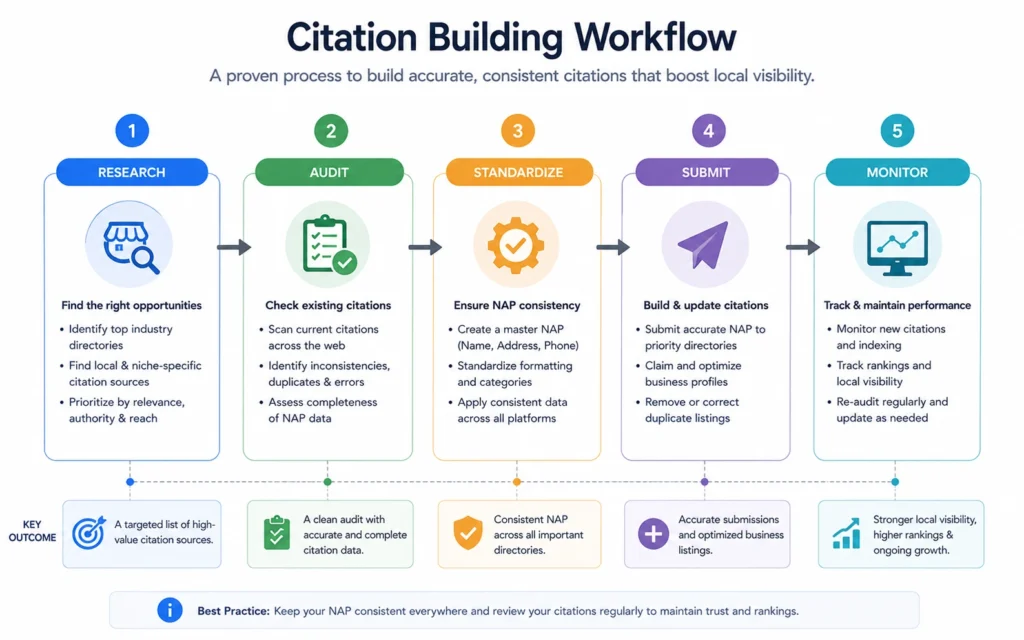
Building citations without a system creates chaos. You’ll lose track of where you’ve submitted, what login credentials you used, and which directories still need updates. Here’s a workflow that scales:
Step 1: Audit existing citations. Search your business name, phone number, and address in Google. Document every listing you find in a spreadsheet. Note the URL, the NAP as it appears, whether you can claim the listing, and login credentials if you already have access. Tools like BrightLocal or Whitespark can automate this, but a manual search catches things algorithms miss.
Step 2: Define your master NAP. Write down the exact version of your business name, address, and phone number you’ll use everywhere. Include punctuation, abbreviations, and spacing. This is your template.
Step 3: Prioritize your target directories. Start with Google Business Profile if you haven’t claimed it. Then move to the major aggregators: Acxiom, Factual, Neustar Localeze, and Infogroup. After that, hit the big general directories: Yelp, Bing Places, Apple Maps, YellowPages, Facebook. Then industry-specific platforms relevant to your business.
Step 4: Submit systematically. Work through your priority list one directory at a time. Use your master NAP document. Screenshot each submission confirmation. Record the URL, submission date, and login credentials in your spreadsheet.
Step 5: Verify and monitor. Most directories require verification via postcard, phone call, or email. Complete these immediately — an unverified citation has less value. Set a quarterly reminder to re-audit your top 20 citations for drift.
The biggest mistake I made early on was submitting to 30+ directories in one weekend without tracking. Three months later, I couldn’t remember which email I used for which platform, and half my listings were unverified. Now I cap submissions at 5-7 per session and update my tracker before moving to the next batch.
Where to Build Citations: The 2026 Priority List
Not every directory deserves your time. Focus on platforms that actually influence local search and drive referrals. Here’s the tiered approach for local SEO citations 2026:
Tier 1 — Non-Negotiable:
- Google Business Profile (the foundation of local search)
- Bing Places (smaller volume, but easy win)
- Apple Maps (critical for iPhone users and Siri queries)
- Facebook (social proof + local discovery)
Tier 2 — Major Aggregators:
- Acxiom
- Factual
- Neustar Localeze
- Infogroup (ExpressUpdate)
These four feed data to countless downstream platforms. Getting them right creates a ripple effect.
Tier 3 — High-Authority General Directories:
- Yelp (especially important for restaurants, services, retail)
- YellowPages (still carries weight despite declining traffic)
- Better Business Bureau (trust signal, not just a citation)
- TripAdvisor (hospitality and tourism)
- Angie’s List / Angi (home services)
- HomeAdvisor (home services)
Tier 4 — Industry-Specific Platforms: Your industry determines this list. Examples:
- Legal: Avvo, FindLaw, Justia, Martindale-Hubbell
- Medical: Healthgrades, Zocdoc, Vitals, RateMDs
- Contractors: Houzz, Thumbtack, BuildZoom
- Real Estate: Zillow, Realtor.com, Trulia
- Restaurants: OpenTable, Resy, TheFork, Zomato
Tier 5 — Local and Community Sites:
- Local chamber of commerce
- City or regional business directories
- Industry associations
- Local news sites (sponsorships or features)
- Community event pages
Don’t skip to Tier 5 before completing Tiers 1-3. The foundation matters.
Common Citation Mistakes That Kill Your Local Rankings
You can build 100 citations and still rank poorly if you make these errors:
Mistake 1: Duplicate listings. Creating a second listing because you “couldn’t find” the first one, or because you moved offices and didn’t update the original. Duplicates confuse search engines and dilute your ranking signals. Always search thoroughly before creating a new listing. If you find duplicates, claim them and request merging or removal.
Mistake 2: Keyword stuffing your business name. “Joe’s Pizza | Best Pizza in Chicago | Deep Dish & Delivery” is not your business name. It’s a violation of Google’s guidelines and will get your listing suspended. Use your legal business name or the name you use on signage. Nothing more.
Mistake 3: Using a virtual office or PO Box. Google requires a physical address where customers can visit you during stated business hours. Virtual offices and PO Boxes violate guidelines for most business types. If you’re a service-area business without a storefront, hide your address and define your service areas instead.
Mistake 4: Ignoring category selection. Your primary category is one of the strongest ranking factors in local search. Don’t pick “Business Consultant” when you’re a “Marketing Agency.” Don’t pick “Restaurant” when you’re specifically a “Pizza Restaurant.” Specificity wins.
Mistake 5: Inconsistent hours. Listing “9 AM – 5 PM” on Google but “9:00 AM – 5:00 PM” on Yelp seems minor, but it’s another inconsistency. Worse: listing hours you don’t actually operate. If you’re closed Sundays, say so everywhere.
Mistake 6: Neglecting citations after building them. Businesses move, phone numbers change, hours shift for holidays. If you don’t monitor and update, your citations drift out of sync. Set a quarterly audit reminder.
When Citations Won’t Fix Your Local SEO Problem
Citations are necessary but not sufficient. If you’ve built consistent citations across 50+ platforms and still aren’t ranking, the problem lies elsewhere:
- Your Google Business Profile is weak. Few reviews, low review velocity, incomplete information, poor photos, or infrequent posting.
- Your on-page SEO is missing the mark. Your website doesn’t clearly signal your location, services, or relevance to local search queries.
- You lack backlinks. Citations aren’t backlinks. You still need authoritative websites linking to your site.
- Your reviews are sparse or negative. Review quantity, quality, and recency matter significantly.
- Your competition is stronger. If every competitor has 100 citations and 200 reviews, your 30 citations and 5 reviews won’t cut it.
Citations remove friction. They don’t create momentum on their own.
Frequently Asked Questions About Local SEO Citations
How many citations do I need to rank locally?
There’s no magic number. A plumber in a small town might rank well with 20-30 consistent citations. A lawyer in New York City might need 100+ to compete. Focus on consistency and relevance over quantity. Complete the Tier 1 and Tier 2 platforms first, then expand based on your competition. Audit the top 3 ranking businesses in your area — if they’re on 15 directories you’re not, that’s your target list.
Do paid directory listings help more than free ones?
Not necessarily. A free Yelp listing with consistent NAP and genuine reviews often outperforms a paid YellowPages ad with thin information. Paid listings can provide additional features like enhanced profiles, advertising placement, or priority support, but they don’t inherently carry more SEO weight. Invest in paid directories only if they drive actual referrals or leads, not for SEO alone.
How long does it take for citations to impact rankings?
Expect 4-12 weeks for new citations to be indexed and influence rankings. Aggregator updates can take longer — sometimes 8-16 weeks to propagate across downstream platforms. Citation cleanup (fixing inconsistencies) often shows results faster than building new citations, sometimes within 2-4 weeks. The key is consistency and patience. Local SEO is a long game.
Can I build citations for a service-area business without a physical address?
Yes, but with restrictions. Google allows service-area businesses (SABs) to hide their street address and display only their service regions. You can still build citations on other platforms, but many directories require a physical address. Use your actual business address (even if it’s a home office) on platforms that require it, but ensure you’re compliant with each platform’s guidelines. Never use a fake address or virtual office to circumvent requirements.
Should I use citation building services or do it myself?
It depends on your time and budget. DIY gives you control and ensures accuracy, but it’s time-consuming — expect 2-4 hours for the initial 30-40 citations. Citation services cost $100-$500+ depending on volume and quality. The risk: some services use automation that creates duplicates or inconsistent NAP. If you outsource, audit their work carefully. For beginners, I recommend building your first 20-30 citations yourself to understand the process, then outsourcing maintenance or expansion if needed.
Continue Exploring
- Local SEO fundamentals — Understanding how citations fit into the broader local search ecosystem will help you prioritize your efforts and avoid treating citations as a standalone tactic.
- Google Business Profile optimization — Your GBP is the most important citation you’ll build. This guide shows you how to optimize it beyond just NAP consistency.