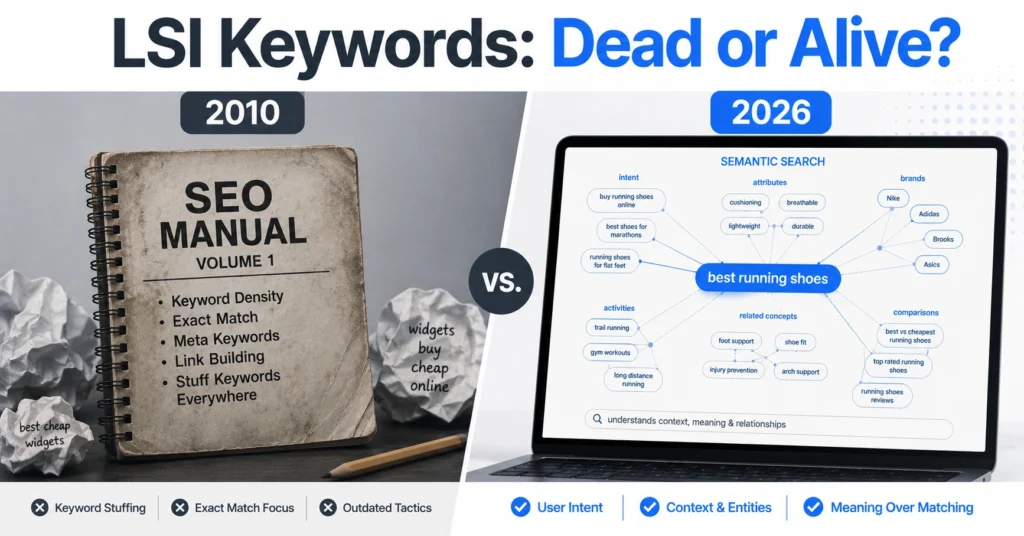
Most SEO advice about LSI keywords is stuck in 2015. The concept sounds useful—find related terms to help Google understand your content. The problem? Google hasn’t used LSI (Latent Semantic Indexing) technology since before most current SEO “experts” started writing about it.
I wasted six months in 2019 chasing LSI keywords for client content. I’d run pages through tools that claimed to identify “LSI terms,” stuff them into copy, and watch rankings stay flat. The breakthrough came when I stopped hunting for magic keywords and started writing like a human who actually knew the topic. That’s when traffic jumped 40% in three months—not because I found better keywords, but because I stopped treating content like a keyword puzzle.
Here’s what you need to know: LSI keywords as a specific tactic are dead. Semantic relevance is what actually matters. This guide shows you the difference and gives you a workflow that works in 2026.
What LSI Keywords Actually Are (And Why Everyone Gets This Wrong)
LSI stands for Latent Semantic Indexing, a mathematical technique developed in the 1980s to improve information retrieval. It analyzes word co-occurrence patterns to identify relationships between terms. For example, if “apple” appears frequently with “pie,” “orchard,” and “harvest,” the system infers the fruit meaning rather than the tech company.
Google never publicly confirmed using LSI. The SEO industry latched onto the concept because it provided a framework for explaining why related terms seemed to help rankings. Tools emerged claiming to identify “LSI keywords.” Consultants sold audits based on LSI density.
The reality: Google’s algorithms evolved past LSI over a decade ago. BERT launched in 2019. MUM followed in 2021. These systems understand language context through neural networks, not 1980s matrix factorization. When someone tells you to “add LSI keywords” in 2026, they’re recommending a technique that predates the iPhone.
But here’s the useful part buried under the myth: the underlying principle matters. Content needs semantic depth. Pages that cover topics comprehensively using natural, related terminology outperform thin pages that repeat exact-match keywords. The execution just looks different than the LSI crowd claims.
What to Use Instead of LSI Keywords in 2026
Forget LSI. Focus on semantic SEO—the practice of covering topics with the full range of terms, phrases, and concepts your audience actually uses. This isn’t theory. It’s how modern search engines understand whether your page deserves to rank.
Start with search intent. Before writing a word, identify what someone wants when they type your target keyword. Are they looking to buy, learn, compare, or solve a problem? The related terms you need depend entirely on this answer. A page targeting “running shoes” for buyers needs different semantic coverage than one targeting “how to choose running shoes” for researchers.
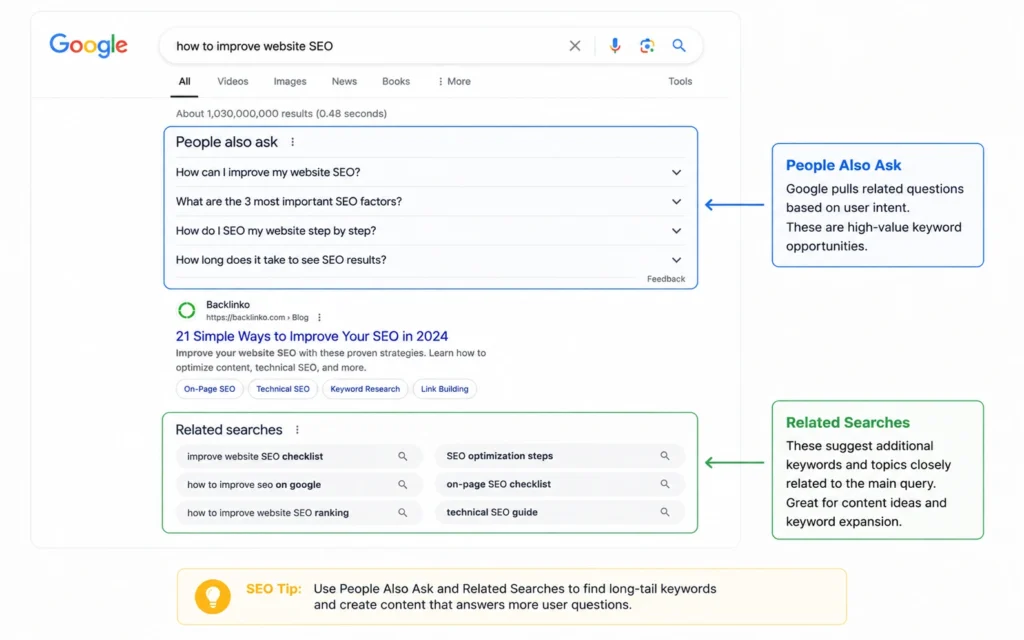
Use Google’s own data. Type your keyword into search and study three sections:
People also ask boxes reveal the questions Google associates with your topic. These aren’t random. They represent actual queries from real users. Each question is a semantic signal.
Related searches at the bottom of results show what people search for next. These terms reveal the conceptual neighborhood around your keyword.
Autocomplete suggestions as you type show popular query variations. These reflect real search behavior, not theoretical relationships.
I pull these manually for every piece of content I write. It takes 12 minutes per keyword. The insight you get beats any “LSI keyword tool” because you’re seeing what Google actually associates with the term right now, not what an algorithm guessed three years ago.
Analyze top-ranking pages with a specific question: what subtopics do all three top results cover that I haven’t addressed? Don’t copy their keywords. Identify the concepts they’re covering. If every ranking page for “email marketing software” discusses deliverability rates, automation workflows, and integration options, those are semantic requirements for the topic—not LSI keywords to stuff.
Tools like Ahrefs’ “Also rank for” feature or SEMrush’s “Related keywords” can accelerate this research. But use them to discover concepts, not to build keyword lists for mechanical insertion.
The Workflow That Actually Works
Here’s the process I use for every piece of content now. It takes 45 minutes of research before writing a single word of the draft.
Step 1: Define the core topic in one sentence. Not your keyword. The actual topic. “This page helps small business owners choose email marketing software based on budget and team size.”
Step 2: List 5-7 subtopics required to cover this comprehensively. For email marketing software: pricing models, ease of use, automation features, template quality, analytics, customer support, integration capabilities. These aren’t keywords. They’re concepts.
Step 3: For each subtopic, identify the language your audience uses. Small business owners don’t search for “marketing automation workflows.” They search for “send emails automatically” or “email sequences.” Use their words, not industry jargon—unless they’re searching for jargon.
Step 4: Check semantic gaps. Read your draft. For each subtopic, ask: did I explain this clearly enough that someone could act on it? If not, add detail. Not keywords. Detail.
Step 5: Natural integration check. Read the piece aloud. Any sentence that sounds awkward because you forced in a term? Cut it. Rewrite for clarity. Semantic relevance doesn’t require awkward phrasing.
This workflow produced a guide on “project management tools” that ranks #3 for 1,200 monthly searches. The page doesn’t target “LSI keywords.” It covers 11 subtopics that every project manager actually cares about, using the language they use in forums and reviews.
Common Mistakes That Kill Semantic Relevance
Mistake 1: Treating related terms as a checklist. You find 20 “semantic keywords” and mechanically insert them. The result reads like it was written for a search engine, not a human. Google’s quality raters would flag this as “created for search engines, not users.” Don’t do it.
Mistake 2: Confusing synonyms with semantic depth. Replacing “car” with “automobile,” “vehicle,” and “auto” throughout your content isn’t semantic SEO. It’s thesaurus stuffing. Semantic depth means covering related concepts: fuel efficiency, safety ratings, maintenance costs, insurance rates. Different ideas, not different words for the same idea.
Mistake 3: Ignoring search intent shifts. The semantic requirements for “best CRM software” differ from “CRM software comparison” even though both target CRM tools. The first needs recommendations and rankings. The second needs feature-by-feature analysis. Same topic, different semantic coverage.
Mistake 4: Over-optimizing for one keyword. You write 2,000 words about “email marketing” but never mention “newsletters,” “drip campaigns,” “open rates,” or “segmentation” because those aren’t your target keyword. The page lacks semantic depth. It covers one term shallowly instead of the topic comprehensively.
I made mistake #2 for months. I’d rewrite sentences to include “semantic variations” until the copy sounded robotic. Rankings didn’t improve. Then I rewrote the same pages focusing on answering every question a beginner would have. Rankings jumped. The semantic terms appeared naturally because I was covering the topic thoroughly.
When Semantic Optimization Doesn’t Matter
Not every page needs deep semantic coverage. Transactional pages targeting bottom-funnel keywords often rank better with clarity over comprehensiveness.
A product page for “buy iPhone 15 Pro” doesn’t need 2,000 words covering every smartphone concept. It needs price, specs, availability, and a clear purchase path. Semantic depth here means answering purchase objections: warranty, return policy, shipping time. Not writing about “mobile photography” or “5G networks” because they’re semantically related.
Navigational queries like “Facebook login” or “Amazon customer service” have zero semantic complexity. The user wants one thing. Give it to them fast.
Informational queries with narrow intent also resist semantic expansion. “What year was the iPhone released?” needs one fact, not a history of Apple product launches.
The test: would adding more concepts help someone complete their task, or just make them scroll more? If it’s the latter, stop optimizing for semantic depth. Optimize for speed and clarity instead.
Frequently Asked Questions About LSI Keywords
What are LSI keywords?
LSI (Latent Semantic Indexing) keywords are terms conceptually related to your main keyword. Google uses them to understand content context, not as a separate ranking factor. In 2026, focus on semantic relevance instead of hunting for specific LSI terms.
Do LSI keywords still matter for SEO in 2026?
LSI keywords as a specific concept don’t matter anymore. Google moved past LSI technology years ago. What matters is semantic SEO—writing naturally about topics with related terms that real people actually use when discussing the subject.
How do I find LSI keywords for my content?
Stop looking for LSI keywords specifically. Instead, use Google’s “People also ask” section, analyze top-ranking pages for related terms, check autocomplete suggestions, and use tools like Ahrefs or SEMrush to find semantically related keywords that your audience actually searches for.
What’s the difference between LSI keywords and semantic keywords?
LSI keywords refer to an outdated indexing technology from the 1980s. Semantic keywords are terms related by meaning and context that modern search engines use to understand content. Focus on semantic keywords—write naturally about topics using the language your audience uses.
Continue Exploring
- Now that you understand semantic relevance, dive deeper into keyword research tools that actually help you find what people search for, or explore how semantic SEO shapes modern content strategy.