They type a seed keyword, ask for 100 keyword ideas, copy the output into a spreadsheet, and assume they’ve completed research. The result is usually a list of phrases that look useful but have never been validated, prioritized, or connected to a business goal.
I made the same mistake during an SEO content audit in early 2025. The first keyword lists looked productive. They were long, organized, and fast to generate. The problem appeared later. Nearly half the keywords were variations that would never deserve their own page. The list was larger. The strategy wasn’t better.
That’s the central lesson of chatgpt keyword research.
ChatGPT is not a keyword database. It’s a thinking tool. When used correctly, it helps you organize, expand, classify, prioritize, and map keyword opportunities faster than manual analysis. The actual search demand data still comes from dedicated SEO tools.
The advantage isn’t keyword discovery alone. It’s decision-making speed.
What ChatGPT Is Actually Good At During Keyword Research
ChatGPT performs best after you already have raw keyword data.
That statement surprises people because most articles frame AI as a replacement for research tools. In practice, AI becomes valuable when the messy work begins.
Keyword research contains two different jobs:
- Finding search demand.
- Organizing search demand.
Most SEO platforms handle the first job well.
ChatGPT helps with the second.
For example, imagine exporting 500 keywords from a research tool. Reading them manually can take 30–45 minutes. Identifying themes takes even longer.
Instead, you can paste keyword groups into ChatGPT and ask:
Group these keywords by search intent and identify potential content clusters.
The output won’t be perfect. But it often reduces first-pass organization work from nearly an hour to under 10 minutes.
That’s a workflow improvement. Not a replacement.
The Fastest ChatGPT Keyword Research Workflow I Actually Recommend
Most keyword workflows contain unnecessary steps.
The practical version looks like this:
Step 1: Collect Real Search Data
Start with a keyword tool.
Use search volume, ranking difficulty, competitor data, or search console information. The source matters less than the fact that the data comes from actual search behavior.
Do not start with AI.
Start with evidence.
Step 2: Build Topic Buckets
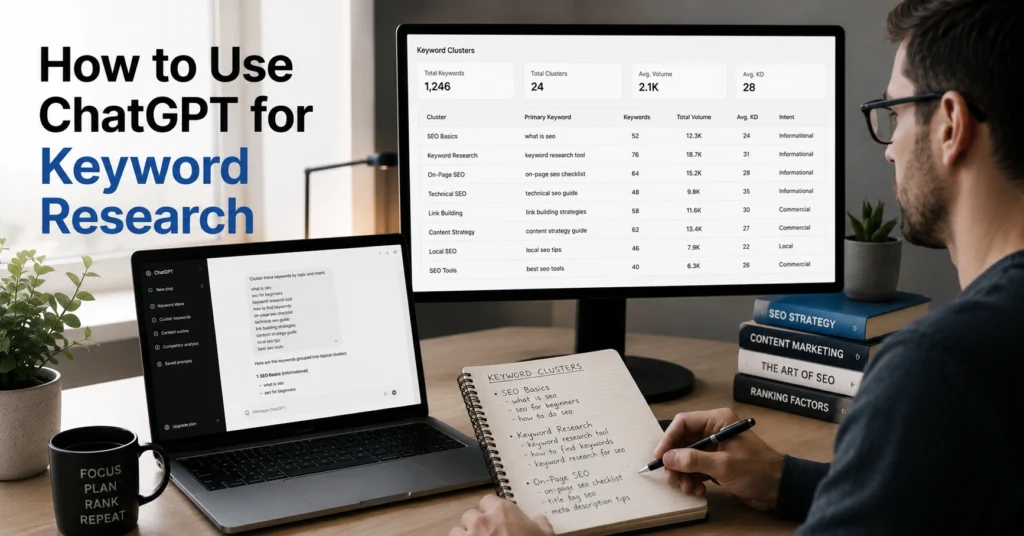
Feed a keyword export into ChatGPT.
Prompt:
Organize these keywords into topic groups. Create categories based on user intent, not word similarity.
This distinction matters.
Word similarity creates messy clusters.
Intent creates pages.
Step 3: Identify Search Intent
Intent classification is one of ChatGPT’s strongest SEO applications.
Ask:
Classify each keyword as informational, commercial investigation, transactional, navigational, or mixed intent.
The goal is not perfect accuracy.
The goal is speed.
You’ll still review the output manually, but reviewing is faster than creating from scratch.
Step 4: Build Content Opportunities
Once intent is clear, ask:
Which keyword clusters should become standalone pages and which should be supporting sections within larger pages?
This is where keyword lists become content strategy.
A keyword only becomes valuable when attached to a publishing decision.
Step 5: Create a Content Map
Ask ChatGPT:
Create a content hierarchy from these keyword clusters. Show pillar pages, supporting articles, and internal linking opportunities.
Now you’re no longer doing keyword research.
You’re building an SEO system.
Keyword Research Fails When Every Keyword Becomes a Page
This is one of the most expensive mistakes in SEO.
Not financially.
Operationally.
A content team receives 300 keywords and assumes each keyword needs an article. Six months later, they have dozens of thin pages competing against each other.
The issue isn’t low effort.
It’s poor keyword mapping.
A specific observation from multiple content audits: pages rarely fail because they target too few keywords. They fail because they target fragmented versions of the same search intent.
For example:
- best email marketing software
- email marketing software comparison
- top email marketing platforms
- email automation software
Many sites create four articles.
One strong comparison page often performs better.
ChatGPT is useful here because it sees semantic overlap quickly.
Still, don’t accept every grouping blindly.
Search the SERP manually before publishing.
Google decides intent. Not ChatGPT.
How to Use ChatGPT for Keyword Clustering at Scale
Keyword clustering becomes painful around the 500-keyword mark.
Below that number, spreadsheets remain manageable.
Above it, patterns become harder to spot.
A workflow I’ve used repeatedly:
- Export keyword list.
- Remove duplicates.
- Split into batches of 100–200 keywords.
- Send batches into ChatGPT.
- Request topic clusters.
- Merge similar outputs manually.
The trade-off is accuracy.
Large language models occasionally merge concepts that should stay separate.
For example:
- CRM software
- customer support software
They relate to customer operations.
They solve different problems.
An experienced SEO notices the distinction immediately.
ChatGPT sometimes doesn’t.
That’s why AI-assisted clustering still requires editorial review.
Use fewer assumptions.
Review more aggressively.
The Unexpected Use Case: Finding Missing Questions Instead of Keywords
Most keyword tools already provide keyword ideas.
The gap often exists elsewhere.
Questions.
Specifically, the questions users ask before they know the keyword they’re searching for.
This is where ChatGPT becomes unusually useful.
Prompt:
A marketing manager is evaluating SEO software for a growing SaaS company. What questions would they ask before purchasing?
The output often reveals content opportunities that traditional keyword reports don’t surface clearly.
Examples:
- How long does SEO software take to show value?
- Which reports matter most?
- What data should be ignored?
- How many users need access?
These become article sections, FAQ opportunities, comparison angles, and conversion assets.
The keyword isn’t always the insight.
The question behind it is.
ChatGPT Keyword Research 2026: What Has Actually Changed
The phrase chatgpt keyword research 2026 suggests a future-looking workflow.
The biggest change isn’t that AI generates more keywords.
It already could.
The change is workflow integration.
SEO teams increasingly use AI between research and publishing rather than before research begins.
A modern workflow looks like this:
Research Tool → AI Organization → Human Review → Content Plan → Publishing
Not:
AI → Publish
The second workflow produces faster content.
The first workflow produces better content.
Those outcomes are not the same.
And ranking pages still reward quality decisions more than speed.
What to Skip — and What to Do Instead
Skip asking ChatGPT for massive keyword dumps.
Most of those lists become noise.
Instead:
- Start with verified keyword data.
- Use AI to organize it.
- Use AI to identify intent.
- Use AI to surface content gaps.
- Use AI to draft keyword maps.
- Validate everything before publishing.
The workflow sounds less exciting than “generate 1,000 keywords instantly.”
It works better.
And SEO has always rewarded methods that work better over methods that sound better.
Frequently Asked Questions About ChatGPT Keyword Research
Can ChatGPT replace keyword research tools?
No. ChatGPT doesn’t provide reliable search volume, ranking difficulty, or demand data. Use SEO tools for discovery and AI for organization, analysis, and planning.
Is ChatGPT good for keyword clustering?
Yes. Clustering is one of the strongest applications of AI in SEO. It speeds up organization and intent grouping, though manual review remains necessary before publishing decisions are made.
What is the best prompt for chatgpt keyword research?
The most useful prompts focus on classification and organization. For example: “Group these keywords by search intent and identify which should become standalone pages.”
Does chatgpt keyword research 2026 work differently?
The core principle remains unchanged. AI helps process information faster. Reliable search demand still comes from dedicated SEO tools and real search data.
Should beginners use ChatGPT for keyword research?
Yes, but only after understanding search intent and content mapping. Otherwise it’s easy to generate large keyword lists without knowing which opportunities deserve content investment.
Continue Exploring
- keyword research fundamentals explains how to validate opportunities before investing time in content production.
- search intent analysis goes deeper into the intent classifications that determine whether a page deserves to exist at all.