Choosing how to optimize a new website is the single most important structural decision an online business makes. Last March, a niche service provider hired an agency that promised to deliver front-page search visibility within 30 days using private link networks. The strategy worked for exactly 18 days before Google deployed a rapid automated spam update.
The entire domain vanished from the organic index, cutting off the business’s primary customer acquisition channel overnight. The shortcut didn’t just fail; it broke the foundational infrastructure of their digital footprint.
To grow your search footprint safely, you must understand the distinction between white hat vs black hat SEO. The entire debate comes down to a clear operational question: are you investing in a permanent business asset that aligns with search documentation, or are you gambling your visibility on temporary flaws in an automated algorithm?
The technical mechanics that define white hat compared to black hat SEO
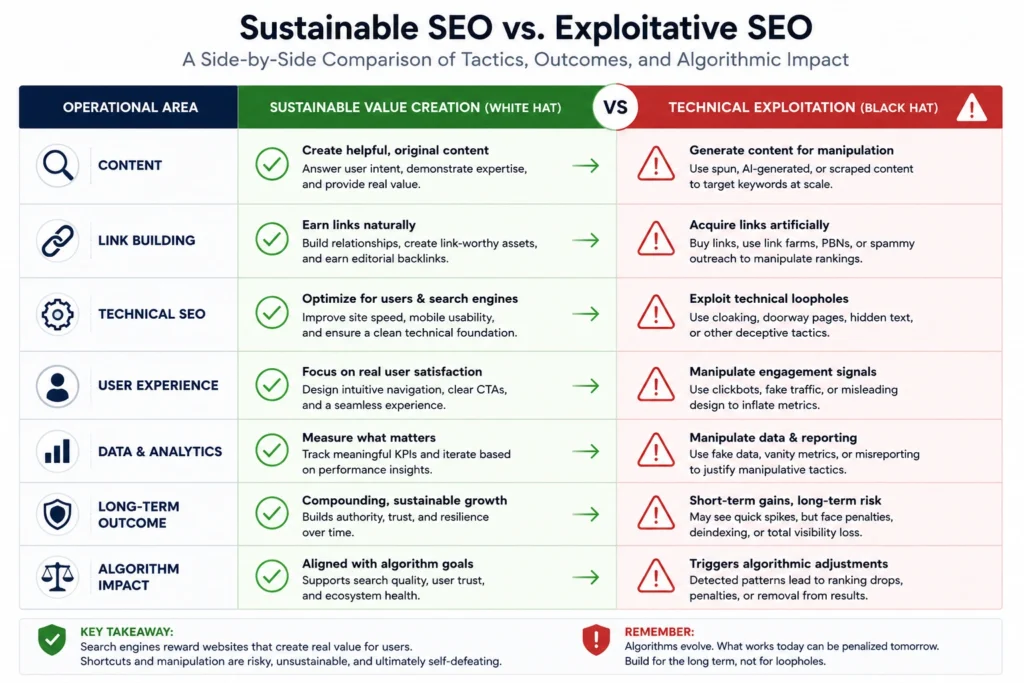
The organic search landscape rewards real utility, not optimization tricks. White hat practices focus on optimizing pages for human readers first, using clear information architecture, verified data signals, and transparent user interfaces. You are building equity into a brand domain when you follow this method.
Black hat SEO operations work inversely. These setups use technical manipulation to trick crawlers into assigning artificial visibility scores to thin or unhelpful pages. Instead of solving a searcher’s problem, black hat setups build complex automation models to bypass quality checks.
[White Hat Pathway] ──> Original Research ──> Clean Site UX ──> Compounding Organic Growth
[Black Hat Pathway] ──> Scaled Spun Data  ──> Crawler Loops ──> Algorithmic Traffic Drop
The three-step blueprint for a risk-free content workflow
You do not need to overcomplicate your production process to stay compliant. Beginners often fall into gray areas because they don’t have a clear quality gate before they hit publish. Use this three-step workflow to verify that your pages match professional search standards.
Step 1: Establish human-first research guidelines
Before opening a document editor, define the unique value your page will offer. If your outline simply rehashes the top three results on the web, your page lacks a reason to exist. Every piece of content should include a proprietary observation, a verified example, a custom dataset, or an experienced operator’s viewpoint.
Step 2: Build clean navigation structures
Search crawlers need clear paths to move through your site. Use descriptive URLs, build a logical internal linking system, and avoid using deceptive structural scripts. Your main text should match what your metadata promises.
Step 3: Verify link acquisition sources
Earning authority is an slow process. If an external service offers to sell you 500 links for $45, reject it immediately. Authentic backlink growth occurs when your content serves as a reference point for other creators in your niche.
Where beginners get trapped: black hat SEO vs white hat trade-offs
The temptation to use shortcuts is strongest when your site is new and your traffic graphs are flat. Beginners look at established domains and feel they can’t compete without using aggressive tricks. This is where most site owners run into terminal indexing issues.
Let’s look at how the black hat SEO vs white hat distinction plays out across core day-to-day deployment decisions:
- Content Generation: White hat strategy focuses on deep topical coverage, expert review, and clear structural formatting. Black hat tactics rely on mass-producing raw, automated text walls designed to catch broad variations of phrases without offering real answers.
- Link Footprints: White hat setups focus on outreach to real editorial sites, guest contributions, and creating useful assets that people quote naturally. Black hat frameworks build private blog networks—networks of expired domains held solely to pass artificial authority scores to a primary site.
- Keyword Deployment: White hat pages integrate phrases into conversational headings and descriptive paragraphs. Black hat layouts use hidden text fields, identical text blocks colored to match background templates, or stuffed footers that hide thousands of repetitive terms from human eyes.
Tactical execution templates for secure organic growth
Building a sustainable optimization practice in white hat vs black hat SEO 2026 demands practical templates that save time without creating compliance risks. Use these two foundational templates to guide your next content and optimization steps.
1. The On-Page Intent Alignment Template
This checklist replaces guesswork with clear, safe structural choices before you finalize a URL structure.
Markdown
### 1. Intent Validation Gate
- Target Phrase: [Insert primary term]
- Dominant SERP Layout: [List type: tool, guide, review matrix]
- Human Reader Objective: [What problem does the user need to solve right now?]

### 2. Information Architecture
- Title Tag (Max 60 chars): [Keyword at front + editorial value]
- H1 Heading: [Descriptive, distinct from title tag]
- Core Value Block: [First 150 words directly addresses the user's primary intent]
- Structural Breaks: [Incorporate an HTML table or bulleted sequence every 400 words]

### 3. Authority & Trust Signals
- Editorial Signature: [Named expert author bio attached]
- Data Verification: [At least two citations pointing to official data or source docs]
- Interaction Block: [A clear call to action that matches the user's journey phase]
2. The Clean Outreach Framework
When contacting other site owners to build visibility, avoid automated spam templates. Use an approach based on mutual editorial value.
Plaintext
Subject: Update for your [Topic] resource page

Hi [Name],

I was reading your guide on [Topic Name] and noticed you referenced the 2024 industry benchmarks.

We just finished tracking these metrics across 400 real accounts to see how those numbers shifted for 2026. Our data revealed that deployment speeds slowed by 14% while infrastructure costs rose.

If you are updating that section soon, our live dashboard might give your readers some useful context: [Insert URL]

Thanks for the insights,
[Your Name]
What it costs: the real investment shift
The differences between these approaches extend to how you allocate your budget, manage your time, and balance your operational risks.
| Strategic Metric | White Hat Approach | Black Hat Framework |
| Primary Cost Type | Skilled editorial work, product design, original research | Automated indexing tools, expired domain acquisitions, proxies |
| Time to First Value | 90 to 180 days of consistent publishing | 14 to 45 days of aggressive deployment |
| Asset Longevity | Compounding value that survives algorithmic core updates | Temporary spikes followed by manual penalties or index bans |
| Risk Profile | Low structural risk; matches long-term platform guidelines | High operational risk; relies on outrunning spam algorithms |
The trade-off is clear. White hat optimization requires patience and an upfront commitment to quality. Black hat setups demand constant monitoring, tool investments, and a willingness to see your entire digital footprint wiped out at any moment.
When to look beyond standard automated tool recommendations
Standard search optimization software tools often generate automated difficulty scores that push beginners toward shortcuts. If a tool claims a phrase has a 90 difficulty score, a beginner might assume they have to use manipulative link schemes to break through.
This is a mistaken conclusion. Software difficulty metrics are simple averages based on backlink counts; they cannot evaluate real topic depth, page layout utility, or brand trust.
If your team possesses real expertise on a difficult topic, write the page anyway. Build a better layout, provide cleaner data, and answer the specific question more effectively than the generic content currently ranking.
You will often find you can outrank sites with high link metrics simply by providing a superior experience for the human reader. For a foundational look at how to align your initial strategy with broader site frameworks, check out our [SEO Category Hub].
Frequently Asked Questions About White Hat vs Black Hat SEO
Is using AI to write blog articles considered white hat or black hat?
Using AI is white hat if it streamlines research or outlining, provided human editors inject unique data and review the output. It turns into black hat when used to mass-produce unedited, low-value content farms to manipulate search metrics.
How do I check if a website has been hit by a black hat penalty?
Log into your Google Search Console profile and inspect the “Manual Actions” tab under the security and manual actions menu. If an evaluator manually penalized your site, the specific technical infraction and affected URLs will appear listed there.
Can a website recover from a permanent search index ban?
Recovery is possible but highly demanding. You must clean up the manipulative elements, audit and disavow spammy external profiles, and file an official reconsideration request detailing your remediation steps with documentation.
Continue Exploring
- SEO Category Hub: Explore our full repository of organic search frameworks to build a clean site foundation from scratch.