The pattern is predictable. Someone starts a blog, opens a keyword tool, finds a term with 20,000 monthly searches, and decides that’s the target. Six months later, the page sits on page five of Google while smaller competitors quietly collect traffic from more specific searches.
Long-tail keywords exist because people rarely search using one or two words. They search using complete problems, detailed questions, and specific intentions. That’s where many new sites find their first rankings.
I’ve made the opposite mistake too. Early keyword research often feels productive because the search volumes look impressive. Then reality arrives. A new website trying to rank for a broad term is competing against established publishers with hundreds or thousands of pages. The keyword was never the opportunity.
The opportunity was hiding inside the longer search phrase.
By the end of this article, you’ll understand what long tail keywords are, why they work, how to find them, and how to decide which ones deserve a page.
Long-tail keywords are specific searches with clearer intent
A long-tail keyword is a search phrase that targets a narrower topic than a broad keyword.
Consider these examples:
| Broad Keyword | Long-Tail Keyword |
|---|---|
| podcast | how to start a podcast with no audience |
| running shoes | best running shoes for flat feet beginners |
| email marketing | email marketing strategy for local businesses |
| keyword research | how to find low competition keywords for a new website |
The important part is not the word count.
A long-tail keyword isn’t defined by having four, five, or six words. It’s defined by specificity.
“Best CRM for real estate agents” is a long-tail keyword because the search intent is narrow and clear. The searcher already knows what they need.
That’s why long-tail keywords often convert better than broad terms. Someone searching “CRM” is exploring. Someone searching “best CRM for real estate agents under $100 per month” is much closer to making a decision.
Why long-tail keywords often beat bigger keywords
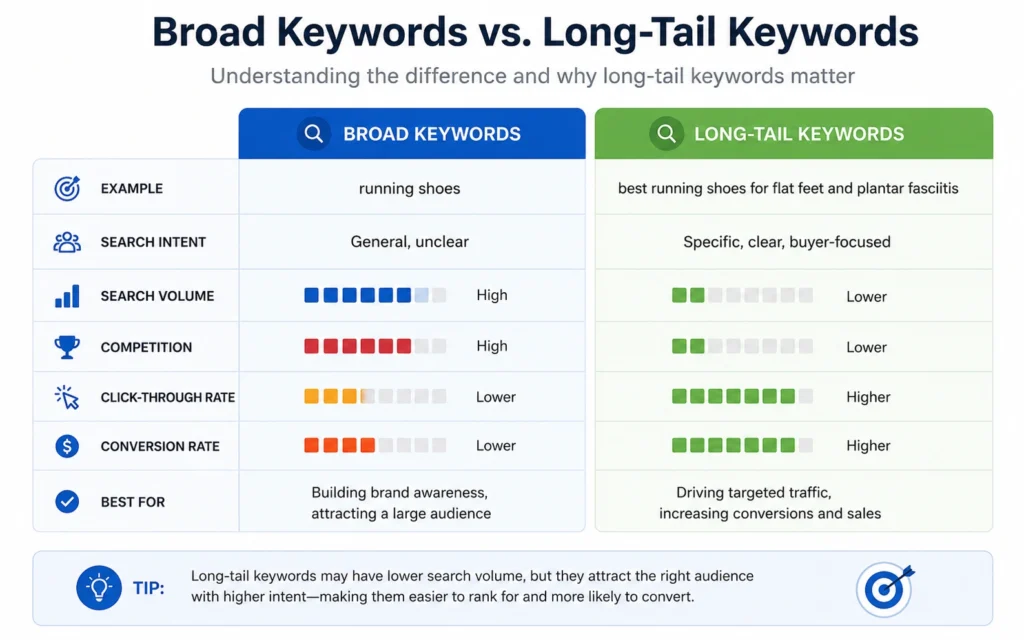
Search volume attracts attention.
Search intent creates results.
Many keyword tools make beginners focus on monthly searches because the numbers are visible. What matters more is whether you can realistically rank and whether the traffic matches your goal.
A keyword with 200 monthly searches can outperform a keyword with 10,000 searches if:
- Competition is lower
- Search intent is clearer
- Visitors are closer to taking action
- The topic matches your expertise
A practical example:
Imagine two articles:
Article A: “SEO”
Article B: “SEO checklist for local service businesses”
Article A competes with major publishers, software companies, and SEO platforms.
Article B competes with a much smaller group of pages targeting a specific audience.
The second page often has a better chance of ranking, attracting qualified visitors, and generating useful actions.
That’s why many successful sites build traffic through dozens or hundreds of long-tail keywords before targeting broader terms.
The easiest way to understand long-tail keywords is through search intent
The biggest shift happens when you stop looking at keywords and start looking at people.
Every search represents a task.
For example:
Informational intent
- how to start a podcast
- how long should a YouTube intro be
- what is keyword clustering
The user wants information.
Commercial intent
- best podcast microphones under $100
- ahrefs vs semrush
- best keyword research tool for beginners
The user is evaluating options.
Transactional intent
- buy blue yeti microphone
- semrush pricing
- podcast hosting plans
The user is close to taking action.
Long-tail keywords usually reveal intent more clearly than broad keywords.
That clarity helps you create pages that answer exactly what the searcher wants.
How to find long-tail keywords without expensive tools
Many beginners assume keyword research requires premium software.
It helps.
It’s not required.
Start with Google’s own search data.
Google Autocomplete
Type a broad topic into Google.
For example:
- podcast editing
- podcast editing software
- podcast editing software for beginners
Google suggests searches people already make.
Those suggestions are often long-tail keyword opportunities.
People Also Ask
Search a topic and examine the questions Google displays.
These questions frequently become article sections or standalone content ideas.
A useful habit is collecting these questions in a spreadsheet before opening any SEO tool.
The list grows faster than most people expect.
Related Searches
Scroll to the bottom of search results.
Google often reveals keyword variations that share the same topic cluster.
These suggestions help you identify supporting content around a primary page.
Keyword tools help you scale the process
Manual research works.
Keyword tools help you do more of it in less time.
Common options include:
- Ahrefs
- Semrush
- KeywordTool.io
- LowFruits
- Ubersuggest
The goal isn’t finding the highest-volume keyword.
The goal is finding keywords with:
- Clear intent
- Reasonable competition
- Relevant audience fit
- Content opportunities you can realistically satisfy
One mistake I see repeatedly is filtering only by search volume.
A keyword with 70 searches can be more valuable than one with 700 if the audience is better aligned with your site.
Use fewer vanity metrics. Spend more time evaluating the search results themselves.
The search results page tells you whether a keyword is realistic
This is where many keyword strategies succeed or fail.
Before creating content, search the keyword manually.
Look at the first page.
Ask:
- Are the ranking sites similar to mine?
- Are giant brands dominating every result?
- Is the search intent obvious?
- Can I create something more useful?
I learned this lesson after spending weeks writing pages for keywords that looked easy in tools but were controlled by large publishers in actual search results.
The keyword data suggested opportunity.
The search results suggested caution.
The search results were right.
A five-minute manual review often saves hours of wasted content production.
A simple long-tail keyword workflow beginners can repeat
Keyword research becomes easier when you stop treating it as inspiration and start treating it as a system.
Use this workflow:
Step 1: Start with a broad topic
Example:
- podcasting
- SEO
- email marketing
- YouTube automation
Step 2: Expand using Google suggestions
Collect:
- Autocomplete terms
- People Also Ask questions
- Related searches
Aim for 20–50 ideas.
Step 3: Validate using a keyword tool
Check:
- Search volume
- Difficulty
- Related variations
Don’t reject low-volume opportunities automatically.
Step 4: Review search results manually
Open the search results.
Look for realistic competition.
Step 5: Group related keywords
Instead of creating one page per variation, combine similar searches into a single topic.
For example:
- how to start a podcast
- starting a podcast for beginners
- beginner podcast setup
These often belong on the same page.
This step prevents content duplication and strengthens topical coverage.
Long-tail keywords in 2026 are becoming more conversational
Search behavior continues to change.
AI assistants, voice search, and conversational search patterns encourage longer queries.
People increasingly search the way they speak.
Examples:
Old style:
- podcast software
New style:
- what is the best podcast software for remote interviews
Old style:
- email automation
New style:
- how do I automate email follow ups for new leads
This doesn’t mean every keyword becomes a question.
It means specificity is becoming more important.
The sites that answer detailed problems clearly are often better positioned than sites chasing the broadest possible topics.
For many publishers, long tail keywords 2026 strategies look less like isolated keywords and more like complete problem statements.
Common mistakes that make long-tail keyword research harder than it needs to be
Choosing keywords only because they have volume
Search volume without intent is often misleading.
Traffic alone doesn’t create results.
Creating separate pages for tiny variations
This fragments authority and creates content overlap.
Group related searches whenever the intent is the same.
Ignoring search results
Keyword tools estimate.
Search results reveal reality.
Always check both.
Targeting topics outside your expertise
Ranking is only part of the job.
You still need content that deserves attention.
Choose topics where you can provide useful answers.
What long-tail keyword research actually costs
The financial cost is often lower than people expect.
You can start with free tools and Google search results.
The real cost is attention.
A beginner can spend:
- 30 minutes gathering ideas
- 30 minutes validating keywords
- 30 minutes reviewing search results
- 30 minutes organizing topics
In roughly two hours, you can build a content plan that supports weeks of publishing.
That’s usually a better investment than spending those same two hours writing an article around the wrong keyword.
Keyword research feels slower at first.
It speeds up everything that follows.
When long-tail keywords are the right strategy—and when they aren’t
Long-tail keywords work best when:
- Your website is new
- Your authority is limited
- You serve a specific audience
- You need qualified traffic
They are less useful when:
- Your goal is broad brand awareness
- You already dominate your niche
- You have significant authority and resources
Even then, most successful content strategies combine both.
Long-tail keywords generate early traction.
Broader keywords become long-term targets.
The mistake is reversing the order.
Frequently Asked Questions About Long-Tail Keywords
Are long-tail keywords always longer phrases?
No. Length alone doesn’t determine whether a keyword is long-tail. Specificity matters more. A three-word phrase can be long-tail if it targets a narrow intent, while a longer phrase can still be broad if the topic remains general.
Do long-tail keywords have lower search volume?
Usually, yes. Individual long-tail keywords often receive fewer searches than broad keywords. Combined across hundreds of pages, they can generate substantial traffic and often attract visitors with clearer intent.
Are long-tail keywords easier to rank for?
Often, but not automatically. Competition depends on the search results, not just keyword length. Always evaluate the pages currently ranking before creating content.
Should every article target a long-tail keyword?
Most newer websites benefit from focusing heavily on long-tail keywords. As authority grows, broader keyword targets become more realistic additions to the content strategy.
Do long-tail keywords still matter in 2026?
Yes. Search behavior continues moving toward detailed and conversational queries. Specific searches help search engines understand intent more clearly, making long-tail keyword targeting relevant for both traditional search and AI-assisted discovery.
Continue Exploring
- keyword research for beginners expands the workflow behind topic discovery, search intent analysis, and keyword evaluation.
- content calendar planning helps you turn keyword ideas into a practical publishing schedule.