The real mistake is choosing topics in isolation. A page gets published. Weeks pass. Nothing ranks. Then someone discovers three competitors already own the search results because they built content around the right keywords months earlier.
Competitor keyword analysis solves that problem.
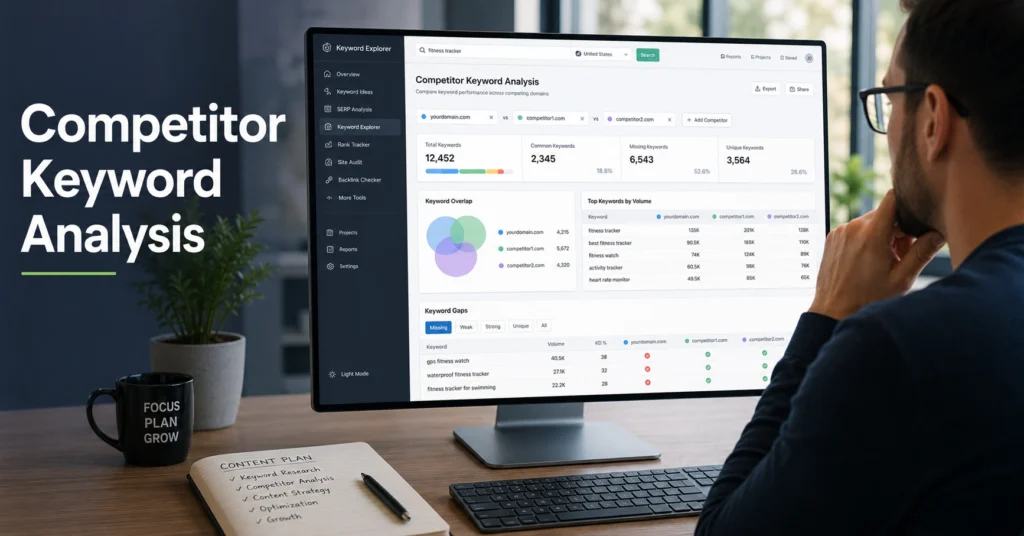
Instead of guessing what people search for, you study websites already earning visibility. You identify which keywords bring them traffic, which pages perform best, and where opportunities still exist.
One of the most useful lessons from real SEO work is this: competitors often validate demand before you do. The goal is not to copy their content. The goal is to understand which topics search engines already associate with authority and usefulness.
By the end of this guide, you’ll know how to perform competitor keyword analysis, find keyword gaps, prioritize opportunities, and build a content plan around evidence instead of assumptions.
What competitor keyword analysis reveals that keyword brainstorming never will
Keyword brainstorming feels productive.
You fill a spreadsheet with ideas and end up with 200 possible topics. The problem is that ideas do not equal demand.
Competitor keyword analysis starts with proof.
You examine websites already ranking for terms related to your niche. That immediately tells you:
- Which topics attract search demand
- Which pages Google prefers
- Which keyword clusters matter
- Which content formats rank
- Which opportunities remain underserved
A beginner often assumes competitors are businesses selling the same thing.
For SEO, competitors are different.
Your search competitors are simply the websites occupying the rankings you want.
A software company may compete with blogs, forums, publishers, and tool directories in search results even when they never compete in sales.
That distinction changes everything.
How competitor keyword analysis actually works
The process is simpler than most guides make it sound.
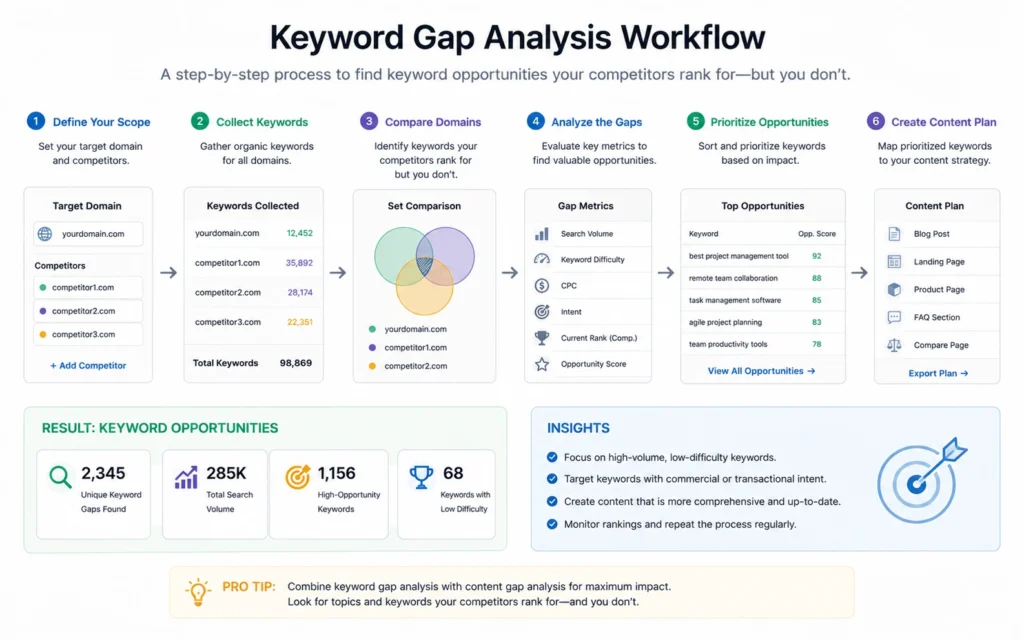
At its core, competitor keyword analysis follows four stages:
- Identify search competitors
- Extract ranking keywords
- Compare keyword coverage
- Prioritize opportunities
The workflow looks like this:
Competitor → Ranking Pages → Ranking Keywords → Gaps → Content Plan
What surprises many beginners is how often the highest-value keywords come from competitor pages they never expected to study.
I’ve seen niche sites discover entire content categories simply because a competitor’s category page ranked for hundreds of related searches they had never considered targeting.
The insight rarely comes from one keyword.
It comes from patterns.
Finding the right competitors before you analyze anything
Bad competitor selection produces bad keyword data.
Start with five to ten searches related to your niche.
Look for websites appearing repeatedly.
For example:
If you run a project management software blog, search terms like:
- project planning templates
- project management workflow
- agile planning guide
- project roadmap examples
The domains appearing again and again become your research targets.
A practical rule:
Ignore competitors that dominate because of brand power alone if you cannot realistically compete with them.
Studying a multinational publisher is useful for understanding topics.
Studying sites closer to your size is usually more useful for identifying opportunities.
Because ranking patterns become more achievable.
The free workflow that works before you buy any SEO tools
Many beginners assume competitor keyword analysis requires expensive software.
Not at first.
You can learn the process using free resources.
Step 1: Search your target keyword
Open Google.
Search a topic you want to rank for.
Record the top-ranking domains.
Step 2: Examine page structures
Open the first-page results.
Notice:
- Page format
- Headings
- Content depth
- Internal links
- Search intent
Step 3: Identify recurring topics
Create a spreadsheet.
List every recurring subtopic.
When five competing pages cover the same concept, that’s usually a signal.
Step 4: Build topic clusters
Group similar terms together.
Don’t treat every keyword as its own article.
Many successful pages rank for dozens or hundreds of closely related terms.
This manual process takes longer, but it teaches something software cannot: how search intent actually behaves.
Why keyword gaps matter more than competitor keywords
Most people stop too early.
They export competitor keywords and call the work finished.
That misses the most valuable insight.
Keyword gaps.
A keyword gap is the difference between what competitors rank for and what your site covers.
Imagine:
Competitor A ranks for:
- keyword research template
- keyword research spreadsheet
- keyword prioritization matrix
Your site covers none of them.
Those missing topics become opportunities.
This shifts competitor keyword analysis from observation to action.
The objective isn’t collecting keywords.
It’s discovering missing coverage.
A content strategy built around closing meaningful gaps usually outperforms one built around random keyword lists.
The ranking-page shortcut most beginners miss
Not all competitor pages deserve equal attention.
Focus on pages ranking for many keywords.
These pages often reveal the strongest content opportunities.
Look for:
- Guides
- Resource hubs
- Category pages
- Templates
- Tools
One ranking page can reveal dozens of related topics.
A useful habit is creating a separate spreadsheet tab called “high-yield pages.”
Whenever a competitor page appears repeatedly across keyword research sessions, save it.
Patterns emerge quickly.
And those patterns often become your future content clusters.
What keyword tools actually help—and where they fall short
Tools accelerate research.
They do not replace judgment.
Popular options include:
- Ahrefs
- Semrush
- Moz Pro
- Ubersuggest
Their strongest use case is speed.
Instead of manually reviewing rankings, they surface:
- Keyword gaps
- Ranking URLs
- Search volume estimates
- SERP changes
- Competitor overlap
But there is a limitation.
Tools show what ranks.
They don’t explain why.
That explanation still comes from reviewing pages, understanding intent, and examining search results directly.
The blunt verdict:
Many SEO beginners spend too much time inside tools and too little time reading actual ranking pages.
Building a competitor keyword analysis template you can reuse
A reusable template keeps research organized.
Use these columns:
| Keyword | Search Intent | Competitor URL | Page Type | Estimated Difficulty | Opportunity Score | Notes |
|---|
Then score opportunities using three questions:
- Can we create something better?
- Can we satisfy the same intent?
- Do we have topical relevance?
If all three answers are yes, move the keyword higher.
If only one answer is yes, deprioritize it.
Simple systems outperform complicated scoring models because you’ll actually use them.
Competitor keyword analysis 2026: what changed and what stayed the same
The core process hasn’t changed.
Search intent still matters.
Topical relevance still matters.
Useful pages still matter.
What’s changing is how search platforms extract answers.
More results now include:
- AI-generated summaries
- Featured snippets
- Entity-based answers
- Knowledge panels
That means keyword targeting alone is becoming less important than topical coverage.
A page that answers a topic comprehensively often performs better than a page optimized around a single phrase.
Competitor keyword analysis 2026 is increasingly about understanding topic ownership rather than individual keyword ownership.
That’s a subtle shift.
But it affects how content gets planned.
What competitor keyword analysis cannot tell you
Every SEO method has limits.
This one does too.
Competitor research shows existing demand.
It rarely reveals future demand.
That’s why some companies publish content before search volume appears.
They’re betting on emerging trends.
Sometimes that works.
Sometimes it produces months of content with little visibility.
I’ve made that mistake before—publishing based on assumptions instead of evidence. The content was well written, but search demand never arrived.
Competitor analysis would have exposed that weakness early.
Still, trend-based content has a place.
Use competitor analysis for proven demand.
Use trend research for future opportunities.
Treat them as separate workflows.
What to skip—and what to do instead
Skip exporting thousands of keywords.
You’ll never use most of them.
Skip copying competitor article structures word for word.
Search engines already have that version.
Skip obsessing over keyword density.
Intent matching matters more.
Do this instead:
- Find recurring topics
- Identify keyword gaps
- Study ranking pages
- Group keywords into clusters
- Build better content around the same search need
That’s where meaningful gains usually come from.
Not bigger spreadsheets.
Better decisions.
Frequently Asked Questions About Competitor Keyword Analysis
How many competitors should I analyze?
Start with three to five. That’s enough to identify patterns without creating unnecessary complexity. Once you understand recurring topics and keyword gaps, expanding to additional competitors becomes much easier.
Is competitor keyword analysis free?
Yes. You can perform a basic analysis using Google search results and spreadsheets. Paid SEO tools mainly save time and provide larger datasets, but they do not replace the underlying process.
How often should I perform competitor keyword analysis?
Quarterly works well for most sites. Competitive industries may benefit from monthly reviews because rankings, content coverage, and search behavior change more frequently.
Should I copy competitor keywords exactly?
No. Use competitor keywords as evidence of demand. Then create content that better matches search intent, provides stronger coverage, or serves a more specific audience.
What’s the biggest mistake beginners make?
Focusing on keywords instead of pages. Ranking pages reveal intent, structure, and topic relationships. Keywords alone rarely provide the full picture
Continue Exploring
- keyword research fundamentals will help you understand how to evaluate opportunities after you discover competitor keywords.
- using keyword tools effectively shows how to turn raw keyword data into actionable content decisions.