Low competition keywords are the fastest path to organic traffic when you’re starting out or working with limited resources. I learned this the hard way in March 2024, spending six weeks trying to rank for “best project management software” — a keyword with 74 KD. Zero traction.
Then I pivoted to “project management tools for remote marketing teams” (KD 18) and ranked on page one in 17 days. The second keyword had one-fifth the search volume but converted three times better because the intent was sharper.
This guide shows you how to find those keywords systematically. Not by guessing. Not by hoping. By using a repeatable workflow that separates keywords worth chasing from keywords that will waste your time.
What Low Competition Keywords Actually Mean (Beyond the KD Score)
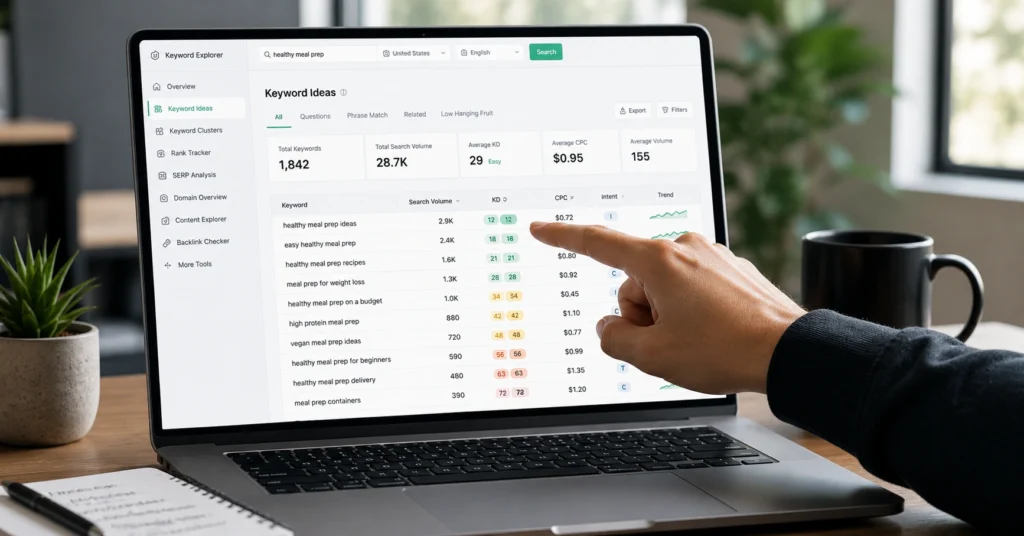
Keyword difficulty scores tell you part of the story. They measure how hard it would be to rank in the top 10 based on the backlink profiles of current ranking pages. But KD alone misses critical context.
A keyword with KD 25 might be impossible if all ten results are from domains with DR 70+. The same KD 25 becomes achievable when three results are Reddit threads, two are outdated guides from 2021, and one is a thin affiliate page with 127 words.
Low competition keywords 2026 require you to look beyond the metric. You’re searching for gaps in coverage, intent mismatches, and content quality problems your competitors haven’t fixed. The score gives you a starting filter. The SERP tells you whether you can actually win.
I track three signals that matter more than KD: the domain authority distribution of page one results, the content freshness (when was the last meaningful update), and whether the top results actually satisfy search intent. If you see forums ranking, that’s a green flag. If you see a 2019 article still holding position three, that’s an opportunity. If the top result is a YouTube video when searchers clearly want a written guide, you’ve found your opening.
The 6-Step Workflow
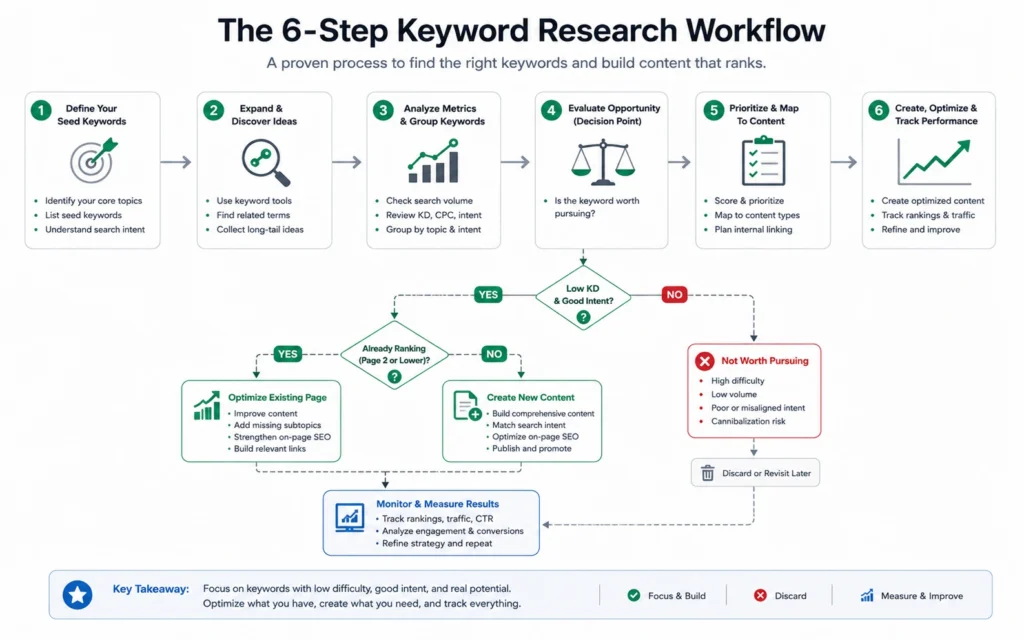
Stop treating keyword research like a fishing expedition. You need a system that moves from broad topics to specific, actionable keywords without drowning in data.
Step 1: Define Your Seed Topics
Start with 5-10 topics you can write about with genuine expertise. These aren’t keywords yet — they’re subject areas. If you’re building a site about home fitness, your seeds might be: bodyweight training, home gym equipment, workout nutrition, injury prevention, and exercise programming.
Write these down. Don’t skip this step. Your seed topics anchor your research and prevent you from chasing keywords outside your expertise zone.
Step 2: Generate Keyword Ideas
Use three sources minimum:
Keyword research tools — Ahrefs, Semrush, or Ubersuggest. Enter each seed topic and export 20-30 related keywords. Don’t filter yet. You want volume here.
Google autocomplete — Type your seed topic into Google and note every suggestion. These are real searches people make. They’re often long-tail and lower competition than tool suggestions.
Competitor analysis — Identify 2-3 sites in your niche. Use “Site Explorer” or similar features to see which keywords drive their traffic. Look for keywords where they rank on page 2-3. Those are your opportunities.
Combine all sources into one master list. You should have 50-100 keywords at this point.
Step 3: Filter by Keyword Difficulty
Set your threshold based on your site’s current authority:
New site (0-6 months old): KD 0-25 Established site (6-18 months): KD 0-35 Authority site (18+ months, consistent content): KD 0-50
Delete everything above your threshold. This hurts. You’ll remove keywords with tempting search volume. Do it anyway. Ranking for KD 60 keywords when you’re KD 20 is a recipe for six months of wasted effort.
Step 4: Check Search Intent
This is where most guides fail you. They tell you to filter by metrics, then publish. Don’t do that.
For each remaining keyword, Google it. Look at the top 10 results. Ask yourself:
- What format dominates? (Blog posts, product pages, videos, forums)
- What angle do they take? (Beginner guide, comparison, review, tutorial)
- What’s the content depth? (Quick answer, comprehensive guide, listicle)
Your content must match this pattern or have a clearly better angle. If every result is a product comparison and you plan to write a beginner guide, you’ll fail — even with low KD.
I rejected 40% of my filtered keywords at this stage in my last research session. They looked perfect on paper. The SERP told a different story.
Step 5: Validate Search Volume and Business Value
Low competition keywords with 10 monthly searches won’t move the needle. Set a minimum threshold:
Informational keywords: 100+ searches/month Commercial keywords: 50+ searches/month Transactional keywords: 20+ searches/month
But volume isn’t everything. Ask: does this keyword attract my target audience? “Free project management templates” has higher volume than “project management software for agencies,” but the first attracts people who won’t pay, while the second attracts buyers.
Prioritize keywords that align with your business model, not just the easiest to rank.
Step 6: Analyze SERP Competition Quality
Now you’re looking for weaknesses. Open the top 5 results for each keyword and score them:
Content quality: Thin (<800 words), adequate (800-2000), comprehensive (2000+) Freshness: Updated in last 6 months, 6-18 months, older than 18 months User experience: Mobile-friendly, fast loading, good formatting Authority signals: Clear author credentials, cited sources, original research
Target keywords where at least 3 of the top 5 results have two or more weaknesses. That’s your opening. You’re not trying to beat perfect content. You’re looking for content you can genuinely improve.
Read the SERP Like a Competitive Intelligence Report
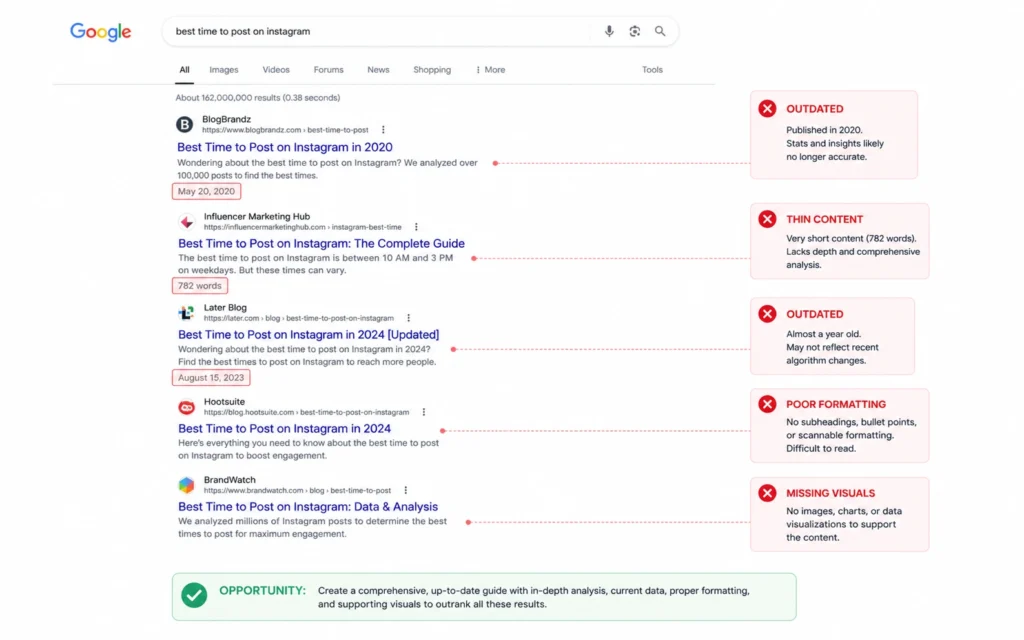
The SERP tells you what Google thinks searchers want. Your job is to give them that — but better.
When I research “best running shoes for flat feet,” I see three product roundups from major publications, two brand-specific guides, and one Reddit thread. The roundups are comprehensive but generic. The Reddit thread ranks because it’s specific and honest.
My angle: a guide that combines expert reviews with real user feedback from running forums, updated quarterly with current pricing and availability. I can beat the roundups on specificity and the Reddit thread on structure and authority.
This is how you think about every keyword. Not “can I rank?” but “how do I win?”
Look for these SERP patterns:
Forum dominance — If Reddit, Quora, or niche forums rank in the top 5, the existing content isn’t satisfying searchers. Create a comprehensive guide that answers the questions people are asking in those threads.
Outdated winners — Check the publish dates. If position 2 hasn’t been updated since 2022, that’s your signal. Publish a current version and emphasize the update date prominently.
Intent mismatch — Sometimes Google gets it wrong. If searchers want a tutorial but get product pages, create the tutorial. Optimize it clearly for that intent. You might steal the ranking.
Geographic gaps — National keywords are competitive. “Best coffee shops in Austin” is easier than “best coffee shops.” Local intent keywords often have lower competition and higher conversion rates.
Tools That Actually Help (And When to Use Free Alternatives)
You don’t need expensive tools to find low competition keywords. But the right tools speed up the process significantly.
Ahrefs — Best for backlink analysis and accurate KD scores. Use it to check the domain authority of ranking pages and identify link gaps. The $99/month plan is worth it if you’re serious about SEO. But if you’re just starting, the free Ahrefs Webmaster Tools gives you enough data for basic research.
Semrush — Strongest for competitor keyword analysis. The “Keyword Gap” feature shows keywords your competitors rank for that you don’t. This is gold for finding low competition opportunities they’ve already validated.
Ubersuggest — Budget option at $29/month. KD scores are less accurate than Ahrefs or Semrush, but the volume is decent for early-stage research. Use it to generate keyword ideas, then validate with manual SERP analysis.
Google Keyword Planner — Free, but designed for ads, not SEO. Search volume ranges are broad (“1K-10K” instead of “3,200”). Still useful for idea generation when you have zero budget.
AnswerThePublic — Free tier available. Shows question-based keywords and search suggestions. Great for finding long-tail variations you’d miss otherwise.
Here’s my actual setup: I use Ahrefs for final validation and competitor analysis, Google autocomplete for idea generation, and manual SERP review for intent checking. Total cost: $99/month. Total time per keyword: 8-12 minutes once you’re practiced.
The tool doesn’t matter as much as the workflow. I’ve seen people waste $300/month on tools because they skip the SERP analysis. Don’t be that person.
Common Mistakes That Kill Your Rankings
I’ve made every mistake on this list. Learn from my wasted hours.
Mistake 1: Chasing volume over intent A keyword with 5,000 searches/month means nothing if those searchers aren’t your audience. I spent two months optimizing for “free marketing tools” before realizing the traffic consisted entirely of people who would never convert. The keyword was easy to rank for. It was also worthless for my business.
Mistake 2: Ignoring SERP features If the top result is a featured snippet, video carousel, or shopping results, organic clicks drop dramatically. Check for these before committing to a keyword. Sometimes the competition isn’t other websites — it’s Google’s own features.
Mistake 3: Publishing once and forgetting Low competition keywords can become medium or high competition as others discover them. Set a quarterly review for your top 20 keywords. Update content, check ranking changes, and adjust your strategy. SEO isn’t set-and-forget.
Mistake 4: Targeting only low competition keywords Yes, this guide is about finding them. But if you only target KD 0-20 keywords forever, you’ll hit a ceiling. Mix your portfolio: 60% low competition, 30% medium, 10% high. The high competition keywords are long-term plays. They might take 12-18 months to rank, but they drive serious volume when they do.
Mistake 5: Not checking keyword trends Use Google Trends to verify the keyword isn’t declining. A low competition keyword with falling search volume is a trap. You’ll rank, then watch traffic disappear. Look for stable or growing trends, especially for evergreen topics.
What to Do When Things Go Wrong
You followed the workflow. You found a KD 15 keyword with weak competition. You published optimized content. Three months later, you’re still on page 3.
Now what?
Diagnose the problem:
Check your technical SEO first. Is the page indexed? Use “site:yourdomain.com/keyword-url” to verify. If it’s not indexed, submit it through Google Search Console and check for crawl errors.
Review your on-page optimization. Does your title tag include the exact keyword? Is it in the H1? The first 100 words? Are you using related terms naturally throughout?
Analyze your backlinks. Even low competition keywords need some authority signals. If the ranking pages have 10-20 backlinks each and you have zero, that’s your problem. Build 5-10 quality links through guest posts, resource pages, or digital PR.
Fix the content:
Sometimes the issue is quality, not promotion. Compare your article to the top 3 results objectively. Are they longer? More detailed? Better formatted? Do they have original research or data you’re missing?
Update your content. Add sections they have that you don’t. Improve your examples. Add visuals if they’re text-only. Make your guide genuinely better, not just different.
Re-optimize for intent:
Maybe you misread the SERP. Go back and check again. Are you sure your content matches what searchers want? If the top results are all comparison tables and you wrote a narrative guide, that’s the mismatch.
Adjust your angle. Add the comparison table. Reformat your content to match the dominant pattern while keeping your unique value.
Give it more time:
New domains take 4-6 months to gain trust from Google. If your site is younger than that, patience might be the only solution. Keep publishing quality content. Build internal links to the struggling page. The authority will come.
When to Abandon a Keyword
Not every keyword is worth fixing. Cut your losses when:
- The keyword volume drops below your minimum threshold (check Google Trends)
- A major competitor publishes significantly better content and dominates the SERP
- The search intent shifts (Google starts showing different result types)
- You’ve invested 3+ months of optimization with zero ranking movement
Move on. Apply what you learned to the next keyword. SEO is a portfolio game. Some will win, some will fail. Your job is to increase the win rate over time.
Frequently Asked Questions About Low Competition Keywords
What keyword difficulty score is considered low competition?
For new websites, aim for keyword difficulty scores between 0-30. Established sites with some authority can target 0-40. The exact threshold depends on your domain strength and backlink profile.
Can I rank for keywords with high search volume and low competition?
Yes, but they’re rare. High volume + low competition keywords usually indicate emerging trends or underserved niches. Move fast when you find them, but verify the search intent matches your content before investing time.
How long does it take to rank for low competition keywords?
With proper on-page SEO and basic technical optimization, you can see low competition keywords rank in 2-8 weeks. New domains typically take longer (6-12 weeks) while established sites may rank in days.
Should I only target low competition keywords?
No. Build a balanced portfolio: 60-70% low competition keywords for quick wins, 20-30% medium competition for growth, and 10% high competition as long-term targets. This mix gives you momentum while building authority.
Continue Exploring
- Ready to put these keywords to work? Learn how to optimize your content for the keywords you’ve identified. Proper on-page SEO ensures Google understands what your page is about and ranks it accordingly.
- Once you’ve published, Master technical SEO fundamentals to remove indexing barriers and help search engines crawl your site efficiently. Technical issues can prevent even the best content from ranking.