Seed keywords are the foundation of every keyword research project. They’re the 10-20 core terms that describe what you do, what you sell, or what problems you solve. Get these right, and your entire SEO strategy has direction. Get them wrong, and you’ll waste hours chasing irrelevant traffic.
I spent three months building content for a B2B SaaS client before realizing our seed list was built around industry jargon instead of customer language. We ranked for terms nobody searched for. Starting over with actual buyer vocabulary changed everything — organic traffic increased 340% in six months. That restart cost us time, but it taught me this: seed keywords SEO isn’t about being clever. It’s about being accurate.
This guide walks you through building a seed keyword list that actually connects to search demand. You’ll learn how to identify core topics, validate search volume, and avoid the trap of overcomplicating this foundational step.
What Seed Keywords Actually Do for Your SEO
Seed keywords serve three specific functions in your research workflow. First, they anchor your keyword expansion. Tools like Ahrefs or SEMrush use these terms to generate related keyword suggestions.
Second, they define your content pillars. Each seed typically becomes a category or topic cluster on your site. Third, they reveal competitive gaps. When you analyze who ranks for your seeds, you see who you’re actually competing against.
The mistake most beginners make is treating seed keywords like a brainstorming exercise with no constraints. You end up with 50+ terms that overlap, compete with each other, or target audiences you can’t serve. That’s not a foundation — that’s noise.
A proper seed list for seed keywords SEO 2026 should pass this test: if you removed one term, would you lose access to an entire topic area? If the answer is no, that term probably isn’t a seed. It’s a variation.
The Four-Step Process
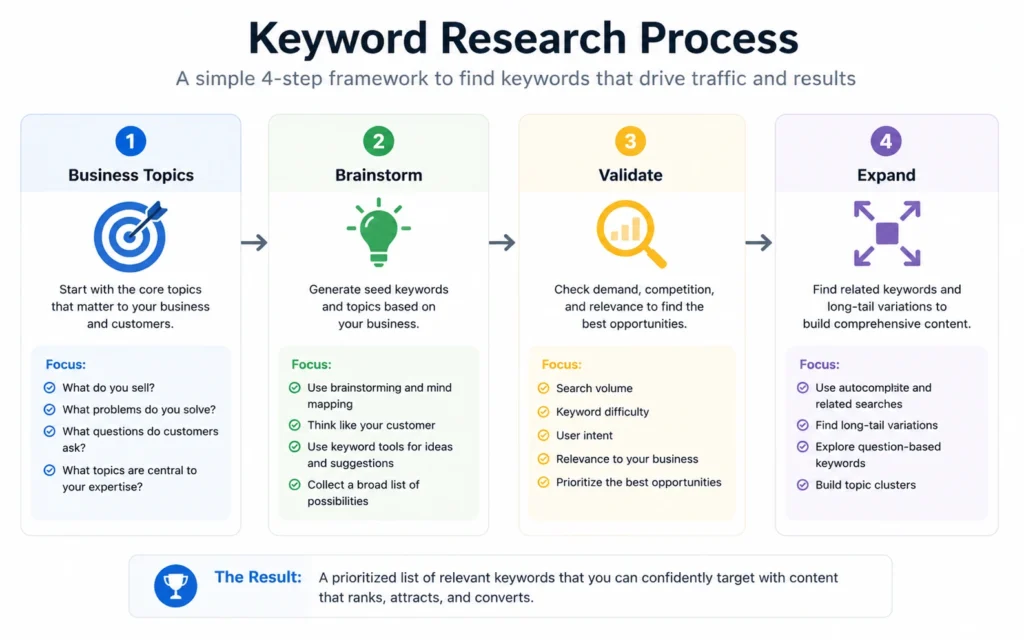
Building your seed list takes 45-60 minutes if you do it right. Rushing this step creates problems downstream. Here’s the workflow I use with every new project.
Step 1: List Your Revenue-Centric Topics
Start with your business, not with tools. Open a blank document and write down 3-5 broad topics that directly connect to revenue or core goals. For an e-commerce store selling running gear, these might be: running shoes, running apparel, running accessories, training guides. For a marketing consultant: email marketing, content strategy, SEO consulting, marketing automation.
Notice these aren’t keywords yet. They’re categories. The distinction matters because categories force you to think structurally about your business. Keywords come later.
I always ask clients this question: “If someone searched for [topic], would you want that person on your site?” If the answer isn’t an immediate yes, that topic doesn’t belong in your seed list. Relevance beats volume every time.
Step 2: Brainstorm Without Tools
Now convert each category into actual search terms. This is where you write down what people might type into Google. For “running shoes,” you might list: running shoes, jogging shoes, trail runners, marathon shoes, best running shoes.
Do this without opening any keyword tool. Use your knowledge of your customers, your products, and your industry. Tools will expand this list later — right now you need human intuition.
Here’s what I’ve learned after auditing dozens of seed lists: business owners consistently underestimate the vocabulary their customers use. They list technical product names instead of problem-based searches. “Orthopedic insoles” instead of “arch support for flat feet.” The second phrase has 3x the search volume.
Spend 15-20 minutes on this step. Set a timer. Write every variation that comes to mind, even if it feels obvious or redundant.
Step 3: Validate Search Volume
Open your keyword tool now. I use Ahrefs for this, but Google Keyword Planner, SEMrush, or Ubersuggest work fine. Enter each term from your brainstorm list and check two metrics: monthly search volume and keyword difficulty.
For seed keywords, you want terms with at least 1,000 monthly searches. Below that threshold, you’re building on sand. The term might be relevant, but it won’t generate enough traffic to justify building a content pillar around it.
Keyword difficulty matters less at this stage. Some of your seeds will be competitive — that’s expected. What you’re looking for here is confirmation that people actually search for these terms.
I typically eliminate 30-40% of brainstormed terms at this stage. They’re either too niche (low volume) or too broad (unclear intent). That’s normal. Validation is a filter, not a pass/fail test.
Step 4: Expand with Modifiers
Take your validated seeds and add modifiers to create variations. Common modifiers include: best, top, how to, guide, review, vs, near me, cheap, affordable, professional.
“Running shoes” becomes: best running shoes, running shoes for beginners, affordable running shoes, running shoes near me. Each variation represents different search intent and different stages of the buyer journey.
Don’t add these to your seed list itself. Keep seeds clean — 10-20 core terms maximum. But document the variations because they’ll become your content ideas later.
This expansion step is where seed keywords SEO 2026 differs from old approaches. Modern search is conversational. People don’t just search “running shoes.” They search “what are the best running shoes for flat feet under $100.” Your modifier list prepares you for that reality.
Common Mistakes That Waste Time
I’ve made every mistake on this list. Learn from my wasted hours.
Mistake 1: Starting with competitor keywords. Yes, competitor analysis matters. But not at the seed stage. If you start by copying what competitors rank for, you’ll miss opportunities they’ve overlooked. Build your own foundation first, then compare.
Mistake 2: Including branded terms as seeds. Unless you’re doing reputation management, “Nike running shoes” isn’t a useful seed for a general athletic store. You can’t rank for someone else’s brand. Focus on generic terms you can actually compete for.
Mistake 3: Confusing products with problems. “Protein powder” is a product. “Post-workout recovery” is a problem. Both can be seeds, but they attract different audiences and require different content. Know which one you’re targeting.
Mistake 4: Over-segmenting too early. “Men’s running shoes,” “women’s running shoes,” “kids’ running shoes” — these aren’t three seeds. They’re one seed with demographic variations. Consolidate at the seed level. Expand later.
What It Costs: Time and Tools
Building a solid seed keyword list takes 45-60 minutes for your first pass. Subsequent reviews take 20-30 minutes. This isn’t a one-time task — you should revisit your seeds quarterly as your business evolves.
Tool costs vary. Google Keyword Planner is free but requires a Google Ads account. Ahrefs starts at $99/month. SEMrush starts at $129/month. Ubersuggest offers a free tier with limitations.
Here’s the honest truth: you don’t need expensive tools to build a good seed list. You need clear thinking about your business and your customers. Tools validate; they don’t replace strategy.
I started my first successful SEO project using only Google Keyword Planner and a spreadsheet. It took longer, but the fundamentals were identical to what I do now with premium tools.
When Things Go Wrong
Your seed list will feel incomplete. That’s normal. You’ll second-guess whether you’ve captured the right terms. You’ll worry about missing something important.
Here’s what to do: publish content based on your current seeds and watch what happens. Search Console will show you what people actually searched for to find your pages. Those real queries become your next round of seeds.
I’ve revised seed lists mid-project more times than I can count. The market tells you what matters. Your job is to listen and adjust.
Another common problem: your seeds generate keyword suggestions that don’t match your business. This means your seeds are too broad. Narrow them. “Shoes” is too broad. “Running shoes” is better. “Trail running shoes for beginners” might be perfect.
Frequently Asked Questions About Seed Keywords SEO
What are seed keywords in SEO?
Seed keywords are the foundational terms that describe your business, products, or content. They’re typically 1-2 word phrases with high search volume that serve as the starting point for keyword research. Examples include “running shoes” for an athletic store or “email marketing” for a SaaS company.
How many seed keywords should I start with?
Start with 10-20 seed keywords maximum. Quality beats quantity here. Each seed should represent a distinct topic area or product category. Too many seeds create scattered research; too few limit your keyword discovery. Focus on the terms that directly connect to revenue or core content goals.
Where do I find seed keywords?
Start with your own knowledge of your business and customers. List what you sell, what problems you solve, and how people describe your offerings. Then validate these terms using tools like Google Keyword Planner, Ahrefs, or SEMrush to confirm search volume and relevance.
Can seed keywords change over time?
Yes. Seed keywords should evolve as your business grows, products change, or market language shifts. Review and update your seed list quarterly. New competitors, trending topics, or product launches all justify revisiting your foundational keywords.
Continue Exploring
Ready to expand your seed list into a full keyword strategy? Learn the complete keyword research process to understand how seeds fit into broader SEO planning. Then Explore long-tail keyword strategies to see how to extend your seeds into specific, low-competition opportunities.