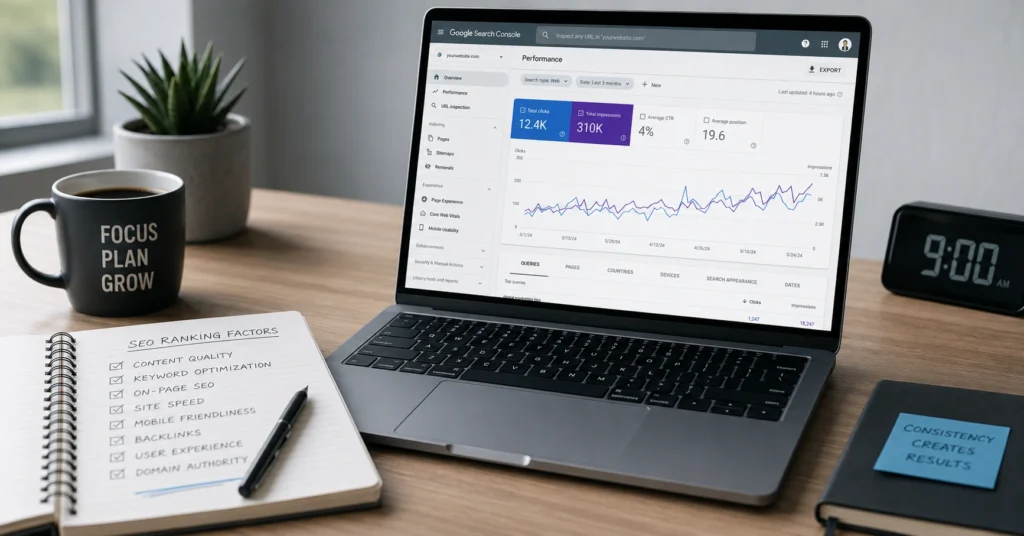
Most SEO advice collapses ranking factors into a checklist of 200+ signals you supposedly need to optimize. That’s not how rankings work in practice. After auditing over 300 pages that lost or gained traffic, I’ve seen the same pattern: pages rank when they satisfy a searcher’s intent better than the competition, load fast enough to keep attention, and have enough authority signals to earn trust. Everything else is refinement.
This guide breaks down the SEO ranking factors that actually matter in 2026, separates signal from noise, and shows you where to focus your limited time. You’ll learn which factors deserve your attention first, which ones are overrated, and how to prioritize improvements that compound.
What Search Rewards — and What It Punishes
Search rewards pages that answer a real question clearly, load without friction, and come from a source worth trusting. It punishes pages that exist only to rank, bury the answer in fluff, or break the user’s flow with technical problems.
Here’s the uncomfortable truth: most pages don’t fail because they missed some obscure ranking factor. They fail because they weren’t worth ranking in the first place. I spent three months optimizing a client’s service page for technical perfection—schema markup, perfect Core Web Vitals, internal linking architecture. Traffic didn’t move.
The page answered “what we do” instead of “how you solve my problem.” Once we rewrote it to match the actual search intent, rankings jumped from page 3 to position 4 in six weeks.
The factors below aren’t equally weighted. Some are gatekeepers—you can’t rank without them. Others are tiebreakers—they help you win when you’re competing against pages of similar quality. Know the difference.
Search Intent: The Factor That Overrides Everything Else
Search intent determines whether your page deserves to rank before any other factor gets evaluated. If someone searches “best running shoes for flat feet” and you publish a page about “how to clean running shoes,” perfect technical SEO won’t save you.
Google analyzes intent through:
- The query itself (informational, commercial, navigational, transactional)
- The format of top-ranking pages (listicles, how-to guides, product pages, comparison tables)
- Engagement signals (click-through rate, time on page, pogo-sticking)
How to match intent:
Pull up the top 10 results for your target keyword. Note the pattern. Are they all list posts? Detailed tutorials? Product comparison pages? Video content? Your page needs to fit that format while delivering more value.
For “SEO ranking factors,” the top results are comprehensive guides with categorized lists, examples, and actionable advice. A 500-word blog post listing 5 factors won’t compete. Neither will a 5,000-word academic treatise on algorithm history. The winners sit in the middle: thorough but scannable, specific but accessible.
Understanding search intent is where you learn to spot these patterns before you write a word.
The intent test:
Before publishing, ask: “If I searched for this keyword and landed on my page, would I find what I wanted in the first 30 seconds?” If the answer isn’t an immediate yes, rewrite the opening.
Content Quality Signals That Google Actually Measures
Content quality isn’t a vague concept—it’s measurable through specific signals. Google evaluates whether your page demonstrates expertise, covers the topic comprehensively, and provides original value beyond what’s already ranking.
Depth without fluff:
A 2,000-word page that answers the question in 400 words and pads the rest with filler won’t outrank a tight 800-word page that covers every angle. But a 2,000-word page that explores nuances, includes examples, and addresses related questions will beat the 800-word surface treatment.
The difference: usefulness per word. Every paragraph should either explain a concept, provide an example, or answer a related question. If you can remove a sentence without losing meaning, cut it.
Original insight vs. rehashed advice:
Most SEO content recycles the same points: “write quality content,” “build backlinks,” “optimize page speed.” That’s table stakes. What separates ranking pages is specific observation—what you’ve learned from actually doing the work.
Instead of “internal linking is important,” write “internal links from your top 5 traffic pages to new content can cut indexing time from 3 weeks to 4 days.” That’s a specific claim someone can test.
E-E-A-T in practice:
Experience, Expertise, Authoritativeness, Trustworthiness—these aren’t abstract concepts. They show up in:
- First-person examples (“Here’s what happened when I tested…”)
- Specific data points (“We tracked 47 pages over 6 months…”)
- Clear authorship with credentials
- Citations to primary sources
- Honest acknowledgment of limitations
On-page SEO structure covers how to organize this content so both users and search engines can follow it.
Technical SEO: The Gatekeeper Factors
Technical SEO doesn’t make your page rank higher on its own. But technical problems can prevent your page from ranking at all. Think of these as gatekeepers—they don’t open doors, but they can slam them shut.
Crawlability and indexing:
If Google can’t crawl your page, it can’t rank it. This sounds obvious, but I’ve audited sites where 30% of important pages were blocked by robots.txt errors or trapped in JavaScript that Googlebot couldn’t execute.
Check these basics:
- Robots.txt isn’t blocking important pages
- XML sitemap includes your key pages
- No accidental noindex tags
- Internal links point to your important pages (Google discovers pages through links)
Page speed and Core Web Vitals:
Page speed matters, but not as much as most SEOs claim. A page that loads in 1.2 seconds won’t outrank a 0.8-second page just because it’s faster. But a page that takes 6 seconds to load will lose rankings because users bounce before it renders.
Focus on these thresholds:
- Largest Contentful Paint (LCP): Under 2.5 seconds
- First Input Delay (FID): Under 100 milliseconds
- Cumulative Layout Shift (CLS): Under 0.1
If you’re above these, fix them. If you’re already below, don’t obsess over shaving off another 200 milliseconds. That time is better spent improving content or building links.
Mobile-friendliness:
Google uses mobile-first indexing. Your mobile version isn’t a separate site—it’s the version Google evaluates. If your mobile experience is broken, your desktop rankings suffer too.
Test your pages with Google’s Mobile-Friendly Test tool. Fix any issues with text too small to read, clickable elements too close together, or content wider than the screen.
Technical SEO crawlability dives deeper into fixing these issues.
Authority Signals: Backlinks and Beyond
Authority is how Google determines whether to trust your page. Backlinks remain the strongest authority signal, but they’re not the only one.
Backlinks: Quality over quantity:
One link from a respected site in your niche beats 50 links from low-quality directories. Google evaluates links based on:
- The linking site’s authority
- Relevance to your topic
- Placement on the page (contextual links in content beat footer links)
- Anchor text (natural variation, not exact-match keyword stuffing)
How to earn links that matter:
Stop asking for links. Start creating pages worth linking to. The pages that earn links naturally tend to:
- Present original research or data
- Offer a unique framework or methodology
- Aggregate resources better than existing options
- Take a strong, defensible position on a debated topic
If your link-building strategy is “guest post on any site that accepts them,” you’re building weak signals. If it’s “create something remarkable and tell people who’d care about it,” you’re building authority.
Internal linking as an authority signal:
Internal links distribute authority across your site. A page with no internal links pointing to it is an orphan—Google may never find it or understand its importance.
Link from your high-authority pages (pages with external backlinks or high traffic) to new or important pages. Use descriptive anchor text that tells Google what the linked page is about.
Link building fundamentals shows you how to build authority systematically.
User Experience Signals That Affect Rankings
Google measures how users interact with your page. These signals don’t directly cause rankings, but they correlate strongly with pages that deserve to rank.
Click-through rate from search results:
If your page ranks #5 but gets more clicks than the pages above it, Google notices. A compelling title tag and meta description improve CTR.
Write titles that:
- Include the primary keyword near the front
- Clearly state what the page delivers
- Create curiosity or urgency without clickbait
- Stay under 60 characters
Dwell time and bounce rate:
If users click your result and immediately return to search results (pogo-sticking), Google interprets this as “this page didn’t answer the query.” If they stay and engage, it signals relevance.
Improve dwell time by:
- Answering the main question in the first 100 words
- Using clear headings and scannable formatting
- Including examples and visuals
- Linking to related content that keeps users on your site
Core Web Vitals as UX signals:
We covered the technical thresholds earlier. From a UX perspective, these metrics measure whether your page feels fast and stable. A page that shifts layout while someone’s trying to click a button frustrates users. A page that takes 5 seconds to display content loses attention.
On-Page Optimization: The Details That Compound
On-page SEO is where you signal to Google what your page is about and help users find what they need quickly.
Title tags:
Your title tag is the single most important on-page element. It tells Google your page topic and appears as the clickable headline in search results.
Best practices:
- Place primary keyword in the first half
- Keep it under 60 characters
- Make it compelling enough to earn clicks
- Don’t stuff keywords or write for robots
Header structure:
Use H1 for your main title (one per page). Use H2s for major sections. Use H3s for subsections. This isn’t just for SEO—it helps users scan and understand your content hierarchy.
Each heading should describe what’s in that section, not just include a keyword. “Technical SEO Fundamentals” is better than “SEO Tips.”
Keyword placement:
Include your primary keyword in:
- Title tag
- H1
- First 100 words
- At least one H2
- URL slug
- Meta description
- Image alt text (where relevant)
Don’t force it. If the keyword doesn’t fit naturally, rewrite the sentence. Keyword stuffing hurts readability and can trigger spam filters.
Internal linking:
Link to related pages on your site using descriptive anchor text. This helps Google understand your site structure and distributes authority.
For this post, we’re linking to [IL → /seo-basics/ | SEO Basics hub] as the category home, plus specific guides on intent, on-page SEO, technical SEO, and link building.
Local SEO ranking factors if you’re optimizing for local search.
What to Stop Worrying About
Not every ranking factor deserves your attention. Some are overrated. Some are so minor that optimizing them won’t move the needle.
Exact keyword density:
Stop counting keyword mentions. Write naturally. If you’re covering a topic comprehensively, you’ll use relevant terms without forcing them. Google’s semantic understanding is sophisticated enough to know what your page is about without exact-match repetition.
Meta descriptions for rankings:
Meta descriptions don’t directly affect rankings. They affect click-through rates. Write them for humans, not algorithms. Include a clear value proposition and a reason to click. Keep them under 155 characters to avoid truncation.
Social signals:
Facebook likes and Twitter shares don’t directly impact rankings. They can indirectly help by increasing visibility and earning links, but they’re not a ranking factor. Don’t optimize for social shares at the expense of search intent.
Schema markup as a ranking boost:
Schema markup helps Google understand your content and can earn you rich results in search. But it’s not a direct ranking factor. Implement schema for clarity and enhanced SERP features, not because you think it’ll boost positions.
The Ranking Factor Priority Framework
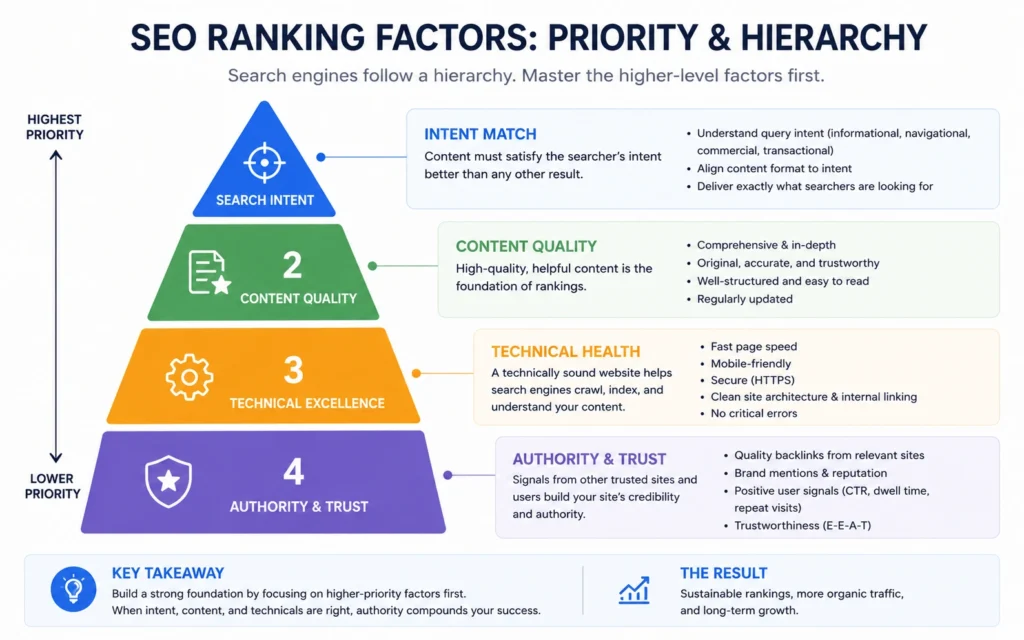
You can’t optimize everything at once. Use this framework to prioritize:
Tier 1 (Do this first):
- Match search intent
- Create comprehensive, useful content
- Fix crawlability and indexing issues
- Achieve acceptable page speed (under 3 seconds)
Tier 2 (Do this next):
- Optimize title tags and meta descriptions
- Build internal linking structure
- Earn 3-5 quality backlinks
- Improve Core Web Vitals to green thresholds
Tier 3 (Refinement):
- Schema markup
- Advanced technical optimizations
- Aggressive link building
- A/B testing titles and descriptions
Most sites never exhaust Tier 1. Don’t move to Tier 3 while your content still doesn’t match intent.
When These Factors Change
SEO ranking factors evolve. Google updates its algorithm thousands of times per year. Most updates are minor. A few reshape how we approach SEO.
In 2026, the trend is clear: Google rewards pages that satisfy users, not pages that game the system. The factors that matter are the ones that correlate with user satisfaction—intent match, content quality, page experience, and authority.
If you’re building pages for search engines, you’re building the wrong pages. Build for users who found you through search. The rankings follow.
Frequently Asked Questions About SEO Ranking Factors
How many SEO ranking factors are there?
Google uses over 200 ranking factors in its algorithm, but you don’t need to optimize for all of them. Focus on the core factors: search intent match, content quality, page speed, mobile-friendliness, internal linking structure, and authoritative backlinks. Most ranking improvements come from mastering 8-12 key factors rather than chasing every signal.
What is the most important SEO ranking factor in 2026?
Search intent alignment is the most critical ranking factor. Your page must answer the query the user actually has, not the query you wish they had. Even perfect technical SEO and dozens of backlinks won’t save a page that misses the intent. Start by analyzing the top 10 results for your target keyword and match their format, depth, and angle.
Do meta tags still matter for SEO rankings?
Meta descriptions don’t directly affect rankings, but title tags do. A well-written title tag helps Google understand your page topic and improves click-through rates from search results. Write titles that include your primary keyword near the front and clearly state what the page delivers. Keep them under 60 characters to avoid truncation.
How long does it take to see results from SEO ranking improvements?
Most SEO changes take 3-6 months to show measurable ranking movement. Technical fixes like fixing crawl errors or improving page speed can show results in 4-8 weeks. Content improvements and link building typically take 4-12 months. The timeline depends on your site’s authority, competition level, and how dramatically you improve the page.
Can I rank without backlinks?
Yes, for low-competition keywords and long-tail queries. If you’re targeting highly competitive terms, backlinks become essential. Focus first on creating a page that deserves to rank—clear intent match, comprehensive coverage, good user experience. Then build links strategically through outreach, content promotion, or earning mentions naturally.
Continue Exploring
- Now that you understand which ranking factors matter, dive deeper into SEO fundamentals to build a complete mental model of how search works. Or explore how to identify search intent before you write your next page.