Most SEO advice treats the three types of SEO as separate checkboxes. Publish content. Build links. Fix site speed. Do all three and you’ll rank.
That’s not how it works.
I spent six months building backlinks to a client’s site before realizing their pages weren’t even indexed properly. The links were real. The content was solid. But technical SEO problems meant Google couldn’t crawl half the site. We were pouring authority into a bucket with holes.
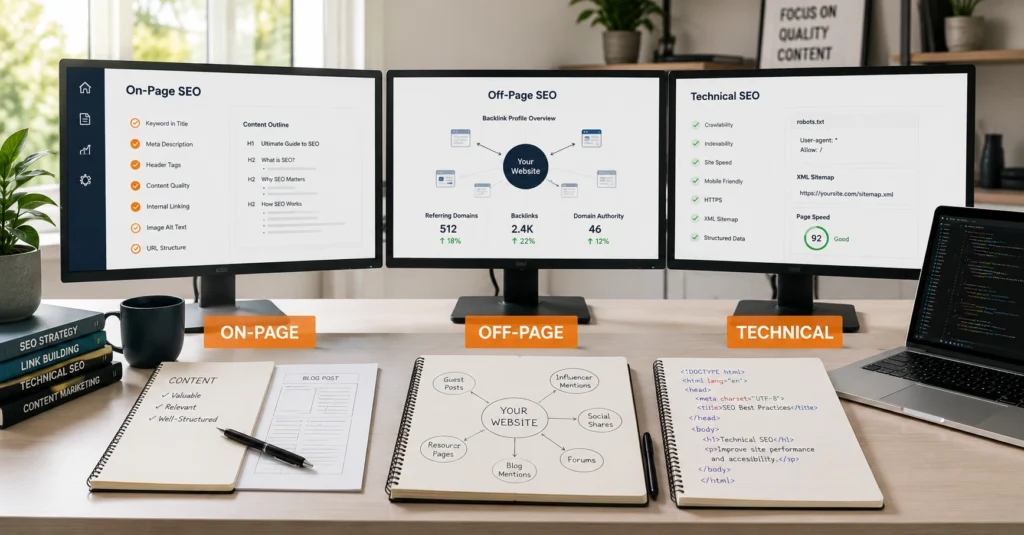
The three types of SEO — on-page, off-page, and technical — don’t function independently. They’re a system. Weakness in one area caps what the other two can achieve.
This guide breaks down what each type actually does, where beginners waste time, and how to prioritize your work so you’re not building on broken foundations.
What On-Page SEO Actually Controls
On-page SEO is everything you control directly on the page itself. The content. The structure. The HTML tags. The internal links. It’s the only type of SEO where you have complete authority — no waiting for Google to recrawl, no begging other sites for links, no developer tickets.
What on-page SEO includes:
- Content quality and relevance — Does the page actually answer the search query better than competing pages?
- Title tags and meta descriptions — What shows in search results and influences click-through rates
- Heading structure (H1, H2, H3) — How you organize information for both readers and search engines
- Keyword placement and semantic relevance — Using terms that match search intent, not just stuffing exact-match keywords
- Internal linking — How you connect this page to other relevant pages on your site
- Image optimization — File names, alt text, and compression that affects load speed
- URL structure — Clean, descriptive URLs that signal topic relevance
- User experience signals — Readability, page layout, mobile-friendliness
Here’s what most beginners miss: on-page SEO isn’t about hitting a keyword density target. It’s about making the page unmistakably about one specific topic and demonstrably useful for the person searching.
I reviewed a site last month that had 47 pages targeting variations of “project management software.” Each page was 600 words, lightly optimized, and essentially said the same thing. None of them ranked. The problem wasn’t technical. It wasn’t a lack of backlinks. The pages didn’t deserve to exist because they didn’t offer distinct value.
On-page SEO in practice:
Let’s say you’re writing a page about “best running shoes for flat feet.”
Weak on-page SEO: 800 words listing five shoes with affiliate links, generic descriptions copied from manufacturer sites, one H1, no internal links, stock images with filenames like “IMG_4521.jpg.”
Strong on-page SEO: 2,000+ words comparing 8-10 shoes based on actual testing, custom photos showing arch support, H2 sections for “What Causes Flat Feet,” “How We Tested,” “Best for Overpronation,” internal links to related guides on running injuries and shoe sizing, schema markup for product reviews, optimized images under 100KB each.
The difference isn’t optimization tricks. It’s whether the page earns its ranking by being genuinely helpful.
on-page SEO checklist breaks down the specific tactics for each element.
What Off-Page SEO Actually Builds
Off-page SEO is everything that happens outside your website that signals authority and trust to search engines. Primarily: backlinks from other sites. But also brand mentions, social signals, reviews, and citations.
What off-page SEO includes:
- Backlinks — Links from other websites pointing to your pages
- Link quality and relevance — Authority of linking domains and topical relationship to your content
- Anchor text distribution — The visible text used in links pointing to your site
- Brand mentions — Unlinked references to your brand or content
- Social signals — Shares, engagement, and visibility on social platforms
- Local citations — Business listings on directories and review sites
- Reviews and ratings — Customer feedback on Google, Yelp, industry-specific platforms
- Digital PR — Media coverage, expert quotes, guest posts
Off-page SEO is the hardest type to control because it depends on other people. You can’t force someone to link to you. You can only create something link-worthy and ask strategically.
Most beginners approach link building backwards. They start with outreach templates and link targets before creating anything worth linking to. That’s why their response rates are 2% and their links come from low-quality directories.
The hierarchy of link value:
Not all backlinks are equal. A link from a relevant, authoritative site in your niche carries far more weight than ten links from random blogs.
High-value links:
- Editorial links from industry publications
- Resource page inclusions on university or government sites
- Mentions in original research or data studies
- Links from sites that rank well for your target keywords
Low-value links (or worse, harmful):
- Paid link schemes
- Directory submissions with no editorial review
- Comment spam on blogs
- Private blog networks (PBNs)
- Reciprocal link exchanges at scale
Google’s algorithms have gotten aggressive about detecting manipulative link building. The penalty isn’t just losing the link value — it’s potential deindexing.
What actually works for off-page SEO in 2026:
Create original research or data that others cite. Publish a study on “average conversion rates by industry” and watch other marketers reference it.
Write genuinely useful tools or templates. A free ROI calculator gets linked more often than another “10 tips” listicle.
Do digital PR the right way. Respond to journalist queries on Help a Reporter Out (HARO) or Qwoted with specific expertise, not generic pitches.
Build relationships before asking for links. Comment on industry blogs, share others’ work, contribute to communities. Then when you do ask, you’re not a stranger.
I’ll be direct: off-page SEO takes the longest to show results and requires the most patience. You can optimize a page in an afternoon. Building real authority takes months or years.
What Technical SEO Actually Fixes
Technical SEO is the infrastructure that allows search engines to crawl, index, and understand your site. If on-page SEO is the content and off-page SEO is the reputation, technical SEO is the foundation.
What technical SEO includes:
- Crawlability — Can Googlebot access your pages?
- Indexation — Are your pages being added to Google’s index?
- Site speed and Core Web Vitals — Load time, interactivity, visual stability
- Mobile-friendliness — Responsive design and mobile usability
- Site architecture — Logical hierarchy and URL structure
- Canonicalization — Preventing duplicate content issues
- XML sitemaps — Helping search engines discover your pages
- Robots.txt — Controlling what gets crawled
- Schema markup — Structured data that helps Google understand content
- HTTPS and security — SSL certificates and safe browsing
- JavaScript rendering — Ensuring dynamic content is crawlable
- 404 errors and redirects — Fixing broken links and proper 301s
Technical SEO is where beginners either overcomplicate everything or ignore it completely until something breaks.
Here’s the reality: most small sites don’t need advanced technical SEO. You don’t need hreflang tags if you’re not targeting multiple languages. You don’t need complex schema if you’re running a simple blog.
But you do need the basics working correctly.
The technical SEO audit every beginner should run:
- Check indexation status — Search
site:yourdomain.comin Google. Are your important pages showing up? If not, you have an indexation problem. - Run a crawl in Google Search Console — Look for coverage errors, crawl anomalies, and mobile usability issues. Fix the red flags first.
- Test page speed — Use PageSpeed Insights or GTmetrix. If your pages take more than 3 seconds to load, you’re losing rankings and visitors.
- Verify mobile-friendliness — Use Google’s Mobile-Friendly Test. If your site isn’t responsive, fix that before doing anything else.
- Check for duplicate content — Use Screaming Frog or Sitebulb to find pages with identical or near-identical content. Consolidate or canonicalize.
Common technical SEO mistakes:
Blocking CSS and JavaScript files in robots.txt, which prevents Google from rendering pages correctly.
Having multiple URL versions of the same page (with and without trailing slashes, HTTP and HTTPS, www and non-www) without proper canonicalization.
Creating infinite crawl loops through poorly configured faceted navigation on e-commerce sites.
Using JavaScript frameworks without server-side rendering, leaving Googlebot unable to see your content.
I audited a site recently where the developer had accidentally set the entire staging subdomain to noindex — but then pushed that code to production. The site had great content and solid backlinks. Zero organic traffic for three months because nothing was indexed. The fix took ten minutes. The discovery took three weeks.
technical SEO fundamentals covers the specific tools and workflows for diagnosing these issues.
How the Three Types of SEO Work Together (or Don’t)
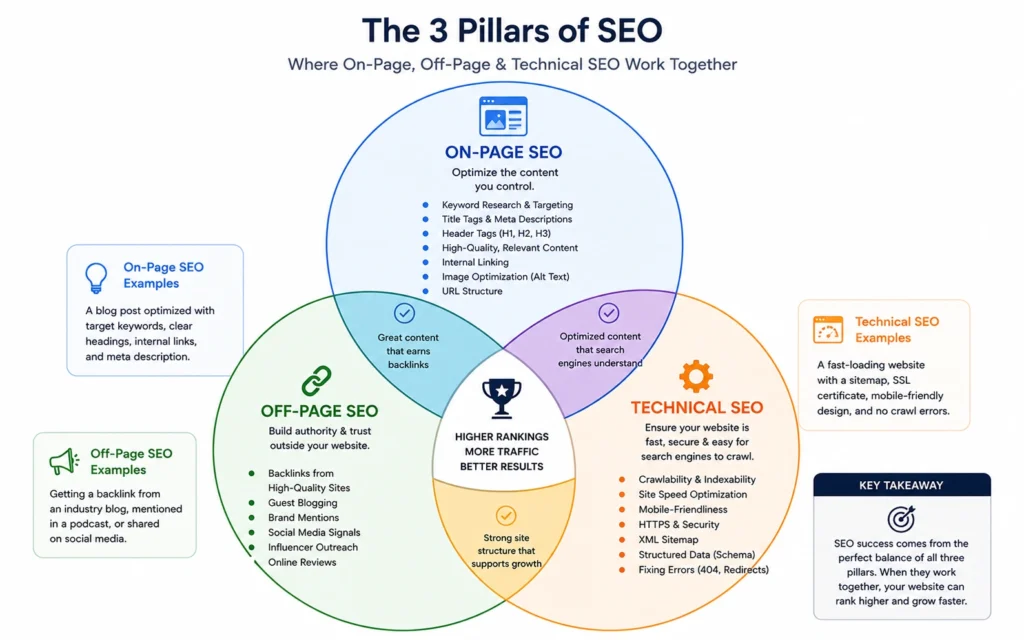
The biggest mistake beginners make is treating the three types of SEO as separate projects. They’ll spend a month optimizing on-page elements, then pivot to link building, then worry about technical SEO — as if they’re independent variables.
They’re not.
The dependency chain:
Technical SEO enables on-page SEO. If Google can’t crawl your pages, your perfect title tags and keyword-optimized content don’t matter. Fix crawlability and indexation first.
On-page SEO enables off-page SEO. Nobody links to thin, generic content. You need pages worth linking to before you start outreach.
Off-page SEO amplifies on-page and technical SEO. Great content on a technically sound site still needs authority signals to rank for competitive terms.
Where the system breaks:
Scenario 1: You build 50 backlinks to a page that returns a 404 error. The links pass authority to a dead end.
Scenario 2: You publish 100 optimized blog posts on a site with a 10-second load time. Google crawls three pages and bounces.
Scenario 3: You fix every technical issue and build perfect internal links, but your content is 400 words of fluff that doesn’t answer the query. You won’t rank.
The right sequence for beginners:
Week 1-2: Technical foundation
- Set up Google Search Console and Analytics
- Fix critical crawl errors
- Ensure mobile-friendliness
- Improve page speed to under 3 seconds
- Create XML sitemap and submit to Google
Week 3-6: On-page optimization
- Research search intent for your target keywords
- Create or optimize 3-5 core pages with comprehensive content
- Optimize title tags, meta descriptions, and headings
- Add internal links between related pages
- Compress images and add alt text
Week 7+: Off-page SEO
- Create one genuinely linkable asset (research, tool, comprehensive guide)
- Identify 20-30 relevant sites for potential links
- Start relationship-building, not just link requests
- Pursue digital PR opportunities
- Monitor brand mentions and request unlinked mentions be linked
This isn’t rigid. You’ll iterate across all three types continuously. But the priority order matters.
What Each Type of SEO Costs (Time, Money, Attention)
Beginners need realistic expectations about what SEO requires. It’s not free just because you’re not paying for ads.
On-page SEO costs:
Time: 4-8 hours per page for quality content creation and optimization Money: $0 if you write it yourself, $200-$1,000 per page for freelance writers Attention: High during creation, low during maintenance Tools: Free (Google Docs, basic keyword research tools) to $100/month (SurferSEO, Clearscope)
Off-page SEO costs:
Time: 10-20 hours per month for outreach and relationship building Money: $0 for organic link building, $500-$5,000/month for digital PR agencies or content promotion Attention: High and sustained — link building never stops Tools: Free (Hunter.io free tier, manual research) to $200/month (Ahrefs, BuzzStream)
Technical SEO costs:
Time: 5-10 hours initial setup, 2-5 hours per month for monitoring Money: $0 for basic fixes, $1,000-$10,000 for developer work on complex issues Attention: Medium during setup, low during maintenance unless problems arise Tools: Free (Google Search Console, PageSpeed Insights) to $300/month (Screaming Frog, Sitebulb, DeepCrawl)
The hidden cost across all three types: patience. SEO takes 3-6 months minimum to show meaningful results. If you need traffic next week, run ads. If you’re building an asset for the next three years, do SEO.
When to Focus on Each Type of SEO
Not all three types need equal attention at all times. Your situation determines priority.
Prioritize technical SEO if:
- Your pages aren’t getting indexed
- You’re seeing crawl errors in Search Console
- Your site loads in more than 3 seconds
- You recently migrated domains or changed site structure
- You’re using a JavaScript-heavy framework
Prioritize on-page SEO if:
- Your pages are indexed but not ranking
- You’re getting impressions but low click-through rates
- Your content is thin or outdated
- You’re targeting new keywords
- Your bounce rate is high
Prioritize off-page SEO if:
- Your content is comprehensive and optimized
- Your technical foundation is solid
- You’re stuck on page 2 for competitive keywords
- Competitors outranking you have significantly more backlinks
- You have a linkable asset ready to promote
Most beginners should cycle through all three in 90-day sprints: fix technical issues, optimize core pages, then build links. Repeat.
What to Skip When You’re Starting Out
You don’t need to do everything at once. Some SEO tactics are advanced, low-impact, or simply not worth the time for beginners.
Skip these initially:
Advanced schema markup beyond basic Article or LocalBusiness types.
Hreflang tags unless you’re genuinely targeting multiple languages and regions.
Disavowing links unless you have a manual penalty from Google.
Obsessing over exact keyword density. Write naturally.
Building links from low-quality directories or article submission sites.
Optimizing for voice search as a separate strategy. Just write clear, conversational content.
Worrying about E-E-A-T signals if you’re not in a YMYL (Your Money Your Life) niche.
Do these instead:
Create content that’s better than what currently ranks.
Fix broken links and 404 errors.
Make your site fast and mobile-friendly.
Build genuine relationships in your industry.
Track rankings and traffic in Google Search Console.
The Honest Limitation
Here’s what this guide doesn’t give you: a guarantee that doing all three types of SEO will make you rank.
SEO is competitive. If you’re targeting “best credit cards” or “project management software,” you’re competing against sites with million-dollar budgets and decades of authority. No amount of perfect on-page optimization or technical fixes will outrank them quickly.
The three types of SEO work best when you:
- Target realistic keywords with manageable competition
- Have patience for 6-12 month results
- Consistently publish and optimize over time
- Adapt when algorithms change
If you need immediate traffic, SEO isn’t the answer. If you’re building a long-term asset, these three types of SEO are the foundation.
Frequently Asked Questions About Types of SEO
Which type of SEO matters most for beginners?
On-page SEO should be your starting point. You control it completely, it costs nothing but time, and it creates the foundation that makes technical SEO and link building actually work. Fix your page content before chasing backlinks.
Can you do SEO without technical knowledge?
Yes, but only to a point. You can handle on-page SEO and basic off-page tactics without coding skills. However, technical SEO issues like crawl errors, slow load times, or broken site structure will cap your rankings no matter how good your content is.
How long does each type of SEO take to show results?
On-page changes can show movement in 2-4 weeks if the page is already indexed. Technical SEO fixes may take 1-3 weeks for Google to recrawl. Off-page SEO through link building typically takes 3-6 months minimum to impact rankings meaningfully.
Do all three types of SEO work together?
They have to. Strong on-page SEO with poor technical foundations means Google can’t crawl your content well. Great technical SEO with weak content means there’s nothing worth ranking. Links to poorly optimized pages waste authority. All three reinforce each other.
Continue Exploring
- Now that you understand the three types of SEO, dive deeper into on-page SEO checklist to optimize your pages, or explore technical SEO fundamentals to fix crawl and indexation issues.