They start with tactics before they understand the system. One video tells them to “write SEO-friendly content.” Another says backlinks matter most. Then a tool flashes a keyword difficulty score like it’s a blood test result that decides whether a page deserves to exist.
That confusion is predictable because SEO advice often skips the uncomfortable part: search engines are trying to rank the most useful result for a search, not the page with the most tricks attached to it.
I learned this the hard way on a small affiliate site in late 2022. The pages were technically clean. Fast load times. Proper headings. Keywords placed everywhere they were “supposed” to be. Traffic still stalled because the pages answered broad topics badly. The ranking problem was not technical. The pages simply did not deserve attention yet.
That’s the shift beginners need first.
SEO is not a bag of hacks. It is the process of making a page understandable, useful, accessible, and trustworthy enough that a search engine feels safe showing it to people.
And once you understand that, the entire field becomes easier to learn.
This guide will help you understand:
- How search engines work
- What actually affects rankings
- The mistakes beginners make early
- Which SEO skills matter first
- A practical 30-day roadmap to start learning SEO properly
What SEO actually is — and what it is not
SEO stands for Search Engine Optimisation.
The definition sounds simple. The execution is not.
SEO is the work involved in helping a page:
- Get discovered
- Get understood
- Get indexed
- Match search intent
- Earn enough authority to rank
Beginners often think SEO means “adding keywords to content.” That’s one small piece of it.
A better mental model is this:
Search engines are recommendation systems with massive trust problems.
Google does not know whether your page is accurate, useful, copied, outdated, misleading, or written by someone who has never used the product they are describing. So it looks for signals.
Some of those signals are technical:
- Can Google crawl the page?
- Is the site structure clear?
- Does the page load properly?
Some are content signals:
- Does the page answer the query?
- Is the structure understandable?
- Does the content stay focused?
Some are authority signals:
- Do other trusted sites link to it?
- Does the site show topical depth?
- Do people engage with it meaningfully?
That combination forms modern SEO.
And this matters in 2026 because search has changed. AI-generated summaries, answer engines, Reddit discussions, YouTube videos, and forum content now compete with traditional web pages for attention.
So SEO today is less about “ranking pages” and more about building pages worth extracting answers from.
answer engine optimisation becomes easier to understand once you see how modern search systems extract and summarize information instead of only listing links.
How search engines actually discover and rank pages
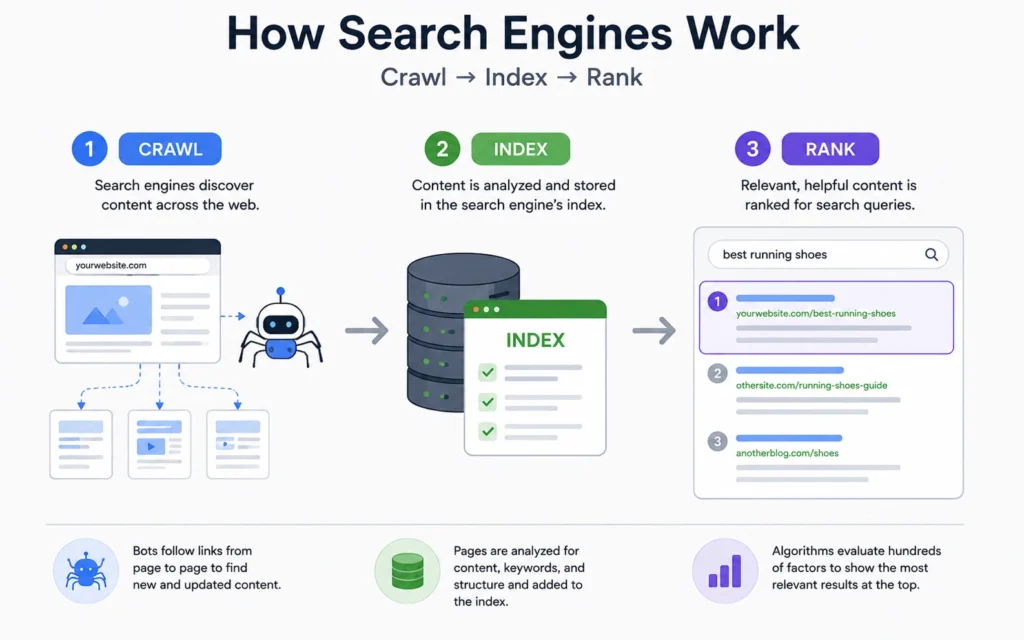
Search engines work through three core stages:
- Crawling
- Indexing
- Ranking
Most beginner confusion disappears once these stages make sense.
Crawling
Search engines use bots — usually called crawlers or spiders — to discover pages across the web.
They move through links.
If a page has no internal links pointing to it, crawlers may struggle to find it. I still see beginner sites publish 40 blog posts that are reachable only from the sitemap. Technically published. Practically invisible.
Internal linking fixes more SEO problems than beginners expect.
Indexing
After discovering a page, Google decides whether the page deserves to enter its index.
This is where weak content often fails.
A page can exist online without being indexed. That surprises beginners because publishing does not guarantee visibility.
Thin pages, duplicate pages, weak category pages, and low-value AI-generated pages often fail here.
indexing problems are frequently content-quality problems disguised as technical problems.
Ranking
Once indexed, the page competes against other pages targeting similar searches.
This is where relevance, authority, usability, and search intent matter most.
And ranking is not permanent.
A page can lose rankings because:
- Competitors publish better content
- Search intent changes
- The page becomes outdated
- Internal links weaken
- The SERP changes format
SEO is maintenance work as much as publishing work.
Why search intent matters more than keywords alone
Keyword research is useful only after you understand intent.
That sentence alone would save many beginners months of wasted writing.
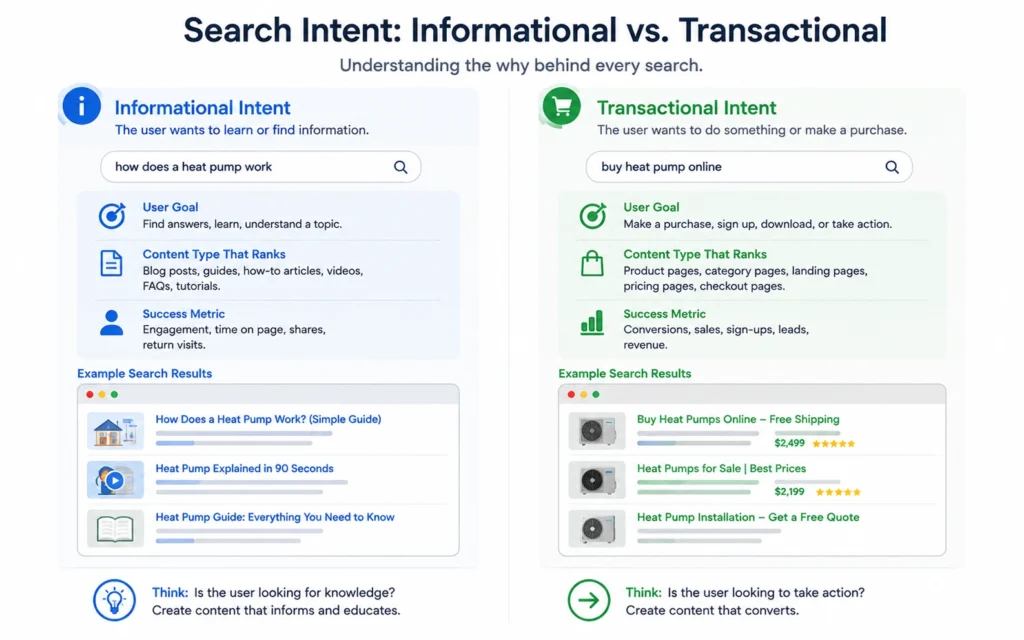
Search intent means the reason behind the search.
Someone searching:
- “what is SEO” wants explanation
- “best SEO tools” wants comparisons
- “hire technical SEO consultant” wants a service
- “how to fix canonical tag” wants a solution fast
The keyword alone does not tell the full story. The expected outcome does.
One beginner mistake appears constantly: writing informational content for transactional searches.
Example:
A page targeting “best SEO software” cannot behave like a Wikipedia article explaining software categories. The reader expects comparison, pricing context, and recommendations.
Search engines learn this from user behavior.
If people click a result and return immediately because the page missed the intent, rankings often weaken over time.
That is why SEO writing is partly psychology.
You are not only matching words. You are matching expectations.
keyword research process becomes much clearer once you stop treating keywords as isolated targets and start treating them as audience problems.
The four parts of SEO beginners should understand first
SEO looks complicated because the industry fragments it into dozens of specialties.
Beginners need four.
1. On-page SEO
On-page SEO is the work done directly on the page itself.
This includes:
- Headings
- Content structure
- Internal links
- Metadata
- Topic focus
- Entity coverage
Good on-page SEO makes the page obviously relevant to the topic.
Bad on-page SEO tries to force relevance through repetition.
Keyword stuffing still appears in 2026. It still reads badly. It still fails long term.
title tags and H1 tags confuse beginners because they look similar but serve different purposes.
2. Technical SEO
Technical SEO helps search engines access and understand the site.
This includes:
- Crawlability
- Indexation
- Site speed
- Canonical tags
- XML sitemaps
- Structured data
Technical SEO matters. But beginners often overestimate it because technical tasks feel measurable.
Improving a page from “weak answer” to “best answer” usually matters more than shaving 0.4 seconds off load speed.
That trade-off matters.
3. Content SEO
Content SEO focuses on usefulness and topical depth.
This is where many SEO wins actually happen.
A strong page:
- Solves the search properly
- Stays focused
- Covers the right subtopics
- Uses examples
- Anticipates follow-up questions
The strongest SEO content often feels less “optimized” and more useful.
That is not an accident.
4. Off-page SEO
Off-page SEO mostly refers to authority signals from outside the site.
Backlinks still matter because links act like trust references.
But beginners often misunderstand this.
A backlink from a relevant, trusted source helps because it transfers credibility. Buying random low-quality links rarely builds durable rankings.
The blunt verdict: most beginners should spend more time improving pages than chasing backlinks.
Where beginners waste time in SEO
Most SEO mistakes are sequencing mistakes.
People work on advanced tactics before the fundamentals deserve attention.
Here are the biggest time traps.
Publishing pages with no clear purpose
A page should answer:
- What query is this targeting?
- What intent is behind it?
- Why should this page exist instead of another one?
If those answers are weak, the page usually stays weak.
Obsessing over SEO scores
Many tools give “SEO optimization” percentages.
Those scores are useful for catching omissions. They are terrible as publishing goals.
I have seen pages with mediocre optimization scores outrank heavily “optimized” competitors because the page solved the search better.
SEO tools assist judgment. They do not replace it.
Copying competitors mechanically
Competitor research matters.
Blind imitation does not.
Beginners often clone heading structures without understanding why those sections exist. That creates generic content fast.
And generic pages are hard to rank now because search engines already have thousands of them.
Jumping between strategies weekly
SEO rewards consistency.
Beginners frequently switch directions every few days:
- Programmatic SEO
- AI content
- Parasite SEO
- Expired domains
- Topical authority maps
Most abandon the basics before the basics had time to work.
That impatience destroys more projects than algorithm updates do.
The SEO Learning Journey Map — a practical 30-day beginner roadmap
Most beginner guides explain concepts but never show how to practice them.
So here is a simple 30-day roadmap.
Not perfect. But practical.
Days 1–5: Learn how search engines work
Focus on:
- Crawling
- Indexing
- Search intent
- SERPs
- Internal links
Use Google searches as training data.
Search topics you know well and study:
- What ranks
- What formats appear
- What intent dominates
- What Google seems to reward
This develops SEO instincts faster than memorizing definitions.
Days 6–10: Learn keyword research basics
Start with:
- Search intent
- Topic grouping
- Long-tail keywords
- SERP analysis
Do not chase high-volume terms first.
A beginner site ranking for 15 low-competition searches teaches more than failing to rank for one huge keyword.
Days 11–15: Build and optimize one page
Choose one topic.
Write one useful page.
Focus on:
- Clarity
- Structure
- Intent match
- Internal links
- Helpful examples
Do not over-optimize.
And do not publish 30 weak articles instead of one strong one. That mistake wastes months.
Days 16–20: Learn technical basics
You do not need to become a developer.
But you should understand:
- What indexing means
- Why canonical tags exist
- What XML sitemaps do
- Why page speed matters
- What crawl errors look like
The goal is literacy, not mastery.
Days 21–25: Study ranking pages deeply
Pick five strong search results in one niche.
Study:
- Heading structures
- Content depth
- Internal linking
- Visual formatting
- Query coverage
This is where many people realize ranking pages are usually clearer, not “smarter.”
Days 26–30: Build a repeatable workflow
Your first SEO workflow should stay simple:
- Research the search
- Understand intent
- Outline the page
- Write clearly
- Improve structure
- Add internal links
- Publish
- Improve based on performance
That cycle matters more than any single tactic.
What SEO tools actually help beginners
Beginners often buy expensive SEO software too early.
You do not need five subscriptions to learn SEO.
Start simpler.
Google Search Console
This is mandatory.
Search Console shows:
- Queries
- Clicks
- Impressions
- Indexation issues
- Technical warnings
It is one of the few tools showing how Google actually sees your site.
Ahrefs or Semrush
These help with:
- Keyword research
- Competitor analysis
- Backlink analysis
Useful tools. Expensive for beginners.
If budget matters, use free tools first and upgrade when your workflow justifies the cost.
Screaming Frog
This tool crawls websites like a search engine crawler.
Beginners do not need advanced configurations immediately. But learning basic crawling analysis teaches site structure quickly.
AI tools
AI tools help with:
- Outlining
- Research assistance
- Content cleanup
- Pattern recognition
They do not replace editorial judgment.
Most AI-written SEO content fails because nobody shaped it into something worth reading.
An AI draft without editorial direction often sounds “correct” while saying almost nothing.
That problem is everywhere now.
beginner SEO tools explains which tools are actually worth paying for at different stages.
What SEO rewards — and what it quietly punishes
SEO rewards consistency more than intensity.
That surprises beginners.
Publishing 80 mediocre pages quickly often loses to publishing 15 strong pages over time.
Search engines increasingly reward:
- Clear intent match
- Useful formatting
- Topical consistency
- Trust signals
- First-hand detail
- Strong internal linking
And they quietly punish:
- Generic content
- Thin pages
- Search intent mismatch
- Mass-produced AI articles
- Weak site structures
- Unfocused publishing
One thing beginners rarely hear:
Many SEO problems are publishing problems, not algorithm problems.
The page failed because it was forgettable.
That is harder to accept than blaming updates.
But it is usually more useful.
What SEO costs in time, effort, and patience
SEO is slower than beginners expect.
A new site can take months before meaningful traffic appears.
That delay filters people out early.
Time cost
A useful beginner article often takes:
- 2–6 hours to research
- 3–8 hours to write
- Additional editing and optimization time
Good SEO work compounds slowly.
Attention cost
SEO rewards consistency of thinking.
You need:
- Topic focus
- Publishing discipline
- Updating habits
- Patience during low-traffic periods
That mental load matters more than many guides admit.
Money cost
You can learn SEO cheaply.
But costs appear eventually:
- Hosting
- Tools
- Writers
- Designers
- Technical help
- Outreach
The important distinction:
SEO can reduce dependency on paid acquisition. It does not eliminate work.
When SEO is worth learning — and when it probably is not
SEO is worth learning if:
- You publish content regularly
- You run a business website
- You sell products online
- You create educational content
- You want compounding traffic over time
SEO is less useful when:
- Your offer changes constantly
- You need immediate traffic
- Your niche has almost no search demand
- Your business depends mostly on referrals or outbound sales
SEO is not mandatory for every business.
That honesty matters because the industry sometimes treats SEO like universal medicine.
It is not.
But when search demand exists and the economics make sense, SEO becomes one of the few marketing channels where good work compounds instead of resetting daily.
And that compounding effect is the reason many people stay with it long enough to become good.
Frequently Asked Questions About What Is SEO
What is SEO in simple terms?
SEO is the process of helping a page become easier for search engines to understand, trust, and recommend to people searching for a topic.
How long does SEO take to work?
Most new websites need several months before meaningful rankings appear. Competitive topics can take much longer because authority, links, and content depth compound slowly.
Is SEO free?
SEO does not require advertising spend, but it still costs time, research, writing, technical work, and consistency.
What matters most in SEO for beginners?
Beginners should focus on search intent, useful pages, internal linking, and clear structure before advanced tactics.
Is SEO still worth learning in 2026?
Yes. But the field is changing. SEO now overlaps with AI answer extraction, entity understanding, and content usefulness much more than keyword repetition.
Continue Exploring
- keyword research process helps you move from SEO theory into actual topic selection and search intent analysis.
- indexing problems explains why pages sometimes fail to appear in Google even after publishing.