They struggle because every guide, tool, and tutorial seems to speak a different language.
One report talks about crawlability. Another mentions canonical tags. Then a keyword tool starts discussing search intent, SERP features, and keyword difficulty. After a few hours, SEO can feel less like marketing and more like learning a new dialect.
I learned this the hard way while reviewing an audit years ago. The recommendations themselves were straightforward. Understanding the terminology took longer than fixing the problems.
This SEO glossary gives you the vocabulary that appears most often in SEO work, audits, content planning, and ranking discussions. By the end, you’ll understand what these terms mean, why they matter, and when you’ll encounter them.
What an SEO Glossary Should Help You Do
A useful glossary doesn’t exist to help you memorize definitions.
It should help you make decisions.
When someone tells you a page has indexing issues, you should know where to investigate. When a tool reports low click-through rate, you should understand what metric changed and why it matters.
That’s the difference between learning terminology and building SEO judgment.
The SEO Terms You Will See Most Often in Real Work
1. SEO
Search Engine Optimization. The practice of improving a page’s ability to earn visibility from search engines.
2. SERP
Search Engine Results Page. The page displayed after a search query.
3. Organic Traffic
Visitors arriving through unpaid search results.
4. Keyword
A search query someone enters into a search engine.
5. Search Intent
The reason behind a search. Usually informational, navigational, commercial, or transactional.
6. Ranking
The position of a page within search results.
7. Impression
A count of how many times a page appeared in search results.
8. Click
A visit generated from a search result.
9. CTR (Click-Through Rate)
Percentage of impressions that became clicks.
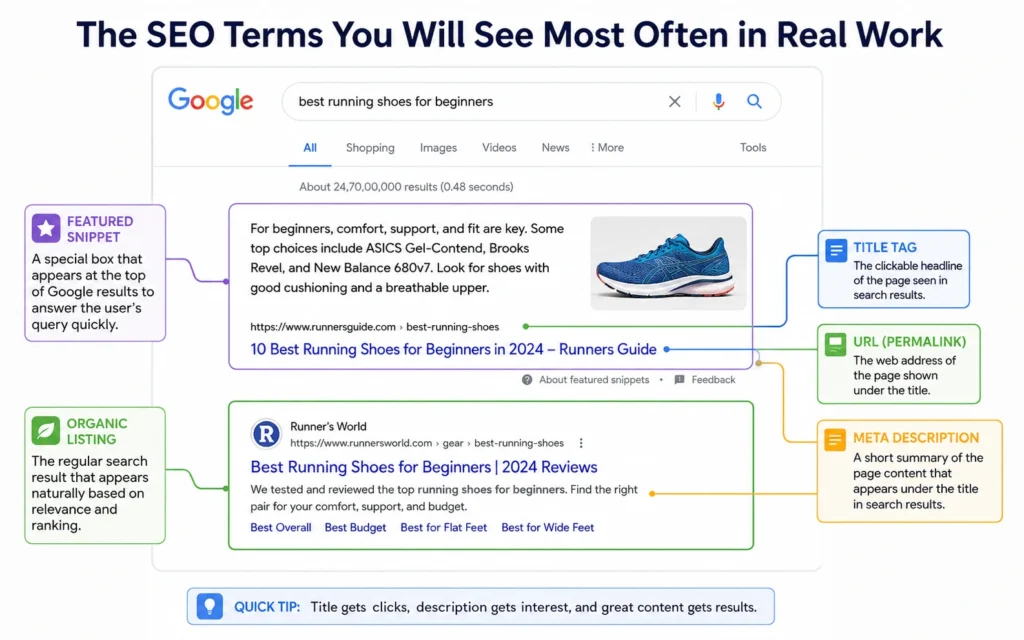
10. Featured Snippet
A highlighted answer appearing above standard results.
11. Query
The exact words entered into a search engine.
12. Search Volume
Estimated monthly searches for a keyword.
13. Keyword Difficulty
An estimate of how hard it may be to rank for a keyword.
14. Long-Tail Keyword
A more specific search phrase with lower volume and clearer intent.
15. Short-Tail Keyword
A broad keyword with higher competition.
The Terms That Shape Keyword Research Decisions
Keyword research is less about finding phrases and more about deciding which pages deserve to exist.
That distinction changes everything.
16. Topic Cluster
A group of related pages covering a broader subject.
17. Pillar Page
The main page covering a large topic.
18. Search Intent Match
How closely a page satisfies the reason behind a search.
19. Topical Authority
The depth and breadth of coverage around a subject.
20. Keyword Cannibalization
Multiple pages competing for the same search intent.
21. Parent Topic
A broader topic that contains related keyword variations.
22. Semantic SEO
Covering related concepts naturally rather than repeating one keyword.
23. Entity
A distinct concept, person, place, product, or organization understood by search engines.
24. Content Gap
A topic competitors cover that your site does not.
25. Search Demand
Evidence that people actively search for a topic.
The On-Page SEO Terms That Affect Content Quality
Many beginners think on-page SEO means inserting keywords into headings.
That’s usually where weak content starts.
Pages rank because they answer a question better, faster, or more completely than competing pages.
26. Title Tag
The title shown in search results.
27. Meta Description
A summary shown beneath the title tag.
28. H1 Tag
The primary heading of a page.
29. H2 Tag
A section heading used to organize content.
30. Internal Link
A link pointing to another page on the same website.
31. Anchor Text
The clickable words used in a link.
32. URL Slug
The readable part of a page URL.
33. Content Freshness
How recently content was updated.
34. E-E-A-T
Experience, Expertise, Authoritativeness, and Trustworthiness.
35. User Intent
The goal a visitor wants to accomplish.
The Technical SEO Terms Beginners Encounter First
Technical SEO sounds intimidating because the language comes from development teams.
Most of the core concepts are easier than they appear.
The first time I reviewed a crawl report, I expected dozens of complicated issues. Most problems came down to pages being blocked, duplicated, or disconnected.
36. Crawl
The process of search engines discovering pages.
37. Crawler
Software used by search engines to discover content.
38. Index
A database of pages eligible to appear in search.
39. Indexing
Adding a page to a search engine’s index.
40. Robots.txt
A file that provides crawling instructions.
41. XML Sitemap
A file listing important URLs on a website.
42. Canonical Tag
A signal indicating the preferred version of similar pages.
43. Redirect
A method of sending visitors from one URL to another.
44. 301 Redirect
A permanent redirect.
45. 404 Error
A page that no longer exists.
46. Crawl Budget
The amount of crawling search engines allocate to a site.
47. Structured Data
Code that helps search engines understand page content.
48. Schema Markup
A common structured data format.
49. Core Web Vitals
Performance metrics focused on user experience.
50. Mobile-First Indexing
Google primarily evaluates the mobile version of a page.
The Performance Metrics That Tell You Whether SEO Is Working
SEO becomes easier when you stop asking, “Did rankings improve?” and start asking, “What changed first?”
Traffic often follows visibility. Visibility often follows indexing. Indexing often follows crawlability.
Understanding the sequence matters.
51. Organic Sessions
Visits generated from unpaid search results.
52. Bounce Rate
Percentage of sessions where users leave without further interaction.
53. Conversion
A completed business goal such as a sale or signup.
54. Conversion Rate
Percentage of visitors who complete a conversion.
55. Average Position
Average ranking across search queries.
56. Visibility
An estimate of how often a site appears in search results.
57. Engagement Rate
A measure of meaningful user interaction.
58. Backlink
A link from another website.
59. Referring Domain
A unique website linking to yours.
60. Domain Authority
A third-party metric estimating link strength. Google does not use Domain Authority as a ranking factor.
That last point causes confusion every year. Domain Authority can be useful for comparison, but it is not a Google metric. Treat it as a directional signal, not a target.
What to Learn After You Understand These 60 Terms
Vocabulary is useful. Workflow is where results come from.
Once these terms feel familiar, focus on four skills:
- Search intent analysis.
- Keyword prioritization.
- Content structure.
- Technical auditing.
Those skills create the context that makes terminology valuable.
A glossary helps you understand the conversation. Execution is what changes performance.
Frequently Asked Questions About SEO Glossary
What is an SEO glossary?
An SEO glossary is a collection of search engine optimization terms and definitions. Its purpose is to help readers understand the language used in audits, reports, keyword research tools, content planning, and technical SEO discussions.
Which SEO terms should beginners learn first?
Start with keywords, search intent, rankings, indexing, title tags, internal links, backlinks, and conversions. These concepts appear repeatedly across content creation, reporting, and technical SEO work.
Is keyword difficulty a Google metric?
No. Keyword difficulty is typically calculated by SEO tools. Different platforms use different formulas, which means scores can vary significantly between tools.
Why is search intent important in SEO?
Search intent helps determine whether a page answers the question behind a search. Pages that match intent usually perform better than pages that focus only on keyword placement.
Does this SEO glossary 2026 guide cover all SEO terms?
No glossary can cover every term because SEO tools and search features continue evolving. These 60 terms cover the concepts beginners encounter most often when learning and applying SEO.
CONTINUE EXPLORING
- SEO basics explained step by step — useful if you want the larger framework behind the terms in this glossary.
- keyword research for beginners — the next logical lesson once you understand the language of SEO.