Most people ask how long SEO takes because they’re trying to answer a different question:
“When will this start producing results?”
That’s the right question.
The problem is that SEO doesn’t operate on a fixed schedule. Google doesn’t know you launched a new website last week. It doesn’t care that your content calendar is full. And it definitely doesn’t adjust rankings because you’ve been waiting patiently for three months.
I’ve seen pages reach page one within six weeks. I’ve also seen well-written content sit outside the top 20 for six months before moving. The difference was rarely the writing itself. More often it came down to competition, search intent alignment, internal linking, and whether the site already had authority.
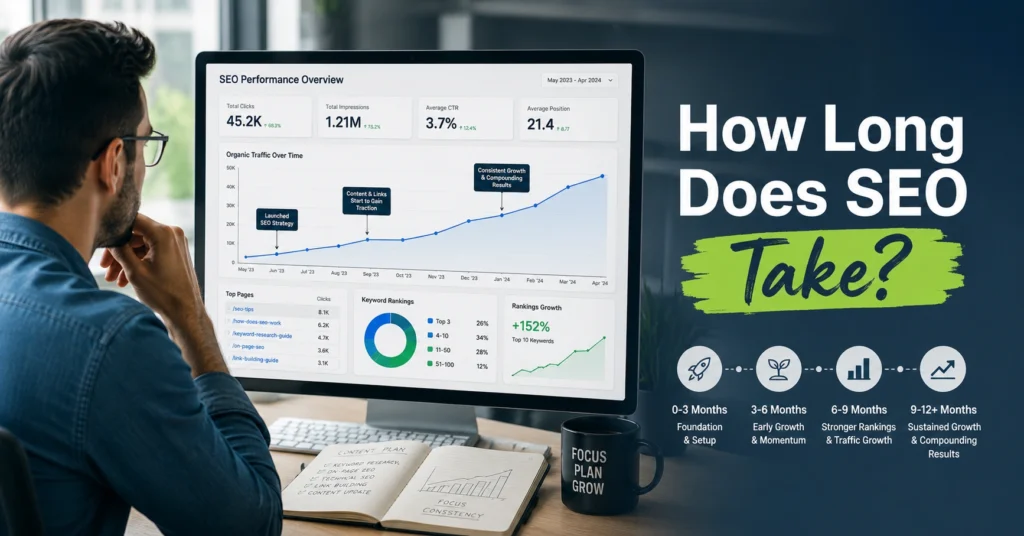
If you’re searching for how long does SEO take, the useful answer is not a number. It’s a timeline framework that explains what should happen at each stage and what delays progress.
By the end of this article, you’ll know what results are realistic in the first 30 days, the first six months, and the first year.
The Short Answer: Most SEO Efforts Need 4–12 Months Before Producing Meaningful Results
A new page can rank faster.
A new website usually cannot.
The timeline most beginners hear is “SEO takes six months.” That statement is incomplete.
A better version would be:
Most websites need four to twelve months before SEO becomes a consistent source of traffic.
The range is wide because SEO is not one activity.
You’re asking Google to:
- Discover your content
- Crawl it
- Understand it
- Compare it against competing pages
- Evaluate site quality
- Measure usefulness signals over time
- Decide where it belongs in search results
That process varies dramatically across industries.
A local plumber targeting one city operates in a different environment than a software company competing against sites with ten years of authority.
This is the first mistake beginners make.
They compare their timeline to someone else’s market.
Why SEO Timelines Depend More on Competition Than Effort
Publishing faster does not automatically mean ranking faster.
This catches many beginners off guard.
You can publish 50 articles in a month and still struggle if every keyword targets heavily established competitors.
Meanwhile, a smaller site targeting specific questions can gain traction surprisingly quickly.
Consider these examples:
| Scenario | Typical Timeline |
|---|---|
| Local service business | 3–6 months |
| New niche website | 6–12 months |
| Established website adding content | 2–6 months |
| Highly competitive SaaS market | 9–18 months |
The important detail is not the number.
It’s the competition level behind the number.
A page about “how to clean a coffee grinder” faces a different challenge than a page targeting “best CRM software.”
One keyword enters a conversation.
The other enters a battlefield.
What Actually Happens During the First Six Months
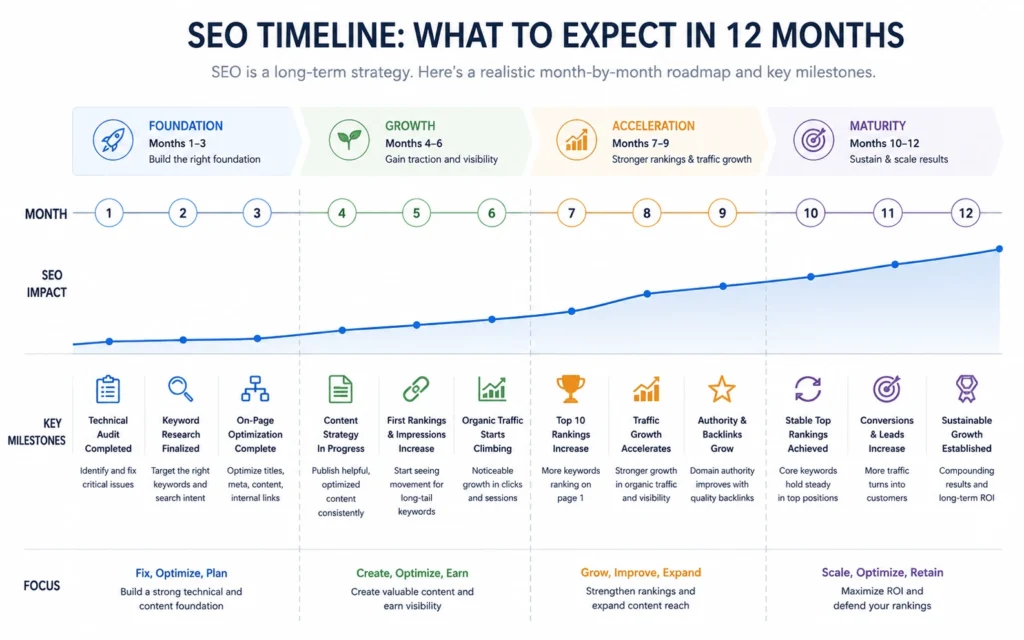
SEO often feels slow because most of the important work is invisible.
You publish content today.
Google may discover it tomorrow.
That doesn’t mean rankings arrive tomorrow.
Here’s what usually happens.
Month 1: Discovery and Indexing
Google finds new pages.
Pages enter the index.
Search Console begins collecting data.
Many site owners expect traffic increases here.
Usually, this phase is about visibility, not rankings.
A common observation from real projects: impressions appear long before clicks.
The page exists in Google’s system before it earns meaningful placement.
Month 2–3: Initial Position Testing
Google starts testing relevance.
Pages often appear on page three, four, or five.
Rankings fluctuate.
Traffic remains modest.
This stage confuses beginners because rankings move without obvious logic.
Google is still evaluating where the page belongs.
Month 4–6: Pattern Recognition
This is where useful signals emerge.
Strong pages start climbing.
Weak pages stagnate.
Internal linking improvements begin showing effects.
Content updates become easier because real query data is available in Search Console.
Many successful pages receive their first meaningful traffic growth during this period.
The SEO Timeline Most People Ignore: Site Authority Accumulation
A page does not rank in isolation.
It ranks as part of a website.
That’s a critical distinction.
Many SEO discussions focus entirely on content quality. Content matters. But search engines also evaluate broader site signals.
This includes:
- Internal linking structure
- Topic coverage
- Historical publishing consistency
- Link profile quality
- Technical health
- User trust indicators
I made this mistake on an early content project.
We spent weeks refining individual articles while ignoring the fact that the site had almost no topical depth. Each article was competing alone.
Traffic improved only after we built clusters around related topics and linked them intentionally.
The lesson was simple:
Google ranks pages.
But it evaluates websites.
What Makes SEO Faster
Some conditions accelerate results.
Not because Google is rewarding you.
Because you’re reducing uncertainty.
The biggest accelerators include:
Existing Website Authority
A site with history often ranks new pages faster.
Google already understands the domain.
Trust doesn’t start at zero.
Strong Search Intent Match
Many pages fail because they answer the wrong question.
A keyword may look attractive.
The search results reveal a different expectation.
When intent matches precisely, rankings tend to stabilize faster.
Focused Topic Coverage
Publishing ten related articles often outperforms publishing ten unrelated articles.
Topical concentration helps search engines understand expertise.
That’s why content clusters continue to work.
Internal Linking
This remains one of the most overlooked SEO activities.
A good internal link does more than pass authority.
It provides context.
Pages that receive strategic internal links are usually discovered faster and understood more clearly.
For a deeper explanation, review on-page SEO checklist.
What Makes SEO Slower
The delays are usually predictable.
Most are self-inflicted.
Targeting Keywords Beyond Your Reach
A new site targeting highly competitive keywords often spends months making little progress.
The issue isn’t content quality.
The issue is positioning.
Publishing Without Keyword Prioritization
Not every keyword deserves a page.
Publishing random topics creates scattered authority.
That’s why keyword selection matters before writing begins.
Weak Internal Architecture
Important pages buried several clicks deep often struggle.
Search engines discover them later.
Users find them less often.
Link equity flows poorly.
Constant Page Rewrites
This surprises people.
Updating content is useful.
Rebuilding pages every week is not.
Frequent structural changes make it harder to evaluate what’s actually working.
Give pages enough time to gather data.
How Long Does SEO Take in 2026? The Answer Hasn’t Changed as Much as People Think
AI-generated content, answer engines, and evolving search features have changed parts of SEO.
They haven’t changed the core timeline.
The question how long does SEO take 2026 is appearing more often because people assume AI has compressed ranking timelines.
In practice, Google’s fundamental challenge remains the same:
Determining whether a page deserves visibility.
AI can increase publishing speed.
It cannot automatically create trust.
It cannot manufacture authority.
And it cannot solve weak intent matching.
If anything, the explosion of AI-assisted publishing has increased competition in many search results.
That makes quality differentiation more important, not less.
The Milestone Framework: What Success Looks Like at Each Stage
Most people measure SEO incorrectly.
They focus only on traffic.
Traffic is a late-stage metric.
Use this progression instead.
Stage 1: Indexation
Goal:
Pages appear in Google’s index.
Metric:
Indexed pages increasing.
Stage 2: Impressions
Goal:
Appear for relevant searches.
Metric:
Search impressions rising.
Stage 3: Rankings
Goal:
Reach top 20 positions.
Metric:
Keywords moving upward consistently.
Stage 4: Clicks
Goal:
Earn traffic.
Metric:
Organic clicks increasing month over month.
Stage 5: Conversions
Goal:
Generate business outcomes.
Metric:
Leads, subscribers, inquiries, or sales.
This framework prevents a common mistake.
Judging SEO success before the page has even completed earlier stages.
When SEO Is the Wrong Growth Strategy
Here’s the blunt verdict.
SEO is not always the best first channel.
If you need leads next month, SEO may not solve that problem.
Paid acquisition, partnerships, outbound outreach, or existing audiences often create results faster.
SEO becomes powerful when:
- You can invest consistently
- You have publishing capacity
- The topic has ongoing search demand
- You can wait for compounding effects
Many founders choose SEO expecting immediate lead generation.
The timeline alone makes that unrealistic.
The trade-off matters.
SEO usually costs less per visitor over time.
It costs more patience upfront.
What to Measure Instead of Asking “How Long?”
The better question is:
“What evidence shows the SEO strategy is working?”
Look for:
- More indexed pages
- More impressions
- More keywords ranking in top 20
- Better click-through rates
- Increased branded searches
- Growth in organic conversions
These indicators appear before large traffic gains.
And they’re far more useful than checking rankings every morning.
One of the most reliable patterns in SEO is this:
Progress becomes visible in Search Console before it becomes visible in analytics.
Watch the leading indicators.
They arrive first.
Frequently Asked Questions About How Long Does SEO Take
How long does SEO take for a brand-new website?
Most new websites need six to twelve months before SEO becomes a reliable traffic source. Some pages may rank earlier, but consistent growth usually requires content, internal links, and accumulated trust signals across the site.
Can SEO work in three months?
Yes, under specific conditions. Local businesses, low-competition topics, and established domains sometimes see meaningful gains within three months. New sites in competitive markets usually need longer.
Why does SEO take so long?
Search engines need time to discover, evaluate, and compare content against existing results. Rankings depend on relevance, authority, competition, and site quality rather than publication date alone.
Does publishing more content speed up SEO?
Only when the content improves topic coverage and serves search intent. Publishing large amounts of low-value content rarely accelerates results and often creates maintenance problems later.
How long does SEO take in 2026 compared to previous years?
The core timeline remains similar. AI tools have increased publishing speed, but search engines still evaluate relevance, authority, and usefulness. Faster content creation has not eliminated the need to earn visibility.
Continue Exploring
- SEO Basics guide provides the broader framework for understanding how crawling, indexing, rankings, and search intent fit together.
- keyword research process shows how choosing better targets often shortens the SEO timeline more than publishing more content.