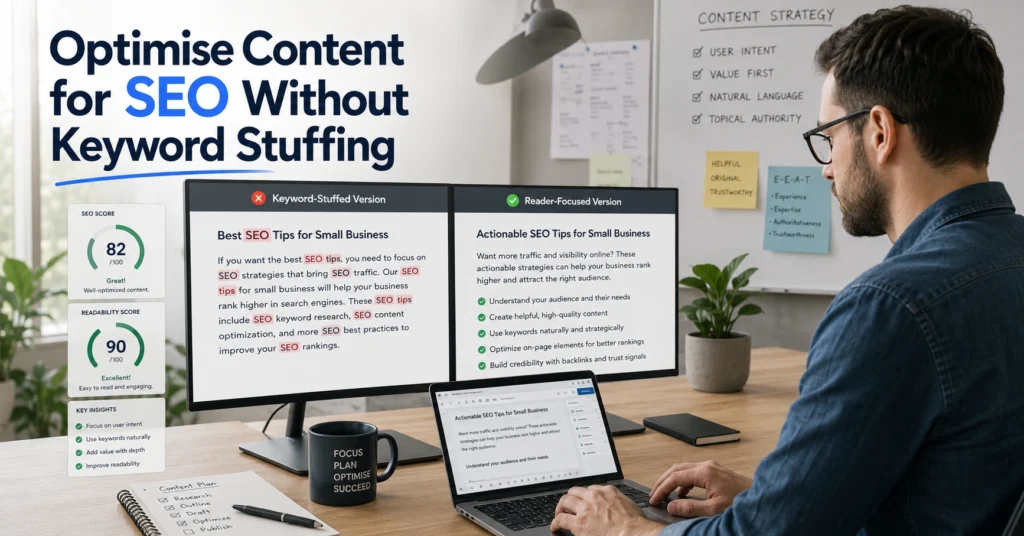
Keyword stuffing did not disappear because search engines became smarter. It disappeared because readers stopped tolerating pages that sounded unnatural.
A page can mention the target keyword twenty times and still fail. Another page can mention it only a handful of times and outperform it because it answers the searcher’s question better.
I’ve reviewed pages where the keyword appeared every 80 words. The result wasn’t stronger relevance. The result was weaker readability, lower engagement, and a page that looked written for a crawler instead of a human being.
That’s the central shift in modern on-page SEO. The goal is no longer repeating a phrase. The goal is demonstrating topic coverage, intent alignment, and usefulness.
If you want to optimize content for SEO, focus on helping search engines understand what the page is about and helping readers accomplish what they came to do. Those are related goals. Most keyword stuffing happens when people treat them as separate.
This article shows exactly how to do that.
The direct answer: optimise content for SEO by increasing relevance, not keyword frequency
Search engines need signals.
Many beginners assume keywords are the only signal available. They are not.
A page communicates relevance through:
- Headings
- Subtopics
- Internal links
- Entities
- Examples
- Structure
- Context
- User satisfaction
A recipe page about sourdough bread doesn’t rank because it repeats “sourdough bread recipe” fifty times. It ranks because it covers ingredients, fermentation, starter maintenance, baking temperatures, troubleshooting, and serving suggestions.
The page proves what it’s about.
That’s the job.
Before adding another keyword occurrence, ask a different question:
What useful information is still missing from this page?
That question usually produces better SEO results.
Step 1: Start with search intent before you write a single heading
Most on-page SEO problems begin before the first paragraph is written.
People choose a keyword and immediately start creating content.
That’s backwards.
The keyword tells you what people searched. Search intent tells you what they expect to find.
For example:
Keyword: optimize content for SEO
Possible intent:
- Beginner education
- Content audit process
- On-page SEO checklist
- Content optimization workflow
Those are different pages.
Open the search results before writing.
Look for:
- Common article angles
- Content format
- Frequently repeated topics
- Questions being answered
When ten high-ranking pages explain content structure, internal linking, and topic coverage, that’s not coincidence. That’s a clue about what searchers expect.
Write for the expectation first.
Then optimise.
Step 2: Build topical coverage instead of repeating the same phrase
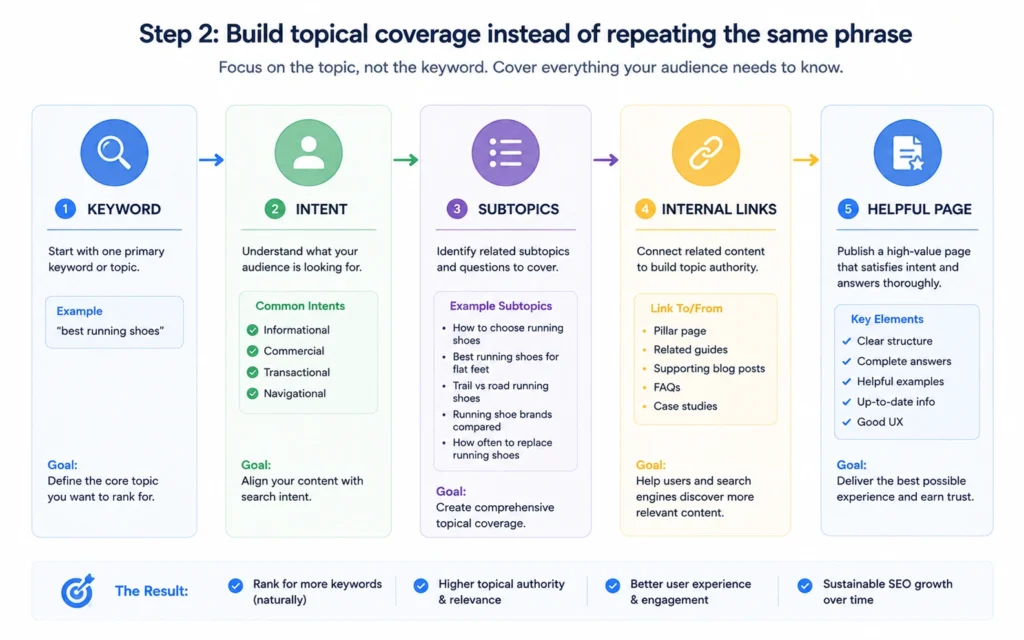
A useful page expands sideways.
A weak page repeats itself.
One of the fastest ways to improve content is creating subtopic coverage around the main subject.
Imagine you’re targeting:
optimize content for SEO
Related concepts might include:
- Search intent
- Heading structure
- Internal linking
- Content freshness
- Topic clusters
- Entity optimisation
- User engagement
- Content audits
Notice something.
None of those require repeating the exact keyword.
Yet each one strengthens the page’s relevance.
A practical workflow looks like this:
- Identify the primary topic.
- List related questions.
- Group them into sections.
- Build content around those sections.
- Remove repetitive wording.
The page becomes broader without becoming bloated.
That’s usually a better ranking signal than another exact-match keyword.
Step 3: Use headings to explain the topic hierarchy
Headings do more than organise content.
They explain relationships.
A common beginner mistake is writing generic headings such as:
- Overview
- Benefits
- Best practices
- Tips
Those headings could belong on almost any article.
Compare that with:
- How search intent changes content structure
- Why internal links help search engines understand page context
- What content audits reveal about weak pages
Those headings communicate meaning.
They help readers scan faster.
They help search engines understand the page structure.
And they reduce the temptation to stuff keywords into body copy because the topic hierarchy already provides context.
Where most keyword stuffing starts: fear that Google won’t understand the page
This fear made more sense fifteen years ago.
It makes much less sense now.
Modern search systems evaluate relationships between concepts, entities, topics, and context.
A practical example:
Suppose your article discusses:
- Title tags
- Meta descriptions
- Internal links
- Anchor text
- Heading hierarchy
Even if the exact keyword appears only a few times, the page clearly signals that it’s about on-page SEO.
The context does heavy lifting.
I once reduced keyword usage on a page by nearly half during a content cleanup project. Traffic didn’t decline. It increased because readability improved and redundant sections were removed.
The lesson wasn’t “use fewer keywords.”
The lesson was “replace repetition with information.”
Step 4: Add entities that belong naturally to the topic
Entities help search engines understand context.
Think of entities as identifiable concepts connected to a subject.
For on-page SEO, examples include:
- Google Search Central
- Title tags
- Canonical tags
- Internal links
- Structured data
When these concepts appear naturally, they strengthen topical relevance.
Don’t force them.
Don’t build sections around random terminology.
Use them when they contribute to understanding.
The page becomes richer because it contains meaningful context rather than repeated phrases.
Step 5: Write sections that answer real questions
Many articles fail because they answer a keyword instead of answering a person.
Readers arrive with questions.
Examples:
- How often should I use a keyword?
- What makes content relevant?
- How do I improve an existing page?
- How many headings should I use?
Every unanswered question creates friction.
Every answered question increases usefulness.
One practical exercise:
Open customer emails, comments, support tickets, forum discussions, or sales calls.
Write down recurring questions.
Build sections around those questions.
The result usually sounds more natural because it came from actual language rather than SEO software.
Step 6: Improve internal linking before expanding word count
A surprising number of pages don’t need more content.
They need better connections.
Internal links help search engines:
- Discover pages
- Understand relationships
- Transfer contextual relevance
They help readers too.
A page about content optimisation should naturally connect to:
The strongest internal links aren’t added for SEO alone.
They’re added because the reader’s next question already exists somewhere else on the site.
That’s the difference.
What to remove before publishing
Most content optimisation guides focus on additions.
Editing is often more valuable.
Before publishing, remove:
- Repeated definitions
- Duplicate examples
- Generic filler
- Empty introductions
- Paragraphs that say the same thing differently
A useful test:
Highlight every sentence containing the target keyword.
Read those sentences together.
If they sound repetitive, the page probably is.
Cut aggressively.
Clarity tends to survive editing. Fluff rarely does.
What it costs: time, effort, and attention
Good optimisation is slower than keyword stuffing.
That’s the trade-off.
Keyword stuffing takes minutes.
Researching intent, building topic coverage, improving structure, and creating better internal links can take several hours.
Still, the work compounds.
A well-structured page can continue attracting traffic for years.
A poorly structured page often requires repeated fixes.
The bigger cost isn’t time.
It’s attention.
You need enough focus to ask:
“What information helps the reader most?”
Not:
“Where can I insert the keyword again?”
What to do when rankings still do not improve
Sometimes the page isn’t the problem.
A content optimisation project can fail because of:
- Weak backlinks
- Poor site architecture
- Indexing issues
- Low domain authority
- Mismatched search intent
This is where many beginners make the wrong diagnosis.
They add more keywords.
The page drops further into repetition.
Instead, investigate:
- Search Console queries
- Indexing status
- Internal links
- Competing pages
- Search intent mismatch
The strongest SEO decision is often identifying the real bottleneck.
Not writing another paragraph.
Frequently Asked Questions About Optimising Content for SEO
How many times should I use a keyword on a page?
There is no useful universal number. Use the keyword where it naturally helps identify the topic. Then focus on covering related concepts, answering questions, and improving relevance. Repetition alone is not a ranking strategy.
Does keyword stuffing still hurt SEO in 2026?
Yes. Keyword stuffing reduces readability and often signals low-quality content. Search systems have become much better at understanding topics through context, entities, and page structure. That’s one reason optimize content for SEO 2026 strategies focus more on topical relevance.
What should I do instead of keyword stuffing?
Build topic coverage. Answer related questions. Improve headings. Add useful examples. Strengthen internal linking. Make the page more complete rather than more repetitive.
Can a page rank without exact-match keywords everywhere?
Yes. Search engines evaluate context, relationships between concepts, and overall topical relevance. Exact-match keywords still help identify the subject, but they are only one signal among many.
Is content length a ranking factor?
Not directly. Longer content sometimes performs better because it covers a topic more thoroughly. Shorter content can rank equally well when it satisfies search intent more effectively.
Continue Exploring
- complete on-page SEO guide — useful if you want the broader framework that connects content, internal links, metadata, and page structure.
- keyword research workflow — useful if you’re struggling to decide which topics deserve their own page before content creation begins.