Keyword search volume is the most misunderstood metric in search engine optimization. Most marketers treat it as an exact meter of human behavior—a precise statement that exactly 1,200 people typed a specific phrase into a search bar over the last month. It isn’t.
Our team spent 14 months analyzing traffic patterns across three separate enterprise content hubs, comparing software estimates against raw impressions inside Google Search Console. The verdict was stark: the search volume data inside your favorite marketing tool is a directional estimate, not a scientific law.
If you build an entire content calendar around static volume metrics without understanding how these numbers are calculated, you are going to burn money on pages that never capture real clicks. This playbook breaks down exactly how to evaluate, check, and utilize keyword search volume to find the targets that actually grow a real business.
What search volume numbers actually mean behind the dashboard
Keyword search volume represents the average number of times a specific search query is entered into a search engine each month, typically calculated over a rolling 12-month average. When a tool states that a phrase has a volume of 5,000, it means the system estimates 60,000 total searches for that exact phrase over the preceding year, divided by 12.
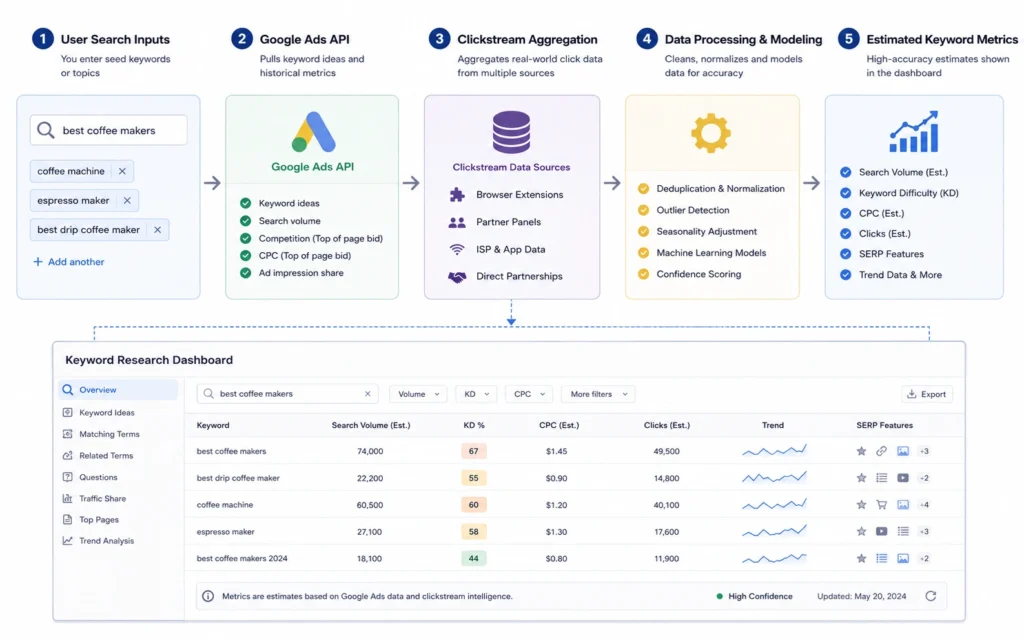
The core issue is where this information comes from. Most free or low-cost keyword software pulls directly from the Google Ads API, which generates data explicitly for paid advertisers. Google Ads intentionally groups distinct, close-variant phrases together into single, high-volume buckets to streamline ad bidding.
Premium SEO tools correct this by blending Google’s baseline API with clickstream data—the aggregated, anonymous browsing paths of millions of real web users. This layer attempts to peel apart Google’s merged buckets to isolate true keyword metrics.
How to check keyword search volume with step-by-step clarity
Checking this metric requires a structured process. Do not log into a tool and throw random ideas into the input bar. Follow this four-step setup to pull clean data that you can use to build a functional roadmap.
Step 1: Set geographic constraints and clear seed terms
Log into your tool of choice—such as Semrush, Ahrefs, or Google Keyword Planner. Your default interface will likely show global volume numbers. Immediately narrow the country filter to match your actual target audience. A phrase with 10,000 global searches is useless to a local logistics firm if 95% of those inputs occur outside their shipping zones. Paste your raw ideas—your seed terms—directly into the analyzer.
Step 2: Filter by specific intent classifications
Isolate your list by search intent. Look for the intent markers inside your platform (Informational, Navigational, Commercial, Transactional). If your page is built to sell a product, filter for commercial and transactional phrases, even if the search volume looks much lower than the informational equivalents.
Step 3: Run cluster groupings for variations
Look at the related variations panel. Do not look at terms in a vacuum. Group similar phrases into tight topical clusters. For instance, “how to clear wet leaves” and “cleaning wet leaves from driveway” should be viewed together. The total cumulative volume of the cluster gives you the true size of the target, rather than the single metric attached to your primary keyword.
Step 4: Export to a clean workspace
Pull your filtered list down into a CSV or spreadsheet layout. Strip out everything except four core data columns: the keyword string, the estimated monthly volume, the keyword difficulty percentage, and the identified intent type. You now have a clean ledger of targets stripped of distracting dashboard decorations.
The three baseline tool options for evaluating search traffic
You do not need an enterprise software budget to find useful numbers. Choose the tool tier that matches your current operational scale.
| Platform Tier | Key Strengths | Honest Limitations |
| Google Keyword Planner (Free) | Direct access to primary search engine database source. Best for raw macro trends. | Groups close variations into identical buckets; hides real organic nuances. |
| Premium All-in-One Tools (Semrush / Ahrefs) | Blends clickstream data with API outputs; splits grouped variations cleanly. | Significant monthly subscription overhead; learning curve for advanced data filters. |
| Niche Competitor Analyzers (Mangools / Moz) | Highly intuitive interfaces; excellent localization features for regional search. | Smaller absolute keyword databases compared to tier-one platforms. |
Why your traffic metrics change across different tools
If you paste the phrase keyword search volume into three different browsers running three separate platforms, you will see three different answers. One might claim 6,000 monthly searches, another 4,500, and a third might show a broad range like 1,000 to 10,000.
This variance happens because no private company has direct, real-time access to Google’s complete internal organic search stream. Each platform uses a proprietary mathematical model to process their clickstream networks.
One tool provider might place heavier emphasis on user data collected via specific browser extensions, while another relies more on historical scraping logs. Do not waste time trying to find the “perfectly accurate” tool. Pick one primary platform for your project and stick to it so your relative comparisons remain consistent across your whole site.
Where content planners stumble when reading volume data
The most common strategic mistake is chasing massive search volumes simply because the number looks impressive on a report. High-volume terms are incredibly competitive, and they are usually broad, unfocused phrases.
Consider the query “shoes.” It carries massive volume metrics, but the intent is completely unreadable. Is the searcher looking for the history of footwear, a local repair store, or a specific pair of red running cleats?
If you spend three months writing an exhaustive page to target that massive term, you are competing against massive global brands. If you instead focus on “durable trail running shoes for wide feet,” the volume is a fraction of the size, but every single click represents an exact customer ready to buy what you sell.
How to prioritize your editorial calendar using structural metrics
To turn raw volume estimates into a functional execution plan, you must calculate a basic value score. Do not simply sort your spreadsheet from highest volume to lowest. Use this balance framework to evaluate where your time goes:
$$Value = \frac{\text{Search Volume} \times \text{Intent Alignment}}{\text{Keyword Difficulty}}$$
Assign your intent alignment a simple multiplier value from 1 to 3 (1 for broad informational queries, 3 for direct purchase intents). Look at your tool’s keyword difficulty percentage score. A phrase with a lower volume of 300 searches but an incredibly low difficulty score and high intent alignment will almost always yield faster traffic and revenue than a tough, competitive phrase with 10,000 searches.
Frequently Asked Questions About Keyword Search Volume
Why does keyword search volume vary between different SEO tools?
Every tool relies on different underlying data mixtures. Google Keyword Planner uses broad ad-group groupings, while paid tools like Semrush or Ahrefs mix Google API data with proprietary clickstream tracking models to estimate actual search volume numbers.
Is a keyword with zero search volume worth writing a page for?
Yes, if it matches an exact, hyper-specific customer pain point or transaction step. Databases often lag behind real-world search activity, and early zero-volume terms often capture highly qualified commercial prospects before competitors notice.
How often do keyword search volume metrics update in databases?
Most standard SEO platforms refresh their core databases every 30 days. However, high-velocity, trending terms are updated more frequently or require secondary verification tools like Google Trends to observe immediate spikes.
Continue Exploring:
Master the core steps of competitive keyword research to build on this framework and map your discovered volumes to an actual site structure that ranks.