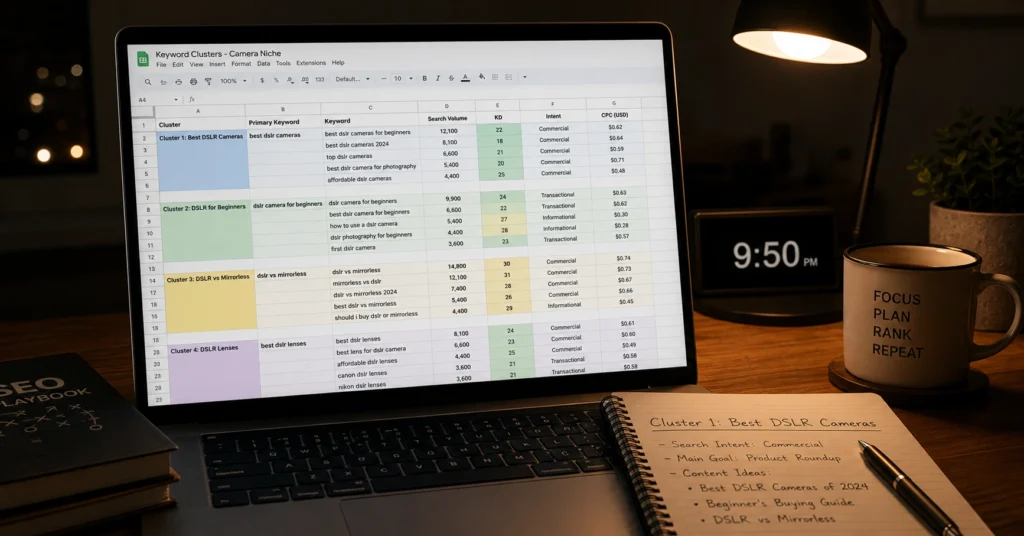
Keyword clustering is the process of grouping keywords by search intent and topical relevance so each cluster maps to a single page. That’s the whole point. Not to make pretty charts. Not to collect more keywords. To stop publishing overlapping pages and build content that Google can clearly understand and rank.
I once spent three weeks writing five blog posts that all tried to rank for variations of “best coffee maker.” They cannibalized each other. Traffic flatlined. The fix wasn’t more content. It was one page per cluster, with clear intent and a single job. That’s what keyword clustering solves.
This post shows you how to cluster keywords in 2026 with a simple, repeatable workflow. You’ll get a concrete method, a template structure, and exact decision rules so you can move from a raw keyword list to a content plan that actually maps to pages.
What keyword clustering should decide before you write a page
Keyword clustering is not about stuffing more terms into one page. It’s about deciding what question a page answers, who the reader is, and what action the page should trigger after they land on it.
The core idea:
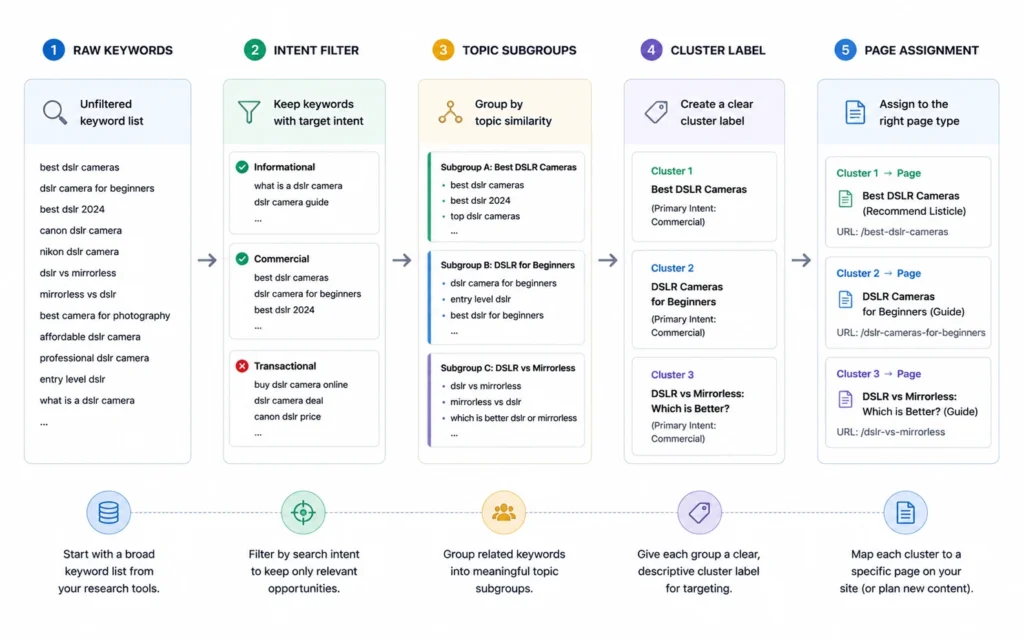
- Group keywords by search intent: informational, commercial, transactional.
- Within each intent, subgroup by topic: equipment, pricing, how‑to, comparisons.
- Assign one cluster = one page.
That’s it. The rest is mechanics.
The mental model most beginner guides skip
Most people start with volume and KD. That’s backwards. Intent comes first. If 70% of keywords in a group are informational (“how to brew coffee”) and 30% are transactional (“buy coffee maker online”), you don’t force them onto one page. You split them.
In 2026, keyword clustering still works because Google rewards clear topical coverage and intent match. When you cluster by intent, you reduce keyword cannibalization and build pillar pages that rank for many related queries.
I’ve watched teams publish 12 pages that all target “best X” and wonder why none rank. When they regroup those 12 pages into 3 intent-based clusters and merge them into 3 stronger pages, organic traffic usually moves within 4–6 weeks. That’s the real outcome of keyword clustering.
The 4-step keyword clustering workflow you can run in one evening
You don’t need complex tools to start. You do need a clean process.
Step 1: Gather your raw keyword list
Pull keywords from one or more sources:
- Google Keyword Planner
- Semrush / Ahrefs
- Site search data
- Existing page analytics (queries that bring impressions but low CTR)
Export them into a spreadsheet. Required columns:
keywordvolumeKD(if available)intent(blank for now)topic(blank for now)cluster_label(blank for now)
Step 2: Classify intent for each keyword
Use SERP pre-analysis to label intent:
- Informational: “how to…”, “what is…”, “guide”, “tutorial”
- Commercial: “best…”, “top…”, “review”, “vs”, “compare”
- Transactional: “buy…”, “price”, “discount”, “near me”, “order”
This is the part that saves weeks of wasted work. If you skip intent, you’ll cluster by volume and end up with confused pages.
Practical rule:
If the SERP for a keyword is dominated by guides and tutorials, it’s informational. If it’s dominated by product pages and checkout flows, it’s transactional. Match the SERP, not your guess.
Step 3: Subgroup by topic within each intent
Within each intent group, look for recurring themes:
- Equipment / products
- Pricing / deals
- How‑to / process
- Comparisons / reviews
Create a topic column and label rows: “equipment”, “pricing”, “how‑to”, “comparisons”.
Then create a cluster_label like:
INFO_howto_coffee_brewingCOMM_best_dslr_camerasTRANS_buy_espresso_machine
Step 4: Assign one cluster to one page
For each cluster:
- Decide if you already have a page that matches.
- If yes, update that page to fully own the cluster.
- If no, create a new page with a clear title and structure that matches the cluster’s intent.
I once merged 7 weak “best blender” posts into one page titled “Best Blenders in 2026: Tested for Smoothies, Soups, and Ice.” Within 5 weeks, the new page ranked on page 1 for 14 long‑tail keywords the old pages never touched. The win wasn’t the title. It was intent + cluster clarity.
What keyword clustering looks like in a real spreadsheet
Here’s a minimal template you can copy.
| keyword | volume | KD | intent | topic | cluster_label |
|---|---|---|---|---|---|
| how to brew coffee | 3200 | 18 | informational | how‑to | INFO_howto_coffee |
| coffee brewing guide | 1900 | 20 | informational | how‑to | INFO_howto_coffee |
| best drip coffee maker | 2400 | 32 | commercial | equipment | COMM_best_drip_coffee |
| best coffee maker 2026 | 1800 | 35 | commercial | equipment | COMM_best_drip_coffee |
| buy espresso machine online | 720 | 27 | transactional | pricing | TRANS_buy_espresso |
You don’t need fancy automation. You do need consistent labels.
Common mistake:
Mixing intents in one cluster. If “best coffee maker” and “how to brew coffee” end up in the same cluster, you’ll be tempted to write one page that tries to be both a buying guide and a tutorial. That page will satisfy neither.
How to turn clusters into a content map
Once clusters are labeled, map them to your site structure.
Pillar page vs. cluster content
- Pillar page: Broad intent, covers a topic area (e.g., “Coffee Makers: The Complete Guide”).
- Cluster content: Specific intent, supports the pillar (e.g., “Best Drip Coffee Makers 2026”, “How to Brew Coffee with a French Press”).
In keyword clustering terms:
- The pillar gets a cluster that covers broad informational + commercial intent.
- Each cluster child gets a tighter intent and a specific job.
Internal linking pattern
- Pillar links to all cluster pages.
- Cluster pages link back to the pillar and to closely related clusters.
- Avoid linking cluster pages to unrelated topics just to “build links.”
This is how you build topical authority without overcomplicating your site.
A common trap: treating keyword clustering as a one-time project. I’ve seen teams cluster once in January, publish 20 pages, then never revisit the clusters. When they add new keywords in June without re-clustering, they silently create cannibalization. Re-cluster every quarter, or at least when you add 50+ new keywords.
When keyword clustering helps most (and when to skip it)
Keyword clustering is not always necessary.
Use keyword clustering when:
- You’re planning a new site section or category.
- You have 50+ keywords around a topic and notice overlapping titles.
- Multiple pages rank for similar queries but none rank well.
- You’re building a pillar page and supporting cluster content.
Skip or simplify clustering when:
- You have fewer than 10–15 keywords for a topic.
- You’re writing a single, narrow how‑to post.
- Your site is tiny and cannibalization isn’t a real problem yet.
In those cases, a simple intent check and a clear title are enough. Don’t overbuild a system for a problem you don’t have.
Tools that help with keyword clustering in 2026
You can cluster manually, or use tools to speed things up.
Manual (spreadsheet)
- Pros: Full control, no cost, forces you to understand intent.
- Cons: Slower, more error-prone if you’re tired.
Automated tools
- Semrush: Keyword clustering and topic modeling features.
- Ahrefs: Keyword grouping via filters and lists.
- Keyword Insights: Dedicated clustering tool with intent tagging.
Better alternatives for specific jobs:
- If you need speed and have 500+ keywords: use an automated tool.
- If you’re learning SEO or have <100 keywords: spreadsheet is fine and often better.
Cost, limits, and the real trade-off:
Automated tools save time but can misclassify intent. You still need to review clusters. The trade-off is speed vs. accuracy.
Common mistakes that waste time in keyword clustering
Mistake 1: Clustering by volume instead of intent
You end up with a page that tries to be a tutorial and a buying guide. It fails both.
Mistake 2: Too many clusters, too thin content
Creating 30 clusters with 3 keywords each leads to 30 thin pages. Better to merge into 8–10 stronger clusters.
Mistake 3: Ignoring SERP changes
Search intent shifts. Re-check SERPs every few months. If the top results change from guides to product pages, your cluster may need to split or shift intent.
Mistake 4: One cluster, multiple pages
If you assign one cluster to 3 pages, you’ll get cannibalization. One cluster = one primary page.
Avoid these and you’ll save weeks of rework.
What keyword clustering costs: time, money, and attention
Time cost
- Manual clustering (0–100 keywords): 1–2 hours.
- Manual clustering (100–500 keywords): 3–5 hours.
- With tools (500+ keywords): 1–3 hours plus review time.
Money cost
- Spreadsheet: $0.
- Tools: $50–$150/month depending on the package.
Attention cost
The real cost is focus. Clustering forces you to make hard decisions about which pages to merge, which topics to drop, and which clusters deserve a pillar. That’s good. But it’s not passive work.
FAQ: Frequently Asked Questions About Keyword Clustering
What is keyword clustering in SEO?
Keyword clustering is the process of grouping keywords by search intent and topical relevance so each cluster maps to a single page or content unit. It helps you avoid publishing overlapping pages and builds topical authority.
How do I cluster keywords for beginners?
Start with a raw keyword list, then group by intent (informational, commercial, transactional). Within each intent, sub-group by topic (equipment, pricing, how‑to). Use a spreadsheet or tool to label clusters, then assign one cluster per page.
Is keyword clustering still useful in 2026?
Yes. In 2026, keyword clustering remains useful because Google rewards clear topical coverage and intent match. It reduces keyword cannibalization and helps you build pillar pages that rank for many related queries.
What tools are best for keyword clustering?
Good options include Semrush, Ahrefs, and Keyword Insights for automated clustering. For beginners, a simple spreadsheet with intent + topic columns works well and is often enough.
Continue exploring
- Keyword Research Hub — Go deeper into the full keyword research workflow, from seed keywords to intent mapping.
- on‑page SEO checklist — Once clusters are mapped to pages, use this checklist to make sure each page clearly owns its cluster.