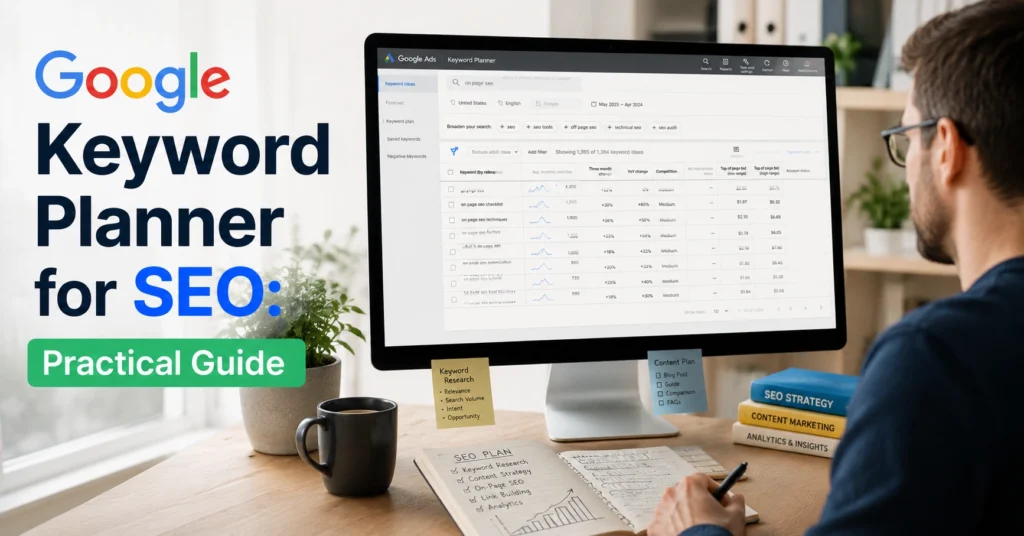
I’ve seen beginners spend hours inside expensive SEO platforms before they understood a simple fact: keyword research is not about finding keywords. It’s about finding search demand that matches a page you can realistically create.
Google Keyword Planner helps with that. But only if you use it as an SEO research tool instead of an advertising tool.
The mistake usually appears in the first ten minutes. Someone enters a broad keyword, exports hundreds of suggestions, and assumes they now have a content strategy. They don’t. They have a spreadsheet.
What you need is a process that turns keyword ideas into publishable content opportunities. That’s exactly what this guide does.
Google Keyword Planner Is Better for Direction Than Precision
Google Keyword Planner was built for advertisers.
SEO professionals use it because the data comes from Google, but that creates an important limitation: many search volumes are grouped into ranges rather than exact numbers.
A beginner often sees this as a flaw.
It isn’t.
When you’re choosing between topics, knowing whether a keyword gets roughly 100 searches or roughly 10,000 searches is usually enough to make a decision.
The real value comes from three areas:
- Discovering keyword ideas
- Estimating relative demand
- Finding topic variations
Treat it as a compass, not a GPS.
That mindset alone prevents a lot of bad decisions.
Setting Up Google Keyword Planner Without Getting Lost in Ads
Google Keyword Planner lives inside Google Ads.
You’ll need a Google Ads account before you can access it.
The setup process tries to move you toward creating ad campaigns. Skip anything related to launching ads if your goal is SEO research.
Once inside Google Ads:
- Open Tools
- Select Keyword Planner
- Choose “Discover New Keywords”
That’s the section you’ll use most often.
There’s another option called “Get Search Volume and Forecasts.”
Useful for advertisers.
Less useful for day-to-day SEO research.
For beginners, spend nearly all your time in Discover New Keywords.
Start With Topics, Not Keywords
Most beginners begin with keywords.
Experienced SEO operators begin with topics.
The difference matters.
Imagine you’re creating content about home coffee brewing.
Many people start with:
- best coffee grinder
- coffee grinder reviews
- coffee grinder for espresso
Instead, begin with the topic:
Home Coffee Grinding
Then enter broad phrases into Keyword Planner.
Examples:
- coffee grinder
- espresso grinder
- burr grinder
- manual coffee grinder
The tool will return dozens or hundreds of related searches.
Now you’re seeing the market instead of a single keyword.
That shift produces better content plans because you can identify entire content clusters rather than isolated articles.
The Keyword Grouping Step Most Beginners Skip
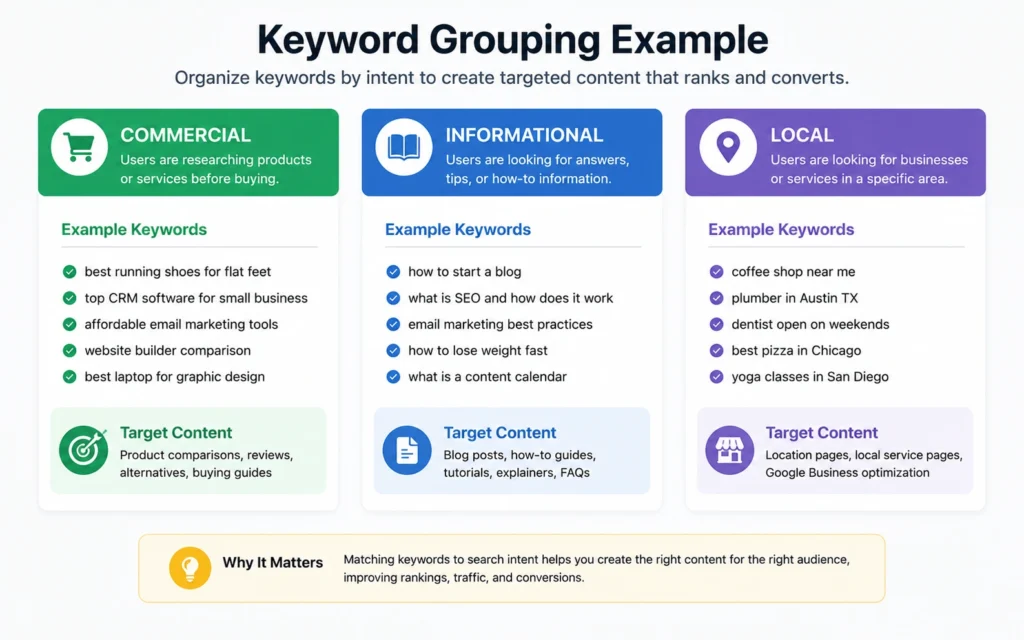
This is where keyword research becomes SEO strategy.
After exporting keyword ideas, don’t immediately start writing.
Group keywords by intent.
A practical example:
Informational Intent
- how to clean a coffee grinder
- coffee grinder maintenance
- why coffee grinder matters
Commercial Intent
- best coffee grinder
- coffee grinder reviews
- coffee grinder comparison
Product Intent
- Baratza Encore review
- Fellow Ode review
- Timemore grinder review
Notice what happened.
Instead of creating thirty weak pages, you now have three strong content groups.
This is one of the biggest differences between beginners and experienced SEO teams.
Experienced teams organize keywords before creating content.
Beginners collect keywords and hope a strategy appears later.
It rarely does.
Search Volume Is Useful — But Competition Often Matters More
A common mistake in google keyword planner SEO research is chasing the biggest number on the screen.
A keyword with 500 searches can outperform a keyword with 10,000 searches.
Because rankings matter more than theoretical traffic.
Consider these two examples:
| Keyword | Volume |
|---|---|
| SEO checklist for dentists | 500 |
| SEO | 246,000+ |
A new website has a realistic chance of ranking for the first keyword.
The second keyword may take years.
The better opportunity is often the smaller keyword with clearer intent.
This isn’t exciting advice.
It’s profitable advice.
Many successful websites are built on hundreds of low-to-medium-volume keywords rather than a handful of giant ones.
How to Find Content Ideas in Under 20 Minutes
Here’s a workflow I still use when evaluating new topics.
Minute 1–5: Enter Seed Topics
Add 3–5 broad topic phrases.
Examples:
- email marketing
- email automation
- newsletter software
Export the suggestions.
Minute 6–10: Remove Irrelevant Keywords
Delete keywords that don’t match your audience.
Be ruthless.
More keywords do not create more opportunities.
Relevant keywords create opportunities.
Minute 11–15: Sort by Search Volume
Look for patterns.
Don’t look for winners.
Patterns reveal what people consistently search for.
Minute 16–20: Create Topic Buckets
Group related keywords into:
- Beginner topics
- Comparison topics
- Tool topics
- Problem-solving topics
At the end of twenty minutes, you should have article ideas rather than keyword lists.
That’s the goal.
Why Keyword Planner Misses Opportunities
This is the trade-off nobody mentions.
Google Keyword Planner shows search demand.
It doesn’t show content opportunity.
Those are different things.
I learned this the hard way while researching a software category several years ago.
One topic showed almost no visible search volume.
Most keyword tools ignored it.
Forum discussions, support tickets, and product communities told a different story.
Six months later that topic became one of the strongest traffic drivers on the site.
The lesson:
Keyword Planner tells you what people search.
It doesn’t always reveal emerging problems.
Use it alongside:
- Industry forums
- Reddit discussions
- Product reviews
- Customer questions
- Support documentation
Keyword Planner is one input.
Not the entire research process.
A Simple Template for Evaluating Keywords
Use this framework before creating any page.
| Question | What To Check |
|---|---|
| Is demand visible? | Search volume exists |
| Is intent clear? | You know what searchers want |
| Can you create something better? | Better explanation, data, examples |
| Is ranking realistic? | Competition fits your site’s authority |
| Does it support a business goal? | Leads, sales, subscribers, customers |
If you can’t answer yes to most of these questions, keep researching.
Publishing weak pages is usually slower than spending another hour validating the topic.
The Metrics Worth Watching in Google Keyword Planner
Beginners often focus on every available column.
Most of them don’t matter.
Pay attention to:
Average Monthly Searches
Shows relative demand.
Useful for prioritization.
Keyword Variations
Useful for understanding language patterns.
Sometimes the highest-volume keyword is not the phrase your audience naturally uses.
Search Trends
A keyword with growing demand can be more valuable than a keyword with slightly higher current volume.
Competition Data
Created for advertisers.
Still useful as a directional signal.
Just don’t treat it as an SEO difficulty score.
Many people make that mistake.
What to Skip — and What to Do Instead
Skip exporting thousands of keywords.
Create topic groups.
Skip chasing the largest search volumes.
Look for achievable rankings.
Skip building one page per keyword.
Build one page per search intent.
Skip relying on Keyword Planner alone.
Use real customer language from communities, forums, reviews, and conversations.
The blunt verdict:
Most keyword research problems are not data problems.
They’re decision problems.
People already have enough data. They just haven’t organized it into content that deserves to rank.
When Google Keyword Planner Is the Right Tool — and When It Isn’t
Use Keyword Planner when:
- You’re building a content plan
- You’re validating demand
- You’re researching topic clusters
- You’re finding keyword variations
Choose a dedicated SEO platform when:
- You need ranking data
- You need backlink analysis
- You need SERP tracking
- You need detailed competitor research
The honest limitation is simple.
Keyword Planner tells you what people search for.
It doesn’t tell you how difficult ranking will be.
For deeper SEO analysis, you’ll eventually need additional tools.
But for beginners, Keyword Planner remains one of the strongest places to learn how search demand actually works.
And that’s a skill that stays useful long after you’ve upgraded your tool stack.
Frequently Asked Questions About Google Keyword Planner SEO
Is Google Keyword Planner free for SEO?
Yes. You can access Google Keyword Planner through a Google Ads account without actively running advertising campaigns. The tool remains useful for keyword discovery, search demand analysis, and content planning.
Is Google Keyword Planner accurate for SEO?
It’s accurate enough for topic validation and keyword discovery. Search volumes are often presented as ranges, so treat them as directional data rather than exact traffic forecasts.
Can beginners use Google Keyword Planner?
Yes. It’s one of the easiest keyword research tools to start with because the interface focuses on keyword ideas and search demand. The challenge is learning how to organize the data into content plans.
Is Google Keyword Planner enough for SEO?
Not entirely It helps identify demand, but it doesn’t provide detailed SEO competition analysis, backlink data, or ranking difficulty. Most growing websites eventually add dedicated SEO tools.
How many keywords should I target per page?
Focus on one primary intent rather than a specific keyword count. A strong page often ranks for dozens of related terms because it solves the searcher’s problem comprehensively.
Continue Exploring
- Keyword Research Hub: Start here if you want the broader framework behind topic selection, search intent, and content planning.
- Best Keyword Research Tools: Compare Keyword Planner against dedicated SEO platforms and see where each tool fits in a real workflow.