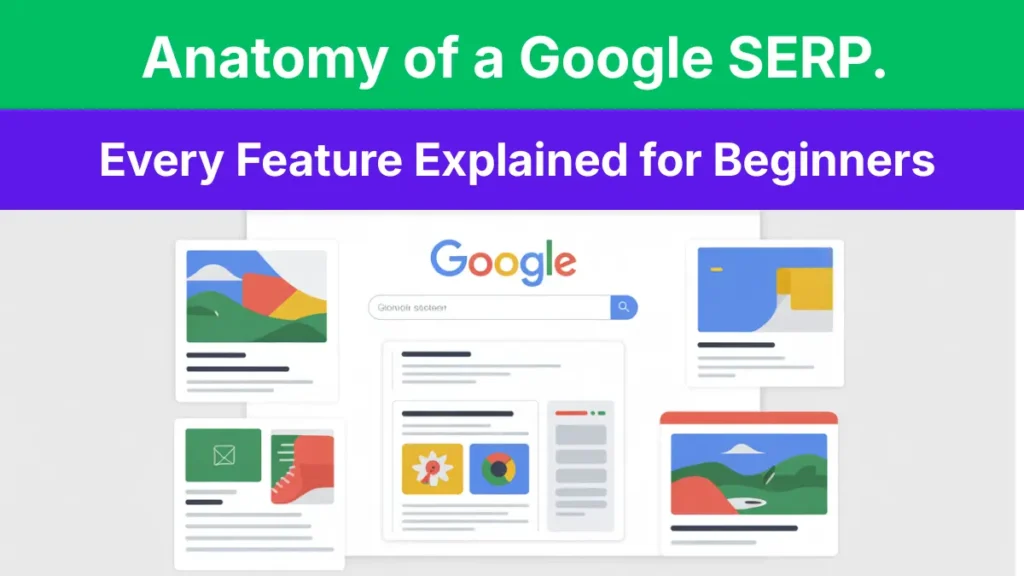
Anatomy of a Google SERP: Every Feature Explained for Beginners
The page Google returns after any search is no longer a simple list of ten blue links. The modern Google SERP — Search Engine Results Page — is a layered environment containing up to a dozen distinct feature types, each governed by its own appearance criteria and its own relationship to organic traffic.
Understanding which Google SERP features appear for your target queries, how each one is triggered, and what each one means for click-through behaviour is foundational to any SEO strategy. Before you optimise a single page, you need to know what you’re competing within.
This guide maps every major SERP feature as it exists in 2026 — what each one is, how Google decides to show it, and what it means for your content.
New to SEO? Start with The Skill Journey’s complete beginner’s guide to SEO
Key Terms
SERP: Search Engine Results Page — the page Google displays in response to any search query.
Organic results: Unpaid listings ranked by Google’s algorithms based on relevance and authority. No payment secures these positions.
Paid results: Advertisements purchased through Google Ads, clearly labelled “Sponsored.” Placement is determined by bid and ad quality, not organic ranking.
Featured snippet: A passage extracted from a ranking web page and displayed prominently above standard organic results — answering the query directly on the SERP.
Zero-click search: A query resolved entirely on the SERP. The user reads their answer and leaves without visiting any website.
The Modern Google SERP in 2026
Why the SERP Looks Nothing Like It Did Five Years Ago
The ten-blue-links SERP is a relic. Research from SparkToro and Datos found that the majority of Google searches in 2024 produced no outbound click to any website — the answer was delivered on the results page itself. The SERP anatomy has fundamentally changed.
In 2026, a single query can trigger paid ad slots, an AI Overview, a featured snippet, a People Also Ask box, and standard organic results — all before the user scrolls. The competition for visibility is no longer just about ranking position. It is about understanding which features appear for your queries, and which of those features you are eligible to win.
Paid Ad Slots
Paid ads appear at the top and bottom of the SERP, clearly labelled “Sponsored.” Google allows up to four at the top of the page and three at the bottom, though fewer typically appear for any given query. They are bought through Google Ads on a cost-per-click auction model.
Paid ads are not a ranking factor and sit entirely outside organic SEO control. They matter for SERP anatomy because on competitive commercial queries, they occupy the most visible real estate — pushing organic results, featured snippets, and even AI Overviews further down the page. Knowing when paid ads dominate a SERP informs both content strategy and realistic click-through expectations.
AI Overviews
AI Overviews are AI-generated summaries that appear near the top of the SERP for a growing range of informational queries. Google synthesises content from multiple indexed sources and presents a consolidated answer, with source citations displayed in a collapsible panel alongside.
How AI Overviews Differ from Organic Rankings
A Google AI Overview is not awarded to the page ranking in position 1. Google pulls from any well-indexed source that directly and clearly answers the query — then applies a separate evaluation layer on top of standard ranking signals. A page in position 4 can be cited in an AI Overview while the page in position 1 is not cited at all.
Appearing in an AI Overview is not the same as receiving a website visit. Most users read the generated summary and do not click through to the cited sources. The implication: AI Overviews are a visibility metric, not a traffic metric — for many queries.
Featured Snippets
A featured snippet pulls a specific passage from a ranking page — a paragraph, a numbered list, a table, or a definition — and displays it in a labelled box above the standard organic results. It answers the query directly on the SERP and is sometimes called “position zero.”
What Triggers a Featured Snippet
What is a featured snippet’s selection logic? Google draws featured snippets exclusively from pages already ranking in the top 10 for the query. You cannot win a featured snippet from position 15. The trigger is content format: direct, answer-first responses structured as concise paragraphs of 40–60 words, clearly formatted numbered steps, or comparison tables are the formats Google most consistently elevates into snippet position.
The page retains its standard organic listing alongside the snippet, so a featured snippet adds a second visual entry point on the same SERP.
People Also Ask
People Also Ask (PAA) boxes are accordion-format question clusters that appear within the SERP — typically after the first few organic results, and often again further down the page. Each question expands to reveal a featured-snippet-style answer sourced from an indexed page, with a link to the source.
How PAA Boxes Affect Keyword Strategy
People Also Ask SEO is a genuine secondary traffic channel, not a cosmetic feature. Each PAA question represents a real search query with sufficient volume to surface in the results. Systematically mining PAA for your target topics reveals sub-topic and secondary keyword opportunities that standard keyword volume tools frequently miss.
Pages that structure content with explicit question-based headings — H2 or H3 phrasing the question directly, followed immediately by a direct answer — are consistently pulled into PAA placements across related queries.
Knowledge Panels
Knowledge Panels appear on the right side of the desktop SERP and prominently at the top of mobile SERPs for entities Google has established in its Knowledge Graph: businesses, people, organisations, brands, and locations.
Panel content is sourced from your website’s structured data markup, verified third-party data sources, Wikipedia, and — for local businesses — Google Business Profile. No single factor controls what appears. Consistent, accurate, structured data across your site and your third-party profiles influences the panel’s content and reduces the chance of incorrect information appearing. You can suggest edits to your Knowledge Panel directly through the panel interface once ownership is verified.
Local Pack
The Local Pack — also called the Map Pack — displays a Google Maps panel alongside three local business listings when the query carries local intent: “coffee shop near me,” “plumber in Edinburgh,” “dentist open Saturday.”
Local Pack results are governed by Google Business Profile signals, not by organic website rankings. A business with no website can appear in the Local Pack. Optimising for it requires a verified and fully completed Google Business Profile, consistent NAP (Name, Address, Phone number) data across all online directories, and a sustained volume of recent, genuine reviews.
Shopping Results
Shopping results — Product Listing Ads (PLAs) — appear as a horizontal image carousel at the top of the SERP for commercial product queries. Each listing shows a product image, price, retailer name, and star rating. They are paid placements run through Google Merchant Center and Google Ads.
Limited free product listings exist in the main SERP for merchants with an active Merchant Center feed, but the primary carousel placement is paid. Shopping results sit entirely outside organic SEO control. They are relevant to SERP anatomy because they dominate the visible fold for product-intent queries, compressing all other feature types below.
Video Carousels
Video carousels appear for queries where Google determines that video content best serves the searcher’s intent — tutorials, how-to guides, product reviews, and entertainment content. Results pull primarily from YouTube. A standard web page does not appear in a video carousel.
The signals Google uses for video carousel inclusion include title relevance to the query, watch time, engagement rate, and whether the video directly addresses the search intent. For content strategists, publishing supporting video content on YouTube — tightly aligned by topic to existing written posts — creates a second independent SERP entry point for the same target query, without competing for the same organic position.
Zero-Click Searches
A zero-click search is any query answered directly on the SERP itself. The user reads the result — in an AI Overview, a featured snippet, a Knowledge Panel, a PAA box, or a direct answer unit — and either searches again or closes the browser. No website receives the visit.
What Zero-Click Means for Your Content Strategy
Zero-click rates are highest for informational queries: definitions, unit conversions, quick factual lookups, weather, sports scores, and calculator-style queries. They are measurably lower for commercial-intent queries and navigational queries, where the user intends to reach a specific page or make a purchase.
The strategic implication is direct: optimising purely for informational head terms in competitive SERP anatomy now frequently means competing for visibility in features that produce no traffic. Query intent analysis and feature-type targeting must be built into the keyword strategy from the start — not applied as an afterthought.
SparkToro’s 2024 zero-click search study — methodology and full data
Frequently Asked Questions
What is a featured snippet and how does it differ from a normal search result?
A featured snippet extracts a specific passage from a ranking web page and displays it in a labelled box above standard organic results. Unlike a normal result, which shows a title and description, a featured snippet shows the actual answer text pulled from the page. The source page retains its standard organic listing alongside the snippet, giving it two visible entries on the same SERP.
What is a Google AI Overview and how is it different from a featured snippet?
A Google AI Overview is a generated summary synthesised from multiple indexed sources, displayed near the top of the SERP for informational queries. A featured snippet pulls a single passage from one specific page. They are distinct features — both can appear simultaneously on the same SERP. AI Overviews cite multiple sources; featured snippets credit one page exclusively.
What does zero-click search mean for my website traffic?
Zero-click searches answer the query on the SERP itself — through a featured snippet, AI Overview, Knowledge Panel, or PAA box — so the user has no reason to visit any website. If your target queries have high zero-click rates, ranking well may drive fewer visits than expected. Prioritising commercial and transactional intent queries in your keyword strategy reduces zero-click exposure significantly.
How does the Local Pack work, and can I appear in it without a website?
The Local Pack displays three local businesses alongside a Google Maps panel for location-based queries. Google Business Profile governs it signals — not website organic ranking. A business with no website can and does appear in the Local Pack. Appearing requires a verified, complete Google Business Profile, consistent name, address, and phone number data across directories, and ongoing review volume.