“Welcome to the world of Digital Marketing. If you are looking for a complete SEO Beginners Guide, you are in the right place. In this post, we will explain everything from scratch.
In this comprehensive SEO guide, we will uncover the secrets behind search rankings. If you’ve ever wondered why some websites appear at the top of Google while others stay buried on page 10, this guide answers that question completely.
SEO, or Search Engine Optimization, is the discipline of making your website more visible in search engine results — so the right people find your content at the right moment, without you paying for every click. This guide covers everything a beginner needs to understand: what SEO is, how search engines actually work, the three pillars every SEO practitioner must master, how the discipline has evolved, and exactly what you should learn next.
By the time you finish reading, you’ll have a clear mental model of SEO that will anchor everything you learn going forward.
What Is SEO? The One-Paragraph Definition
SEO stands for Search Engine Optimization. It is the practice of improving a website’s content, structure, and authority so that search engines — primarily Google, which handles over 90% of global search queries — rank it higher in organic (unpaid) results for queries that your target audience is already searching for.
The higher you rank, the more people see your page, click on it, and visit your site. Unlike paid advertising, where your visibility disappears the moment your budget runs out, SEO builds compounding, durable traffic over time.
That’s the definition. But to use SEO effectively, you need to understand the system it operates within.
Why SEO Is the Most Valuable Long-Term Marketing Channel
Before going deeper into how SEO works, it’s worth anchoring why it deserves your full attention.
Google processes approximately 8.5 billion searches every single day. Every one of those searches represents a person with a specific need — a question to answer, a product to find, a problem to solve, a comparison to make. If your website appears in front of those people at exactly the moment they are looking, you win highly qualified, pre-motivated traffic without paying per click.
Here’s what separates SEO from every other marketing channel:
- Compounding returns: A page that earns a top ranking today can continue delivering traffic for 3 to 5 years, with no additional investment per visitor.
- High-intent audience: Organic search visitors arrived because they searched for exactly what you offer. They are pre-qualified before they land on your page.
- Brand trust: Users trust organic results more than paid ads. Appearing at the top of organic results signals credibility.
- Channel independence: Unlike social media, where algorithm changes can wipe out your reach overnight, SEO equity lives on your own domain — an asset you own and control.
- Scalability: A single well-optimized page can rank for hundreds of keyword variations, multiplying traffic without multiplying effort.
SEO is not a tactic. It is a long-term business asset — one that compounds in value the longer and more consistently you invest in it.
The Three Pillars of SEO
Every SEO decision you will ever make belongs to one of three categories. This framework is the most important mental model in all of SEO. Internalize it now — it will make every future concept instantly easier to understand.
Pillar 1: On-Page SEO
On-page SEO refers to everything you do on your own web pages to communicate relevance and quality to both users and search engines.
This includes:
- The words you choose and how you use them (keywords, headings, body text)
- How you structure your content (H1, H2, H3 hierarchy; paragraph length; lists; tables)
- HTML signals embedded in the page (title tags, meta descriptions, alt text, canonical tags)
- The quality, depth, and accuracy of your content itself
- Schema markup — machine-readable code that tells search engines what your content means, not just what it says
On-page SEO is entirely within your control. You decide every word, every heading, every tag, and every piece of structured data on your pages.
Core principle: On-page SEO tells search engines what your page is about.
Pillar 2: Off-Page SEO
Off-page SEO refers to everything that happens outside your website that influences how search engines perceive your authority and trustworthiness.
The primary off-page signal is backlinks — links from other websites pointing to yours. When a credible, relevant website links to your page, it acts as a vote of confidence. Google interprets those votes as signals of genuine authority. A page with 200 high-quality backlinks from reputable sources will, all else being equal, outrank a technically identical page with no backlinks.
Off-page SEO also includes:
- Unlinked brand mentions across the web
- Press coverage and earned media
- Reviews and ratings on third-party platforms
- Social signals (indirect influence)
- Increasingly: how often AI systems like ChatGPT and Perplexity cite your content
You cannot directly control off-page SEO — but you can engineer it. Creating genuinely valuable, citable, shareable content is the most reliable off-page strategy in existence.
Core principle: Off-page SEO tells search engines whether to trust your page.
Pillar 3: Technical SEO
Technical SEO refers to the infrastructure of your website — the backend configurations that determine whether search engines can find, access, read, and understand your content correctly.
Even the most brilliant content is invisible if your website blocks search engine crawlers, takes 9 seconds to load, or has broken architecture that prevents indexing. Technical SEO removes every barrier between your content and search engine discovery.
You can explore our detailed guide on [Technical SEO for Beginners]
Technical SEO covers:
- Robots.txt files and crawl directives
- XML sitemaps
- HTTPS security
- Page speed and Core Web Vitals
- Mobile-first design
- Redirect management
- Duplicate content resolution
- JavaScript rendering
Core principle: Technical SEO tells search engines how to access your page.
How Search Engines Actually Work
To optimize for search engines, you must first understand how they operate. Search engines work through three sequential stages: crawling, indexing, and ranking.
You should monitor your site on Google Search Console.
Stage 1 — Crawling
Crawling is the discovery phase. Search engines deploy automated programs called web crawlers (Google’s crawler is named Googlebot) that continuously traverse the internet by following links from page to page, collecting the content of every page they can access.
Think of Googlebot as a reader with an infinite to-do list. It starts from a set of known URLs (called seed pages), follows every hyperlink it finds on those pages, reads the content of each new page it discovers, and schedules return visits to check for updates.
What can prevent crawling:
- A
robots.txtfile that instructs Googlebot not to access certain pages - Login walls or paywalls requiring authentication
- JavaScript content that hasn’t fully loaded by the time the crawler arrives
- Pages with no inbound links (called orphaned pages — they exist, but no path leads to them)
- Server errors that prevent pages from loading
If Googlebot cannot reach your page, Google does not know it exists. No crawl means no possibility of ranking.
Stage 2 — Indexing
After crawling, Google analyzes the content of each page and stores it in its index — an enormous database organized by topic, keyword, entity, and quality signals.
The index is Google’s internal library. When you perform a search, Google doesn’t query the live internet in real time — it searches its pre-built index to find stored pages that best match your query.
During indexing, Google evaluates:
- All text content on the page
- Structured data (schema markup)
- Images and their alt text
- The HTML elements: title, headings, meta tags and canonical tags
- Page quality signals: depth, accuracy, E-E-A-T indicators
- Technical health: mobile-friendliness, Core Web Vitals performance
Critical distinction: A page can be crawled without being indexed. Google may crawl a page and decide not to include it — because the content is too thin, it’s a near-duplicate of another page, or a noindex directive has been applied.
Being indexed means being eligible to rank. Not all crawled pages make it to the index.
Stage 3 — Ranking
Ranking is the decision phase. When a user submits a query, Google’s algorithms evaluate every indexed page relevant to that query and sorts them from most to least useful — producing the results page (SERP) you see.
This happens in fractions of a second and involves hundreds of ranking signals. The primary factors include:
- Relevance: Does this page’s content actually match what the user is looking for — not just in keywords, but in intent?
- Authority: How many credible, relevant websites link to this page and to this domain?
- Quality: Is the content accurate, comprehensive, well-written, and trustworthy?
- Page experience: Does it load fast, work on mobile, and avoid visual instability?
- Freshness: For time-sensitive queries, has the content been updated recently?
- Entity relevance: Does the page connect to recognized entities — people, organizations, places, concepts — in Google’s Knowledge Graph?
Modern Google uses a combination of traditional keyword-matching algorithms and advanced neural language models (including BERT, MUM, and Gemini’s underlying architecture) to understand both the literal words in a query and the underlying meaning and intent behind it.
The Modern SEO Landscape: Four Disciplines You Need to Know
SEO in 2026 is not a single discipline — it is a family of four interconnected practices. Understanding all four is what separates an advanced practitioner from a beginner.
Traditional SEO
The foundation: on-page optimization, keyword research, link building, technical health and content strategy. Everything in the Tier 0–3 modules of this curriculum. Still, the most important discipline because every other one is built on top of it.
AI-SEO
Optimizing your content and technical infrastructure to appear in AI-powered search results: Google AI Overviews, ChatGPT Search, Microsoft Copilot, Perplexity, and Gemini. The key additional layer involves structured content, entity recognition, and ensuring AI crawlers can access your site.
AEO — Answer Engine Optimization
Structuring your content to win direct answer positions: featured snippets, People Also Ask boxes, voice search results, and zero-click answer panels. AEO is about becoming the answer, not just ranking near the answer.
GEO — Generative Engine Optimization
The newest frontier: optimizing to be cited and recommended by large language models (LLMs) like ChatGPT, Claude, and Gemini when users ask them questions. GEO combines entity SEO, content authority, structured data, and off-site brand mentions into a system that influences what AI systems say about you.
All four disciplines are covered in depth throughout this curriculum.
The History of SEO: How We Got Here (And Why It Matters)
Understanding SEO’s history is not academic exercise. It explains why every modern SEO rule exists, and what happens to websites that ignore those rules.
Era 1 — The Wild West (1994–2003)
Early search engines ranked pages primarily by keyword frequency. The more times a keyword appeared, the higher the page ranked. This produced a predictable outcome: practitioners stuffed keywords everywhere — visible text, hidden text, meta tags, invisible white text on white backgrounds.
There was no meaningful concept of quality. The algorithm was gameable, and everyone gamed it.
Era 2 — The Link Economy (2003–2011)
Google’s PageRank algorithm introduced a groundbreaking insight: the number and quality of other websites linking to a page is a reliable proxy for its real-world authority. Links became the currency of SEO.
Predictably, the currency was immediately counterfeited. Link farms, paid link schemes, reciprocal link exchanges, and comment spam proliferated. The signal designed to measure genuine authority became the most manipulated metric in digital marketing.
Era 3 — The Quality Revolution (2011–2015)
Google began systematically penalizing manipulation. Two landmark updates reshaped the industry permanently:
Google Panda (2011): Targeted thin, low-quality, and duplicate content. Entire content farms — sites publishing thousands of shallow, keyword-stuffed pages — lost 80%+ of their organic traffic overnight.
Google Penguin (2012): Targeted manipulative link building. Sites with unnatural link profiles — purchased links, low-quality directory spam, exact-match anchor text over-optimization — were penalized or de-indexed.
The lesson the industry learned: build genuine value or face consequences.
Era 4 — The Semantic & Mobile Era (2013–2020)
Search evolved from matching keywords to understanding meaning.
Hummingbird (2013) rewrote Google’s core algorithm to understand the intent and context of a query, not just its constituent words.
RankBrain (2015) introduced machine learning into ranking — a neural network that interprets ambiguous queries and adapts based on user behavior signals.
BERT (2019) brought transformer-based NLP to search — allowing Google to understand the contextual relationship between every word in a query, including function words like “not,” “for,” and “to” that earlier algorithms largely ignored.
Mobile became mandatory with Google’s mobile-first indexing rollout, which began in 2017 and completed in 2023 — meaning Google now uses the mobile version of your site as the primary version for indexing and ranking.
Era 5 — The AI Revolution (2020–2026)
The most disruptive period in search history, and the one we are currently living through.
MUM (2021): A model 1,000× more powerful than BERT, capable of processing text, images, video, and audio simultaneously, across 75 languages.
Helpful Content System (2022): Google’s clearest signal yet — content created primarily to manipulate search rankings rather than genuinely help users will be actively suppressed.
ChatGPT (November 2022): The public launch of conversational AI search changed user behavior at scale. By 2026, ChatGPT processes over 750 million queries monthly.
Google AI Overviews (2024): AI-synthesized answer blocks now appear above organic results for millions of queries, fundamentally changing what it means to be visible in search.
GEO emerges as a discipline (2025): SEO practitioners begin systematically measuring and optimizing for AI citation — not just search engine rankings.
The most important insight from this history: every era of SEO rewards genuine quality and punishes manipulation. The specifics of what Google can detect have evolved dramatically. The underlying principle has not changed since 1998.
Your SEO Learning Roadmap
This guide is the entry point to a structured curriculum that takes you from absolute beginner to expert practitioner. Here is what comes immediately next — and how it builds:
Tier 0: Foundation (Complete These First)
| Module | What You’ll Learn |
|---|---|
| A0.1 — What Is SEO? | A deep dive into the definition, purpose, and business case for SEO |
| A0.2 — How Search Engines Work | Crawling, indexing, and ranking in detailed, practical depth |
| A0.3 — Search Intent | The single most important concept for keyword and content strategy |
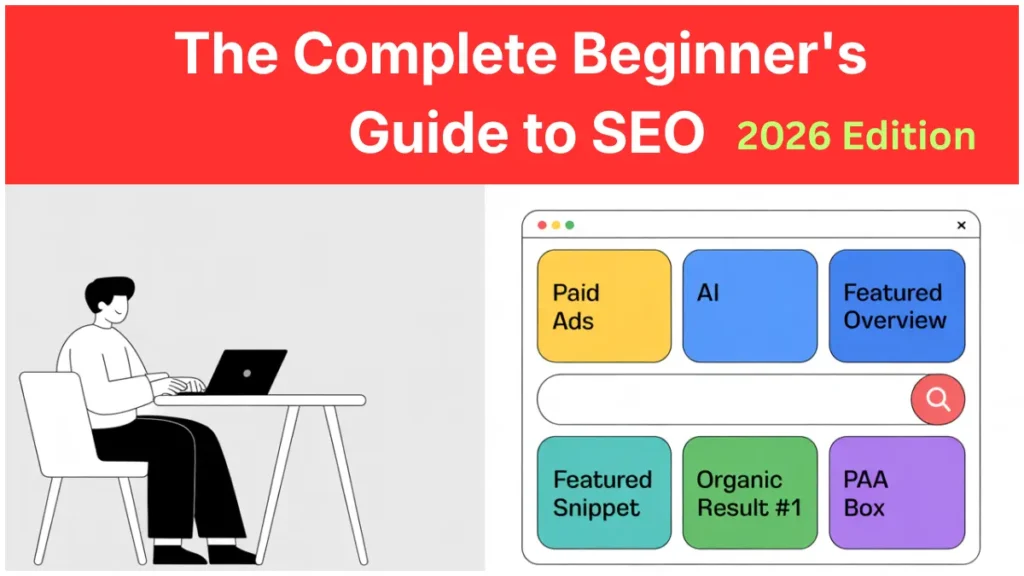
| A0.4 — Anatomy of a SERP | Every element of a Google results page — and how to win each one |
| A0.5 — The SEO Toolkit | Setting up Google Search Console, GA4, and the essential free tools |
| A0.6 — Web Architecture for SEO | What every SEO must know about domains, hosting, CMS, and HTML |
Tier 1: Beginner (Build Your Core Skills)
- Keyword research: finding, evaluating, and clustering keywords
- On-page SEO: title tags, meta descriptions, headings, content structure
- Technical SEO foundations: robots.txt, sitemaps, canonicals, HTTPS, redirects
- Content writing for SEO: structure, depth, readability, and formatting
- Core Web Vitals: LCP, CLS, and INP — what they measure and how to improve them
To learn more about how to write articles, check out our post on Content Writing Tips.
Tier 2: Intermediate (Develop Strategic Depth)
- Topical authority and content architecture: pillar pages and content clusters
- Schema markup and structured data: full implementation guide
- E-E-A-T: building expertise, authority, and trust signals
- Advanced crawlability and JavaScript SEO
- Link building: digital PR, outreach, and authority acquisition
Tier 3 & 4: Advanced and Expert
- Entity SEO and Google’s Knowledge Graph
- Semantic SEO and NLP content optimization
- Programmatic SEO at scale
- AI-SEO, AEO, and GEO: the complete advanced curriculum
- Vector embeddings, information retrieval theory, and LLM visibility strategies
Each module is a standalone post at this depth — fully self-contained, implementation-ready, and designed to build directly on the module before it.
The One Mindset That Predicts SEO Success
Before you proceed to Module A0.1, there is one foundational mindset to absorb — one that separates practitioners who consistently build search authority from those who spin their wheels indefinitely.
SEO is a long-term compounding investment, not a short-term traffic tactic.
A new website typically takes 3 to 12 months to achieve meaningful organic traffic from SEO. Competitive niches can take longer. This is not a flaw — it is the source of SEO’s value. The same time investment that makes SEO slow to build makes it extraordinarily durable once established. A page that earns a ranking today can compound traffic for years. Every piece of quality content you publish today is a long-term asset that accrues value over time.
The businesses and practitioners who treat SEO as a patient, consistent investment — publishing excellent content, earning genuine authority, maintaining technical health — consistently dominate the ones who chase shortcuts.
There are no shortcuts that work permanently. There is only the work.
Key Concepts Recap
- SEO is the practice of improving a website’s content, structure, and authority to earn higher organic search rankings
- Search engines operate through three stages: Crawl (discovery), Index (storage and analysis), Rank (ordering by quality and relevance)
- The three pillars of SEO are On-Page (what the page is about), Off-Page (why the page should be trusted), and Technical (how the page can be accessed)
- Modern SEO encompasses four disciplines: Traditional SEO, AI-SEO, AEO, and GEO
- SEO’s history shows that every era rewards genuine quality and punishes manipulation — the principle is permanent even as the algorithms evolve
- SEO is a long-term compounding investment — the most durable traffic channel available to any website
FAQs
What is SEO in simple terms?
SEO is the practice of making your website appear higher in search results so more people find it when they search for topics you cover — without paying for ads.
How long does SEO take to show results?
Most websites begin seeing meaningful organic traffic within 3 to 12 months. Highly competitive niches may take longer. SEO is a long-term discipline with compounding returns.
What are the three pillars of SEO?
On-Page SEO (your content and HTML elements), Off-Page SEO (backlinks and external authority signals), and Technical SEO (your site’s infrastructure and accessibility to search engines).
Is SEO still relevant in 2026?
Yes. Organic search remains the dominant traffic channel for most websites. Traditional SEO is also the foundation upon which AI-SEO, AEO, and GEO are built — making it more important, not less.
What is the difference between SEO and paid search?
SEO earns unpaid organic rankings through content quality and site optimization. Paid search (Google Ads, PPC) buys visibility at a cost-per-click. SEO is long-term and compounding; paid search is immediate but stops the moment your budget does.
What’s Next
→ Module A0.1: What Is SEO? Definition, Meaning & Why It Matters
A focused, deep-dive hub post on the SEO definition itself — with business case data, real-world examples, and the clearest explanation of what SEO actually does available anywhere.
→ Module A0.2: How Search Engines Work — Crawling, Indexing & Ranking
Go deeper into the mechanics of Googlebot, the indexing pipeline, and the ranking algorithm — with practical implications for every technical and content decision you’ll make.